 Add to Chrome
 Add to Firefox
 Add to Edge
Differentially Private Model Merging
Apr 22, 2026
In machine learning applications, privacy requirements during inference or deployment time could change constantly due to varying policies, regulations, or user experience. In this work, we aim to generate a magnitude of models to satisfy any target differential privacy (DP) requirement without additional training steps, given a set of existing models trained on the same dataset with different privacy/utility tradeoffs. We propose two post processing techniques, namely random selection and linear combination, to output a final private model for any target privacy parameter. We provide privacy accounting of these approaches from the lens of R'enyi DP and privacy loss distributions for general problems. In a case study on private mean estimation, we fully characterize the privacy/utility results and theoretically establish the superiority of linear combination over random selection. Empirically, we validate our approach and analyses on several models and both synthetic and real-world datasets.

Overcoming the Incentive Collapse Paradox
Mar 27, 2026AI-assisted task delegation is increasingly common, yet human effort in such systems is costly and typically unobserved. Recent work by Bastani and Cachon (2025); Sambasivan et al. (2021) shows that accuracy-based payment schemes suffer from incentive collapse: as AI accuracy improves, sustaining positive human effort requires unbounded payments. We study this problem in a budget-constrained principal-agent framework with strategic human agents whose output accuracy depends on unobserved effort. We propose a sentinel-auditing payment mechanism that enforces a strictly positive and controllable level of human effort at finite cost, independent of AI accuracy. Building on this incentive-robust foundation, we develop an incentive-aware active statistical inference framework that jointly optimizes (i) the auditing rate and (ii) active sampling and budget allocation across tasks of varying difficulty to minimize the final statistical loss under a single budget. Experiments demonstrate improved cost-error tradeoffs relative to standard active learning and auditing-only baselines.
Distribution-Free Fair Federated Learning with Small Samples
Feb 25, 2024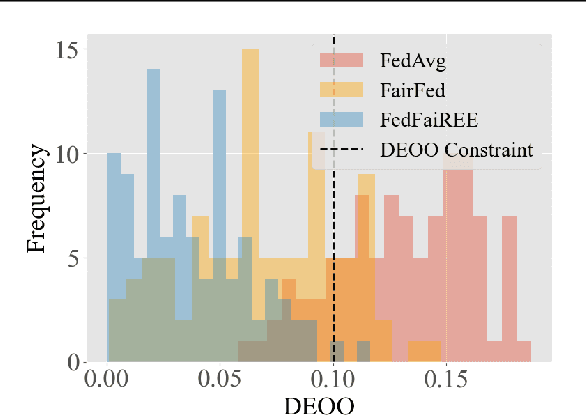

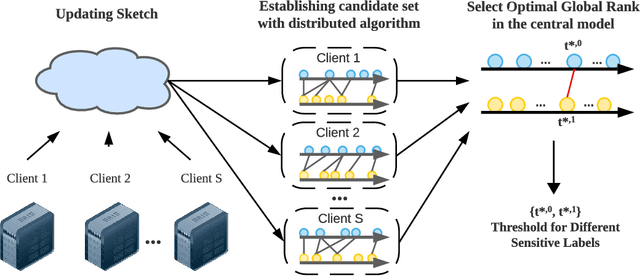
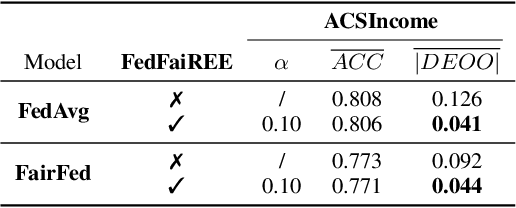
As federated learning gains increasing importance in real-world applications due to its capacity for decentralized data training, addressing fairness concerns across demographic groups becomes critically important. However, most existing machine learning algorithms for ensuring fairness are designed for centralized data environments and generally require large-sample and distributional assumptions, underscoring the urgent need for fairness techniques adapted for decentralized and heterogeneous systems with finite-sample and distribution-free guarantees. To address this issue, this paper introduces FedFaiREE, a post-processing algorithm developed specifically for distribution-free fair learning in decentralized settings with small samples. Our approach accounts for unique challenges in decentralized environments, such as client heterogeneity, communication costs, and small sample sizes. We provide rigorous theoretical guarantees for both fairness and accuracy, and our experimental results further provide robust empirical validation for our proposed method.