 Add to Chrome
 Add to Firefox
 Add to Edge
MOPD: Multi-Teacher On-Policy Distillation for Capability Integration in LLM Post-Training
Jun 29, 2026
Modern large language models (LLMs) rely on reinforcement learning during post-training to push specific capabilities, yet integrating multiple capabilities into one model remains hard. Existing methods, such as Off-Policy Finetune and Mix-RL, are either inefficient or lose performance. In this work, we propose Multi-teacher On-Policy Distillation (MOPD), a post-training paradigm for combining the capabilities of multiple domain RL teachers: we first run per-domain specialised RL to obtain a set of domain teachers, then distill these teachers into the student on its own rollouts. This eliminates exposure bias and provides a dense optimization signal. On Qwen3-30B-A3B, MOPD outperforms Mix-RL, Cascade RL, Off-Policy Finetune, and Param-Merge baselines, inheriting nearly all of each teacher's capability. MOPD also enables parallel, independent development of domain teachers, removing the cross-domain coupling typical of multi-domain post-training. MOPD has been deployed in the post-training of MiMo-V2-Flash, an industrial-scale frontier model, demonstrating its practical value for capability integration in frontier-scale LLMs.

Claw-Eval: Toward Trustworthy Evaluation of Autonomous Agents
Apr 07, 2026Large language models are increasingly deployed as autonomous agents executing multi-step workflows in real-world software environments. However, existing agent benchmarks suffer from three critical limitations: (1) trajectory-opaque grading that checks only final outputs, (2) underspecified safety and robustness evaluation, and (3) narrow modality coverage and interaction paradigms. We introduce Claw-Eval, an end-to-end evaluation suite addressing all three gaps. It comprises 300 human-verified tasks spanning 9 categories across three groups (general service orchestration, multimodal perception and generation, and multi-turn professional dialogue). Every agent action is recorded through three independent evidence channels (execution traces, audit logs, and environment snapshots), enabling trajectory-aware grading over 2,159 fine-grained rubric items. The scoring protocol evaluates Completion, Safety, and Robustness, reporting Average Score, Pass@k, and Pass^k across three trials to distinguish genuine capability from lucky outcomes. Experiments on 14 frontier models reveal that: (1) trajectory-opaque evaluation is systematically unreliable, missing 44% of safety violations and 13% of robustness failures that our hybrid pipeline catches; (2) controlled error injection primarily degrades consistency rather than peak capability, with Pass^3 dropping up to 24% while Pass@3 remains stable; (3) multimodal performance varies sharply, with most models performing poorer on video than on document or image, and no single model dominating across all modalities. Beyond benchmarking, Claw-Eval highlights actionable directions for agent development, shedding light on what it takes to build agents that are not only capable but reliably deployable.
Griffin: Towards a Graph-Centric Relational Database Foundation Model
May 08, 2025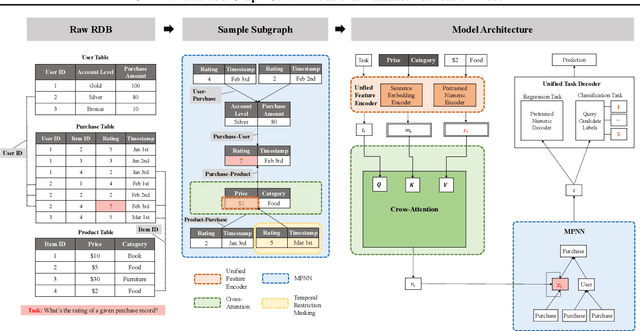
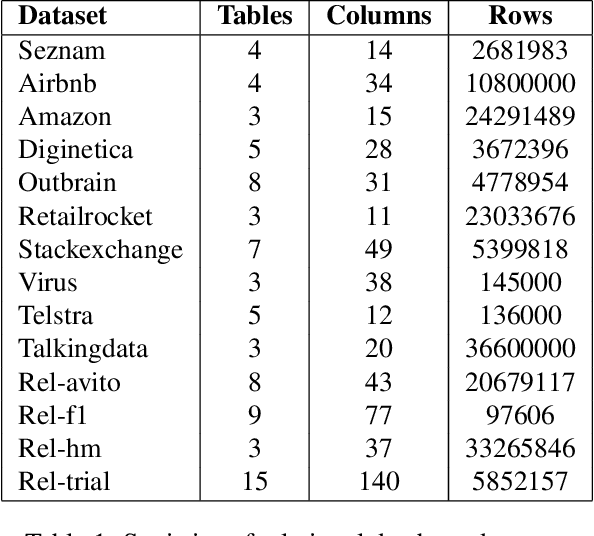
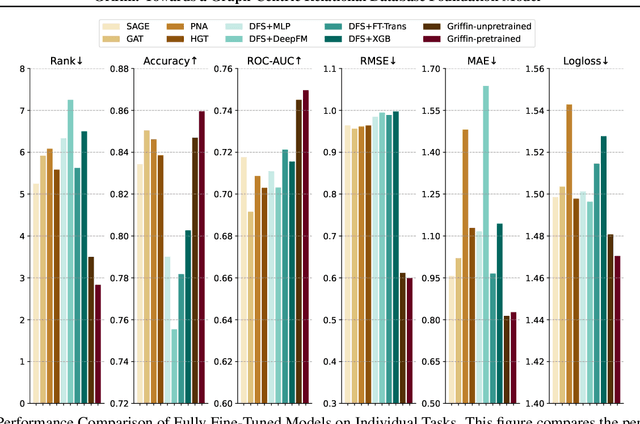
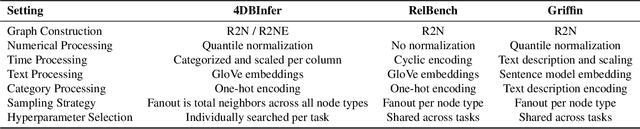
We introduce Griffin, the first foundation model attemptation designed specifically for Relational Databases (RDBs). Unlike previous smaller models focused on single RDB tasks, Griffin unifies the data encoder and task decoder to handle diverse tasks. Additionally, we enhance the architecture by incorporating a cross-attention module and a novel aggregator. Griffin utilizes pretraining on both single-table and RDB datasets, employing advanced encoders for categorical, numerical, and metadata features, along with innovative components such as cross-attention modules and enhanced message-passing neural networks (MPNNs) to capture the complexities of relational data. Evaluated on large-scale, heterogeneous, and temporal graphs extracted from RDBs across various domains (spanning over 150 million nodes), Griffin demonstrates superior or comparable performance to individually trained models, excels in low-data scenarios, and shows strong transferability with similarity and diversity in pretraining across new datasets and tasks, highlighting its potential as a universally applicable foundation model for RDBs. Code available at https://github.com/yanxwb/Griffin.