 Add to Chrome
 Add to Firefox
 Add to Edge
Reinforcement Learning for Self-Improving Agent with Skill Library
Dec 18, 2025
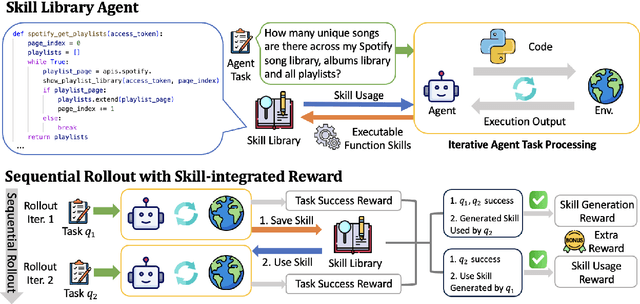
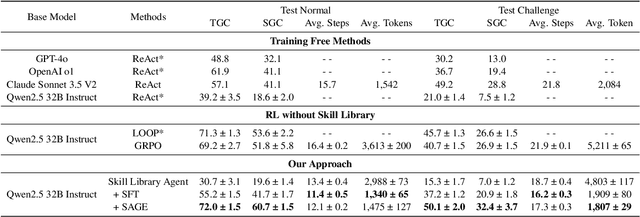
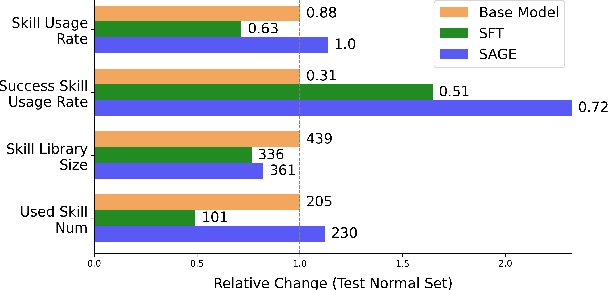
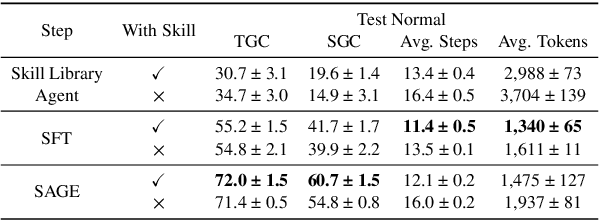
Large Language Model (LLM)-based agents have demonstrated remarkable capabilities in complex reasoning and multi-turn interactions but struggle to continuously improve and adapt when deployed in new environments. One promising approach is implementing skill libraries that allow agents to learn, validate, and apply new skills. However, current skill library approaches rely primarily on LLM prompting, making consistent skill library implementation challenging. To overcome these challenges, we propose a Reinforcement Learning (RL)-based approach to enhance agents' self-improvement capabilities with a skill library. Specifically, we introduce Skill Augmented GRPO for self-Evolution (SAGE), a novel RL framework that systematically incorporates skills into learning. The framework's key component, Sequential Rollout, iteratively deploys agents across a chain of similar tasks for each rollout. As agents navigate through the task chain, skills generated from previous tasks accumulate in the library and become available for subsequent tasks. Additionally, the framework enhances skill generation and utilization through a Skill-integrated Reward that complements the original outcome-based rewards. Experimental results on AppWorld demonstrate that SAGE, when applied to supervised-finetuned model with expert experience, achieves 8.9% higher Scenario Goal Completion while requiring 26% fewer interaction steps and generating 59% fewer tokens, substantially outperforming existing approaches in both accuracy and efficiency.

Enhancing Multi-hop Reasoning in Vision-Language Models via Self-Distillation with Multi-Prompt Ensembling
Mar 03, 2025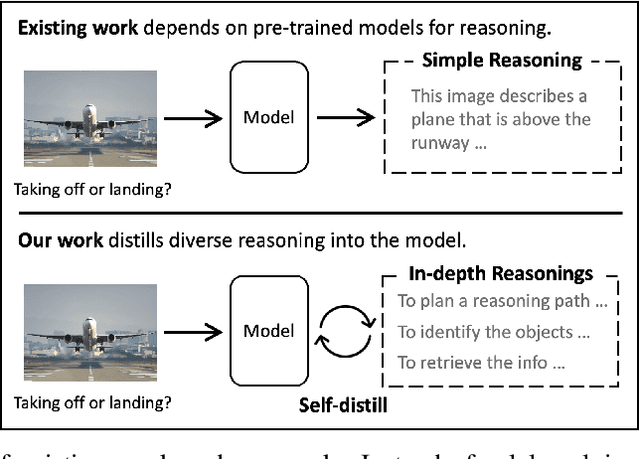
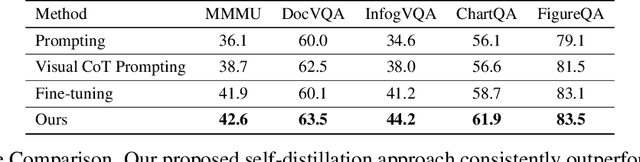
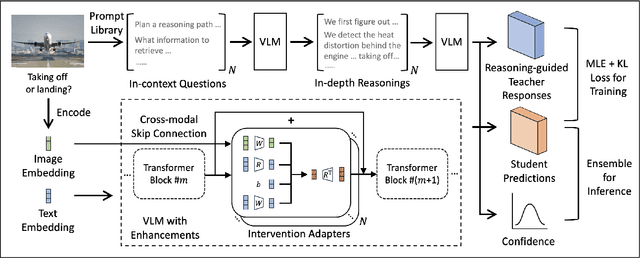
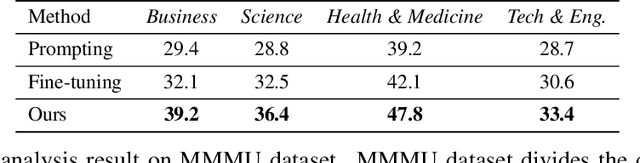
Multi-modal large language models have seen rapid advancement alongside large language models. However, while language models can effectively leverage chain-of-thought prompting for zero or few-shot learning, similar prompting strategies are less effective for multi-modal LLMs due to modality gaps and task complexity. To address this challenge, we explore two prompting approaches: a dual-query method that separates multi-modal input analysis and answer generation into two prompting steps, and an ensemble prompting method that combines multiple prompt variations to arrive at the final answer. Although these approaches enhance the model's reasoning capabilities without fine-tuning, they introduce significant inference overhead. Therefore, building on top of these two prompting techniques, we propose a self-distillation framework such that the model can improve itself without any annotated data. Our self-distillation framework learns representation intervention modules from the reasoning traces collected from ensembled dual-query prompts, in the form of hidden representations. The lightweight intervention modules operate in parallel with the frozen original model, which makes it possible to maintain computational efficiency while significantly improving model capability. We evaluate our method on five widely-used VQA benchmarks, demonstrating its effectiveness in performing multi-hop reasoning for complex tasks.
A Systematic Survey of Automatic Prompt Optimization Techniques
Feb 24, 2025Since the advent of large language models (LLMs), prompt engineering has been a crucial step for eliciting desired responses for various Natural Language Processing (NLP) tasks. However, prompt engineering remains an impediment for end users due to rapid advances in models, tasks, and associated best practices. To mitigate this, Automatic Prompt Optimization (APO) techniques have recently emerged that use various automated techniques to help improve the performance of LLMs on various tasks. In this paper, we present a comprehensive survey summarizing the current progress and remaining challenges in this field. We provide a formal definition of APO, a 5-part unifying framework, and then proceed to rigorously categorize all relevant works based on their salient features therein. We hope to spur further research guided by our framework.