 Add to Chrome
 Add to Firefox
 Add to Edge
Sparse-LiDAR Prompting of Monocular Geometry Foundations: An Empirical Study Toward Long-Range Driving Depth
May 26, 2026
Sparse-LiDAR-prompted depth foundation models (PromptDA, Prior Depth Anything, DMD3C) have shown strong results on indoor scenes or within KITTI's standard 80-meter evaluation cap. However, two limitations remain: (i) systematic distance-stratified evaluation in long-range driving regimes (50-150 m) is largely absent; (ii) prior approaches built on disparity-based foundations rely on pre-interpolated dense priors, leaving truly sparse LiDAR injection on point-map foundations (e.g., MoGe-2, NeurIPS 2025) unexplored. We present SLIM (Sparse-LiDAR Injected Monocular geometry), the first adaptation of MoGe-2 to accept truly sparse LiDAR input. SLIM integrates a partial-convolution sparse encoder with a multi-scale fusion neck that fuses LiDAR features into the point-map decoder at five scales. We adopt density-agnostic training (random injection ratio in [0.005, 0.30]) so a single model serves diverse input densities. On Virtual KITTI and CARLA, SLIM reduces the absolute relative error of the MoGe-2 baseline by approximately 39-51% at 100-150 m. Ablation across six injection ratios shows partial-convolution injection improves both AbsRel and RMSE on Virtual KITTI in all six settings; on CARLA, AbsRel improves in five of six settings (one near-tie at 0.015 differs by 0.0013), and RMSE is comparable across encoders, with partial-convolution improving in three settings (by up to 0.31 unit) and losing by at most 0.11 unit in the other three.

Multi-agent Reinforcement Learning for Dynamic Resource Management in 6G in-X Subnetworks
May 10, 2022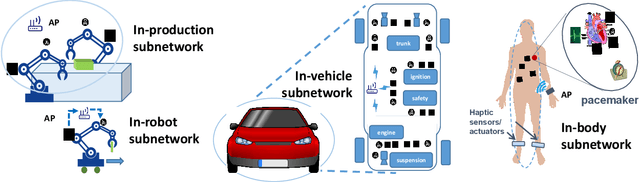
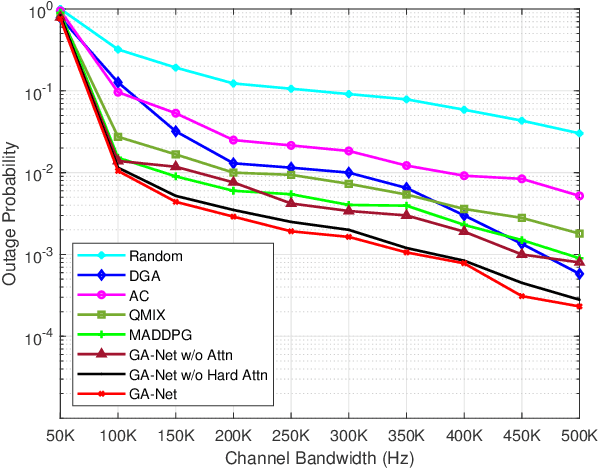
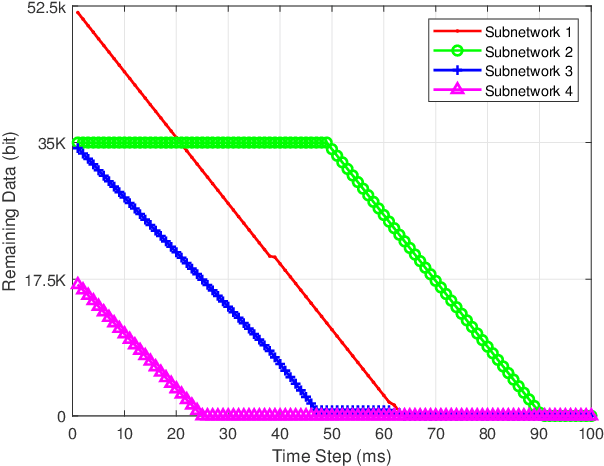
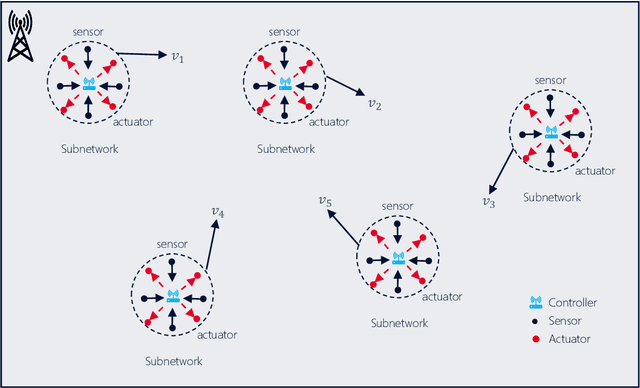
The 6G network enables a subnetwork-wide evolution, resulting in a "network of subnetworks". However, due to the dynamic mobility of wireless subnetworks, the data transmission of intra-subnetwork and inter-subnetwork will inevitably interfere with each other, which poses a great challenge to radio resource management. Moreover, most of the existing approaches require the instantaneous channel gain between subnetworks, which are usually difficult to be collected. To tackle these issues, in this paper we propose a novel effective intelligent radio resource management method using multi-agent deep reinforcement learning (MARL), which only needs the sum of received power, named received signal strength indicator (RSSI), on each channel instead of channel gains. However, to directly separate individual interference from RSSI is an almost impossible thing. To this end, we further propose a novel MARL architecture, named GA-Net, which integrates a hard attention layer to model the importance distribution of inter-subnetwork relationships based on RSSI and exclude the impact of unrelated subnetworks, and employs a graph attention network with a multi-head attention layer to exact the features and calculate their weights that will impact individual throughput. Experimental results prove that our proposed framework significantly outperforms both traditional and MARL-based methods in various aspects.