 Add to Chrome
 Add to Firefox
 Add to Edge
Planning Neural Dynamics with Lie Group Embedding through Supervised Projective Manifold Learning
May 24, 2026
We propose Lie group embedded dynamical neural networks (LieEDNN) and the corresponding learning algorithms based on gradient descent and metric projection on smooth manifold, where we treat Lie group as an intrinsic representation for continuous symmetry of manifold geometry. Thereby we achieve learnable and stable dynamics on the underlying manifold for general Lie group, and we are able to utilize the powerful representation capability of Lie group such as SO(3) and SE(3) to solve real world engineering problems in areas such as robotics, graphics, and control. Two core challenges are: (i) General Lie groups are incompatible with addition arithmetic, which is necessary for neural network interactions. (ii) The dynamics evolve in the nonlinear representation space of special algebra rather than the normal Euclidean space, which violates the paradigm of common neural ODEs. To address these two challenges, we firstly introduce adjoint Lie group action on the Lie algebra, which induces a linear mapping and transfer to the block-wise structure of weight matrices, such that addition could operate on the Lie algebra as a vector space. Then we parameterize the Lie algebra and the adjoint action as linear transformation so that the architecture is aligned with neural network perceptrons. Explicitly, this embedding appears as block-wise manifold constraints on weights, and we develop algorithms to learn the equilibrium with stability guarantees of the temporal neural network dynamics. Experiments are implemented on a specific Lie group SE(3), with the application scenario of telescopic manipulators.

Integrating LTL Constraints into PPO for Safe Reinforcement Learning
Mar 01, 2026This paper proposes Proximal Policy Optimization with Linear Temporal Logic Constraints (PPO-LTL), a framework that integrates safety constraints written in LTL into PPO for safe reinforcement learning. LTL constraints offer rigorous representations of complex safety requirements, such as regulations that broadly exist in robotics, enabling systematic monitoring of safety requirements. Violations against LTL constraints are monitored by limit-deterministic Büchi automata, and then translated by a logic-to-cost mechanism into penalty signals. The signals are further employed for guiding the policy optimization via the Lagrangian scheme. Extensive experiments on the Zones and CARLA environments show that our PPO-LTL can consistently reduce safety violations, while maintaining competitive performance, against the state-of-the-art methods. The code is at https://github.com/EVIEHub/PPO-LTL.
Near-Constant Strong Violation and Last-Iterate Convergence for Online CMDPs via Decaying Safety Margins
Feb 11, 2026We study safe online reinforcement learning in Constrained Markov Decision Processes (CMDPs) under strong regret and violation metrics, which forbid error cancellation over time. Existing primal-dual methods that achieve sublinear strong reward regret inevitably incur growing strong constraint violation or are restricted to average-iterate convergence due to inherent oscillations. To address these limitations, we propose the Flexible safety Domain Optimization via Margin-regularized Exploration (FlexDOME) algorithm, the first to provably achieve near-constant $\tilde{O}(1)$ strong constraint violation alongside sublinear strong regret and non-asymptotic last-iterate convergence. FlexDOME incorporates time-varying safety margins and regularization terms into the primal-dual framework. Our theoretical analysis relies on a novel term-wise asymptotic dominance strategy, where the safety margin is rigorously scheduled to asymptotically majorize the functional decay rates of the optimization and statistical errors, thereby clamping cumulative violations to a near-constant level. Furthermore, we establish non-asymptotic last-iterate convergence guarantees via a policy-dual Lyapunov argument. Experiments corroborate our theoretical findings.
Ensuring Safety in an Uncertain Environment: Constrained MDPs via Stochastic Thresholds
Apr 07, 2025This paper studies constrained Markov decision processes (CMDPs) with constraints against stochastic thresholds, aiming at safety of reinforcement learning in unknown and uncertain environments. We leverage a Growing-Window estimator sampling from interactions with the uncertain and dynamic environment to estimate the thresholds, based on which we design Stochastic Pessimistic-Optimistic Thresholding (SPOT), a novel model-based primal-dual algorithm for multiple constraints against stochastic thresholds. SPOT enables reinforcement learning under both pessimistic and optimistic threshold settings. We prove that our algorithm achieves sublinear regret and constraint violation; i.e., a reward regret of $\tilde{\mathcal{O}}(\sqrt{T})$ while allowing an $\tilde{\mathcal{O}}(\sqrt{T})$ constraint violation over $T$ episodes. The theoretical guarantees show that our algorithm achieves performance comparable to that of an approach relying on fixed and clear thresholds. To the best of our knowledge, SPOT is the first reinforcement learning algorithm that realises theoretical guaranteed performance in an uncertain environment where even thresholds are unknown.
Industrial Internet Robot Collaboration System and Edge Computing Optimization
Apr 03, 2025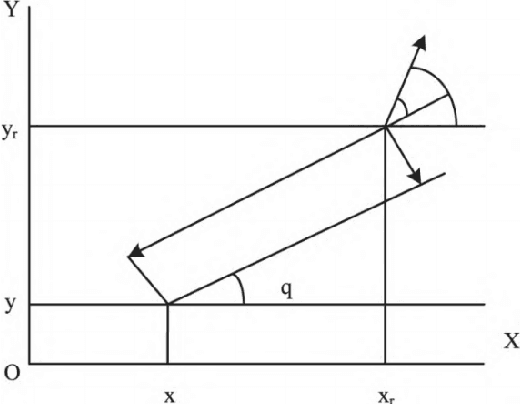
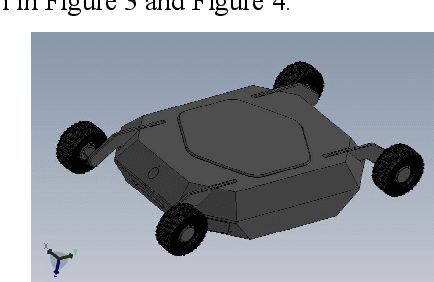
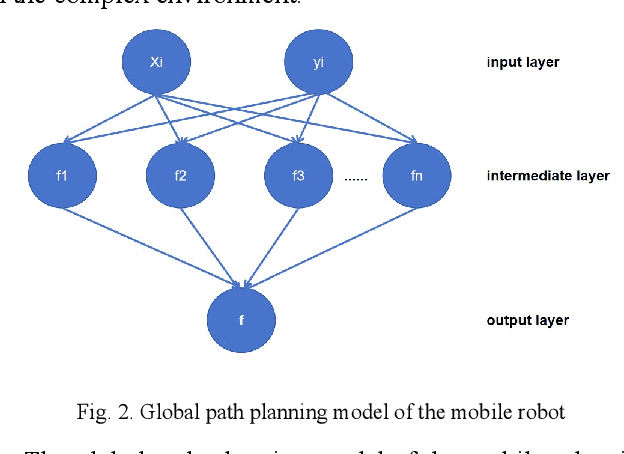
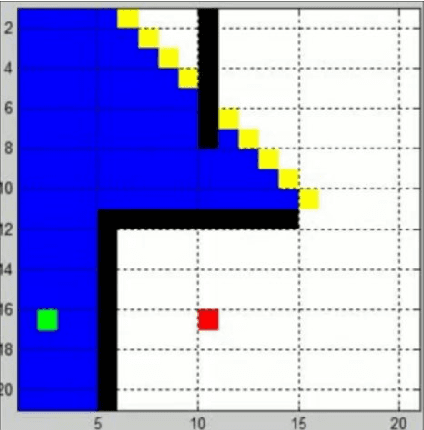
In a complex environment, for a mobile robot to safely and collision - free avoid all obstacles, it poses high requirements for its intelligence level. Given that the information such as the position and geometric characteristics of obstacles is random, the control parameters of the robot, such as velocity and angular velocity, are also prone to random deviations. To address this issue in the framework of the Industrial Internet Robot Collaboration System, this paper proposes a global path control scheme for mobile robots based on deep learning. First of all, the dynamic equation of the mobile robot is established. According to the linear velocity and angular velocity of the mobile robot, its motion behaviors are divided into obstacle - avoidance behavior, target - turning behavior, and target approaching behavior. Subsequently, the neural network method in deep learning is used to build a global path planning model for the robot. On this basis, a fuzzy controller is designed with the help of a fuzzy control algorithm to correct the deviations that occur during path planning, thereby achieving optimized control of the robot's global path. In addition, considering edge computing optimization, the proposed model can process local data at the edge device, reducing the communication burden between the robot and the central server, and improving the real time performance of path planning. The experimental results show that for the mobile robot controlled by the research method in this paper, the deviation distance of the path angle is within 5 cm, the deviation convergence can be completed within 10 ms, and the planned path is shorter. This indicates that the proposed scheme can effectively improve the global path planning ability of mobile robots in the industrial Internet environment and promote the collaborative operation of robots through edge computing optimization.