 Add to Chrome
 Add to Firefox
 Add to Edge
Blurb-Refined Inference from Crowdsourced Book Reviews using Hierarchical Genre Mining with Dual-Path Graph Convolutions
Dec 24, 2025
Accurate book genre classification is fundamental to digital library organization, content discovery, and personalized recommendation. Existing approaches typically model genre prediction as a flat, single-label task, ignoring hierarchical genre structure and relying heavily on noisy, subjective user reviews, which often degrade classification reliability. We propose HiGeMine, a two-phase hierarchical genre mining framework that robustly integrates user reviews with authoritative book blurbs. In the first phase, HiGeMine employs a zero-shot semantic alignment strategy to filter reviews, retaining only those semantically consistent with the corresponding blurb, thereby mitigating noise, bias, and irrelevance. In the second phase, we introduce a dual-path, two-level graph-based classification architecture: a coarse-grained Level-1 binary classifier distinguishes fiction from non-fiction, followed by Level-2 multi-label classifiers for fine-grained genre prediction. Inter-genre dependencies are explicitly modeled using a label co-occurrence graph, while contextual representations are derived from pretrained language models applied to the filtered textual content. To facilitate systematic evaluation, we curate a new hierarchical book genre dataset. Extensive experiments demonstrate that HiGeMine consistently outperformed strong baselines across hierarchical genre classification tasks. The proposed framework offers a principled and effective solution for leveraging both structured and unstructured textual data in hierarchical book genre analysis.

An Adaptive Data-Resilient Multi-Modal Framework for Hierarchical Multi-Label Book Genre Identification
May 05, 2025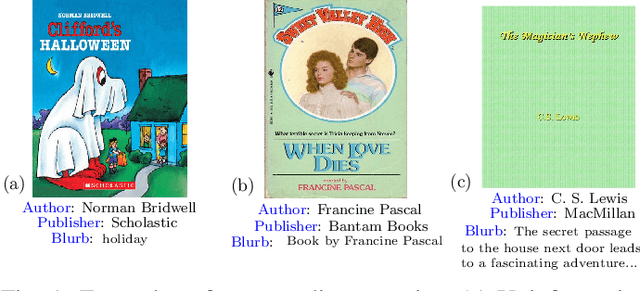
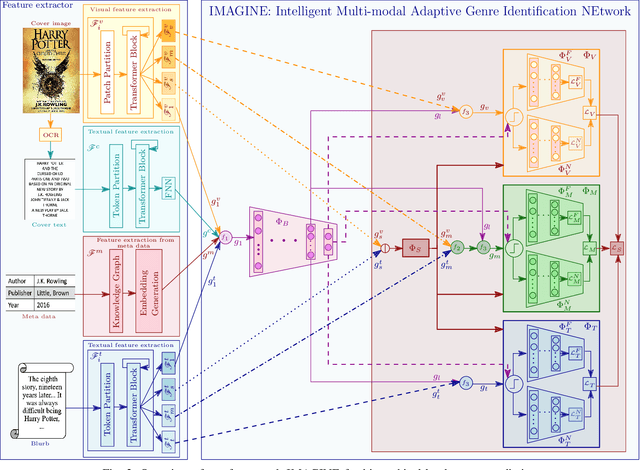
Identifying the finer details of a book's genres enhances user experience by enabling efficient book discovery and personalized recommendations, ultimately improving reader engagement and satisfaction. It also provides valuable insights into market trends and consumer preferences, allowing publishers and marketers to make data-driven decisions regarding book production and marketing strategies. While traditional book genre classification methods primarily rely on review data or textual analysis, incorporating additional modalities, such as book covers, blurbs, and metadata, can offer richer context and improve prediction accuracy. However, the presence of incomplete or noisy information across these modalities presents a significant challenge. This paper introduces IMAGINE (Intelligent Multi-modal Adaptive Genre Identification NEtwork), a framework designed to address these complexities. IMAGINE extracts robust feature representations from multiple modalities and dynamically selects the most informative sources based on data availability. It employs a hierarchical classification strategy to capture genre relationships and remains adaptable to varying input conditions. Additionally, we curate a hierarchical genre classification dataset that structures genres into a well-defined taxonomy, accommodating the diverse nature of literary works. IMAGINE integrates information from multiple sources and assigns multiple genre labels to each book, ensuring a more comprehensive classification. A key feature of our framework is its resilience to incomplete data, enabling accurate predictions even when certain modalities, such as text, images, or metadata, are missing or incomplete. Experimental results show that IMAGINE outperformed existing baselines in genre classification accuracy, particularly in scenarios with insufficient modality-specific data.