 Add to Chrome
 Add to Firefox
 Add to Edge
PRISMA: Preference-Reinforced Self-Training Approach for Interpretable Emotionally Intelligent Negotiation Dialogues
Apr 20, 2026
Emotion plays a pivotal role in shaping negotiation outcomes, influencing trust, cooperation, and long-term relationships. Developing negotiation dialog systems that can recognize and respond strategically to emotions is, therefore, essential to create more effective human-centered interactions. Beyond generating emotionally appropriate responses, interpretability - understanding how a system generates a particular emotion-aware response, is critical for fostering reliability and building rapport. Driven by these aspects, in this work, we introduce PRISMA, an interpretable emotionally intelligent negotiation dialogue system targeting two application domains, viz. job interviews and resource allocation. To enable interpretability, we propose an Emotion-aware Negotiation Strategy-informed Chain-of-Thought (ENS-CoT) reasoning mechanism, which mimics human negotiation by perceiving, understanding, using, and managing emotions. Leveraging ENS-CoT, we curate two new datasets: JobNego (for job interview negotiation) and ResNego (for resource allocation negotiation). We then leverage these datasets to develop PRISMA by augmenting self-training with Direct Preference Optimization (DPO), guiding agents toward more accurate, interpretable, and emotionally appropriate negotiation responses. Automatic and human evaluation on JobNego and ResNego datasets demonstrate that PRISMA substantially enhances interpretability and generates appropriate emotion-aware responses, while improving overall negotiation effectiveness.

Strategic Prompting for Conversational Tasks: A Comparative Analysis of Large Language Models Across Diverse Conversational Tasks
Nov 26, 2024


Given the advancements in conversational artificial intelligence, the evaluation and assessment of Large Language Models (LLMs) play a crucial role in ensuring optimal performance across various conversational tasks. In this paper, we present a comprehensive study that thoroughly evaluates the capabilities and limitations of five prevalent LLMs: Llama, OPT, Falcon, Alpaca, and MPT. The study encompasses various conversational tasks, including reservation, empathetic response generation, mental health and legal counseling, persuasion, and negotiation. To conduct the evaluation, an extensive test setup is employed, utilizing multiple evaluation criteria that span from automatic to human evaluation. This includes using generic and task-specific metrics to gauge the LMs' performance accurately. From our evaluation, no single model emerges as universally optimal for all tasks. Instead, their performance varies significantly depending on the specific requirements of each task. While some models excel in certain tasks, they may demonstrate comparatively poorer performance in others. These findings emphasize the importance of considering task-specific requirements and characteristics when selecting the most suitable LM for conversational applications.
EmoInHindi: A Multi-label Emotion and Intensity Annotated Dataset in Hindi for Emotion Recognition in Dialogues
May 27, 2022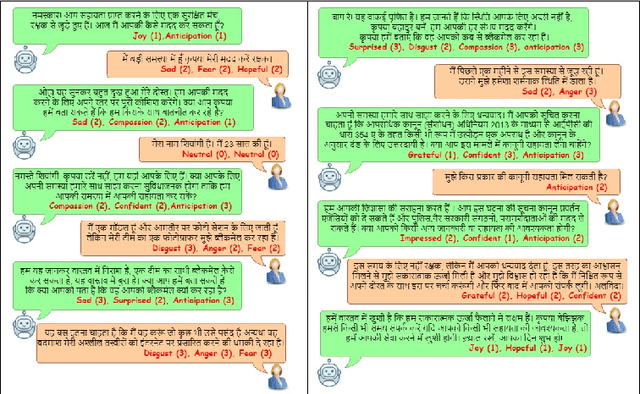
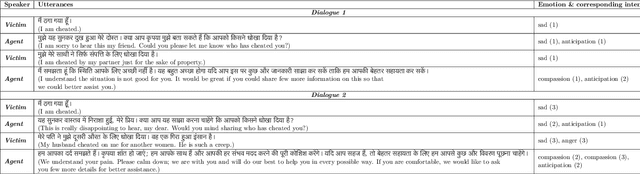
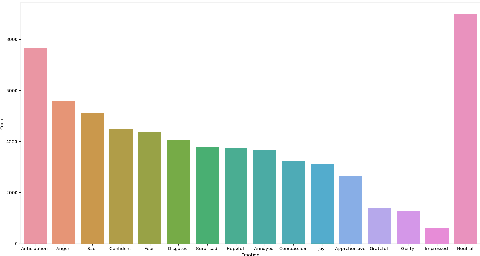
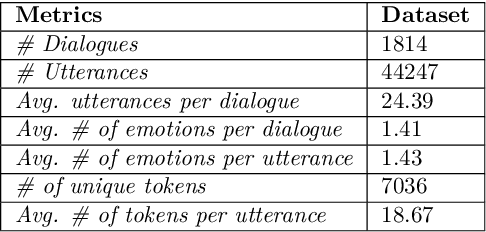
The long-standing goal of Artificial Intelligence (AI) has been to create human-like conversational systems. Such systems should have the ability to develop an emotional connection with the users, hence emotion recognition in dialogues is an important task. Emotion detection in dialogues is a challenging task because humans usually convey multiple emotions with varying degrees of intensities in a single utterance. Moreover, emotion in an utterance of a dialogue may be dependent on previous utterances making the task more complex. Emotion recognition has always been in great demand. However, most of the existing datasets for multi-label emotion and intensity detection in conversations are in English. To this end, we create a large conversational dataset in Hindi named EmoInHindi for multi-label emotion and intensity recognition in conversations containing 1,814 dialogues with a total of 44,247 utterances. We prepare our dataset in a Wizard-of-Oz manner for mental health and legal counselling of crime victims. Each utterance of the dialogue is annotated with one or more emotion categories from the 16 emotion classes including neutral, and their corresponding intensity values. We further propose strong contextual baselines that can detect emotion(s) and the corresponding intensity of an utterance given the conversational context.