 Add to Chrome
 Add to Firefox
 Add to Edge
LLM Pretraining Shapes a Generalizable Manifold: Insights into Cross-Modal Transfer to Time Series
May 19, 2026
Can language-pretrained transformers become effective time-series forecasters, and why? In this paper, we show that cross-modal transfer arises because language pretraining preconditions time series training with a reusable manifold. A linear probe on frozen LLM states decodes realistic time-series trajectories without paired supervision, and retrieval in this projected space yields competitive forecasts, showing that structure and dynamics exist before finetuning. Pretrained initialization also improves optimization, producing coherent gradients and a highly anisotropic loss landscape unlike random initialization. Finetuning then acts as low-dimensional alignment, reusing existing directions rather than learning temporal primitives from scratch, as evidenced by low-rank updates, subspace alignment, and shared features for periodicity, trend, and repetition. Together, these results support a geometric account of LLM-to-time-series transfer: language pretraining builds the manifold, and finetuning projects numerical dynamics onto task-relevant directions.

Robin: a Suite of Multi-Scale Vision-Language Models and the CHIRP Evaluation Benchmark
Jan 16, 2025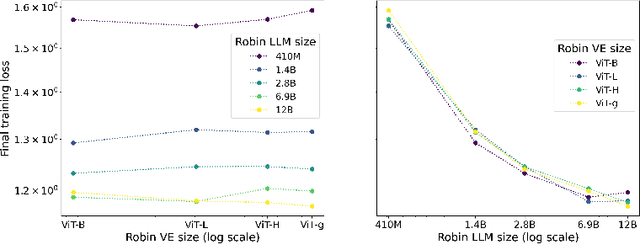
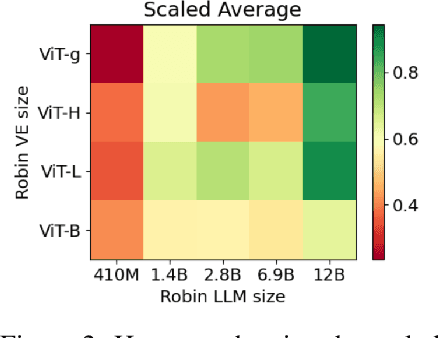


The proliferation of Vision-Language Models (VLMs) in the past several years calls for rigorous and comprehensive evaluation methods and benchmarks. This work analyzes existing VLM evaluation techniques, including automated metrics, AI-based assessments, and human evaluations across diverse tasks. We first introduce Robin - a novel suite of VLMs that we built by combining Large Language Models (LLMs) and Vision Encoders (VEs) at multiple scales, and use Robin to identify shortcomings of current evaluation approaches across scales. Next, to overcome the identified limitations, we introduce CHIRP - a new long form response benchmark we developed for more robust and complete VLM evaluation. We provide open access to the Robin training code, model suite, and CHIRP benchmark to promote reproducibility and advance VLM research.