 Add to Chrome
 Add to Firefox
 Add to Edge
THREAD: Trajectory Planning for Hybrid Rigid-Soft Manipulators with Environment-Aware Diffusion
Jun 19, 2026
Manipulation in confined environments, such as threading a manipulator through narrow apertures, remains a fundamental challenge, especially for conventional rigid robots. Hybrid rigid-soft manipulators offer promise but face two compounding planning challenges: backbone shapes feasible in free space become infeasible under environmental contact, and planning rigid and soft segments independently ignores their kinematic coupling. We present THREAD, the first diffusion-based trajectory planner for hybrid manipulation, learning a generative prior over physically realizable backbone trajectories conditioned on local environment geometry, with physics-inspired losses encoding curvature, smoothness, and collision constraints jointly across both segments. Trained in simulation, THREAD achieves 92.4% task success with 5x fewer collisions than the strongest baseline. We show cross-embodiment real-world transfer with minimal online updates, successfully threading through apertures as small as 1.3x the soft segment diameter.

SIRfyN: Single Image Relighting from your Neighbors
Dec 08, 2021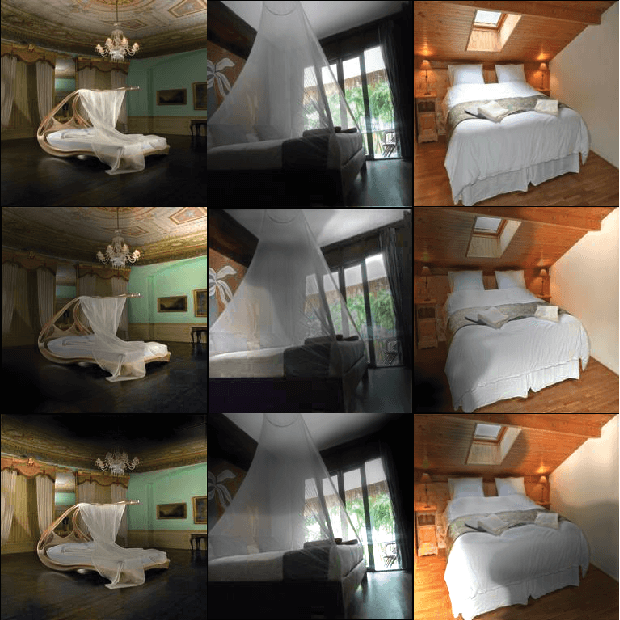
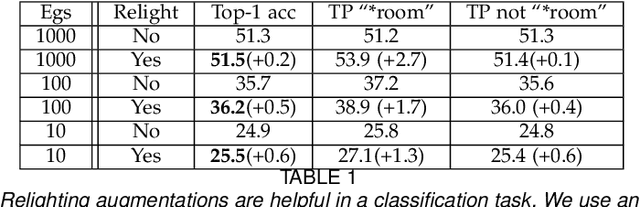
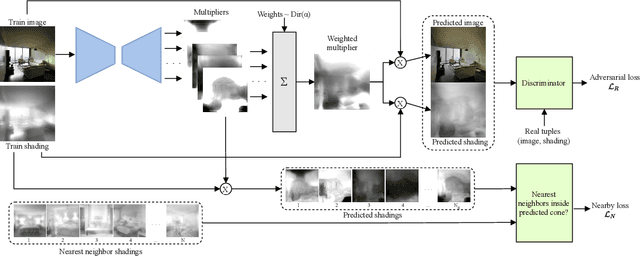
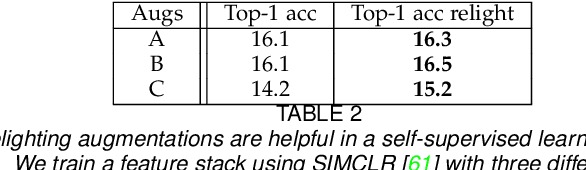
We show how to relight a scene, depicted in a single image, such that (a) the overall shading has changed and (b) the resulting image looks like a natural image of that scene. Applications for such a procedure include generating training data and building authoring environments. Naive methods for doing this fail. One reason is that shading and albedo are quite strongly related; for example, sharp boundaries in shading tend to appear at depth discontinuities, which usually apparent in albedo. The same scene can be lit in different ways, and established theory shows the different lightings form a cone (the illumination cone). Novel theory shows that one can use similar scenes to estimate the different lightings that apply to a given scene, with bounded expected error. Our method exploits this theory to estimate a representation of the available lighting fields in the form of imputed generators of the illumination cone. Our procedure does not require expensive "inverse graphics" datasets, and sees no ground truth data of any kind. Qualitative evaluation suggests the method can erase and restore soft indoor shadows, and can "steer" light around a scene. We offer a summary quantitative evaluation of the method with a novel application of the FID. An extension of the FID allows per-generated-image evaluation. Furthermore, we offer qualitative evaluation with a user study, and show that our method produces images that can successfully be used for data augmentation.