 Add to Chrome
 Add to Firefox
 Add to Edge
Personalized Generative Models for Contextual Debiasing
May 25, 2026
Different visual patterns appear with different frequencies in the world: e.g., beach balls appear on sand more often than they do on a road. These statistics are reflected in vision datasets, and as a result trained models more easily recognize objects in common scenarios. However, recognizing a beach ball on a road may arguably be even more important than recognizing it on sand. We study how to mitigate this discrepancy. Since collecting uncommon images in the real world may be difficult, we explore whether generating images with less frequent contexts can serve as effective training augmentation. A key challenge is guiding generations to remain close to the original dataset distribution while creating diverse images with uncommon contexts. We introduce Decoupling Contextual Patterns with Generations (DecoupleGen), a method that personalizes text-to-image diffusion models to facilitate coherent synthesis of images with rare contexts while preserving original visual details. The generated images contain semantically meaningful content and remain visually aligned with the original datasets. We further apply verification constraints to ensure relevance of the augmented data. We evaluate our approach on object classification and recognition tasks on complex scene datasets. Our experiments demonstrate consistent improvements over previous approaches, and our analyses identify factors underlying these improvements.

Real-time Digital RF Emulation -- II: A Near Memory Custom Accelerator
Jun 13, 2024


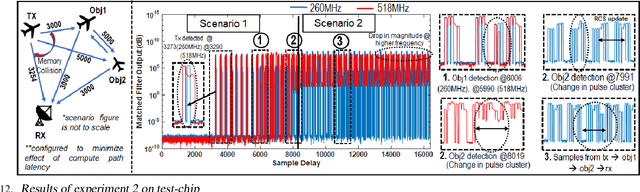
A near memory hardware accelerator, based on a novel direct path computational model, for real-time emulation of radio frequency systems is demonstrated. Our evaluation of hardware performance uses both application-specific integrated circuits (ASIC) and field programmable gate arrays (FPGA) methodologies: 1). The ASIC testchip implementation, using TSMC 28nm CMOS, leverages distributed autonomous control to extract concurrency in compute as well as low latency. It achieves a $518$ MHz per channel bandwidth in a prototype $4$-node system. The maximum emulation range supported in this paradigm is $9.5$ km with $0.24$ $\mu$s of per-sample emulation latency. 2). The FPGA-based implementation, evaluated on a Xilinx ZCU104 board, demonstrates a $9$-node test case (two Transmitters, one Receiver, and $6$ passive reflectors) with an emulation range of $1.13$ km to $27.3$ km at $215$ MHz bandwidth.