 Add to Chrome
 Add to Firefox
 Add to Edge
Benchmarking Deep Learning for Future Liver Remnant Segmentation in Colorectal Liver Metastasis
Apr 09, 2026
Accurate segmentation of the future liver remnant (FLR) is critical for surgical planning in colorectal liver metastases (CRLM) to prevent fatal post-hepatectomy liver failure. However, this segmentation task is technically challenging due to complex resection boundaries, convoluted hepatic vasculature and diffuse metastatic lesions. A primary bottleneck in developing automated AI tools has been the lack of high-fidelity, validated data. We address this gap by manually refining all 197 volumes from the public CRLM-CT-Seg dataset, creating the first open-source, validated benchmark for this task. We then establish the first segmentation baselines, comparing cascaded (Liver->CRLM->FLR) and end-to-end (E2E) strategies using nnU-Net, SwinUNETR, and STU-Net. We find a cascaded nnU-Net achieves the best final FLR segmentation Dice (0.767), while the pretrained STU-Net provides superior CRLM segmentation (0.620 Dice) and is significantly more robust to cascaded errors. This work provides the first validated benchmark and a reproducible framework to accelerate research in AI-assisted surgical planning.

Rotation Equivariant Convolutions in Deformable Registration of Brain MRI
Apr 09, 2026Image registration is a fundamental task that aligns anatomical structures between images. While CNNs perform well, they lack rotation equivariance - a rotated input does not produce a correspondingly rotated output. This hinders performance by failing to exploit the rotational symmetries inherent in anatomical structures, particularly in brain MRI. In this work, we integrate rotation-equivariant convolutions into deformable brain MRI registration networks. We evaluate this approach by replacing standard encoders with equivariant ones in three baseline architectures, testing on multiple public brain MRI datasets. Our experiments demonstrate that equivariant encoders have three key advantages: 1) They achieve higher registration accuracy while reducing network parameters, confirming the benefit of this anatomical inductive bias. 2) They outperform baselines on rotated input pairs, demonstrating robustness to orientation variations common in clinical practice. 3) They show improved performance with less training data, indicating greater sample efficiency. Our results demonstrate that incorporating geometric priors is a critical step toward building more robust, accurate, and efficient registration models.
MoME: Mixture of Visual Language Medical Experts for Medical Imaging Segmentation
Oct 30, 2025In this study, we propose MoME, a Mixture of Visual Language Medical Experts, for Medical Image Segmentation. MoME adapts the successful Mixture of Experts (MoE) paradigm, widely used in Large Language Models (LLMs), for medical vision-language tasks. The architecture enables dynamic expert selection by effectively utilizing multi-scale visual features tailored to the intricacies of medical imagery, enriched with textual embeddings. This work explores a novel integration of vision-language models for this domain. Utilizing an assembly of 10 datasets, encompassing 3,410 CT scans, MoME demonstrates strong performance on a comprehensive medical imaging segmentation benchmark. Our approach explores the integration of foundation models for medical imaging, benefiting from the established efficacy of MoE in boosting model performance by incorporating textual information. Demonstrating competitive precision across multiple datasets, MoME explores a novel architecture for achieving robust results in medical image analysis.
XOCT: Enhancing OCT to OCTA Translation via Cross-Dimensional Supervised Multi-Scale Feature Learning
Sep 09, 2025Optical Coherence Tomography Angiography (OCTA) and its derived en-face projections provide high-resolution visualization of the retinal and choroidal vasculature, which is critical for the rapid and accurate diagnosis of retinal diseases. However, acquiring high-quality OCTA images is challenging due to motion sensitivity and the high costs associated with software modifications for conventional OCT devices. Moreover, current deep learning methods for OCT-to-OCTA translation often overlook the vascular differences across retinal layers and struggle to reconstruct the intricate, dense vascular details necessary for reliable diagnosis. To overcome these limitations, we propose XOCT, a novel deep learning framework that integrates Cross-Dimensional Supervision (CDS) with a Multi-Scale Feature Fusion (MSFF) network for layer-aware vascular reconstruction. Our CDS module leverages 2D layer-wise en-face projections, generated via segmentation-weighted z-axis averaging, as supervisory signals to compel the network to learn distinct representations for each retinal layer through fine-grained, targeted guidance. Meanwhile, the MSFF module enhances vessel delineation through multi-scale feature extraction combined with a channel reweighting strategy, effectively capturing vascular details at multiple spatial scales. Our experiments on the OCTA-500 dataset demonstrate XOCT's improvements, especially for the en-face projections which are significant for clinical evaluation of retinal pathologies, underscoring its potential to enhance OCTA accessibility, reliability, and diagnostic value for ophthalmic disease detection and monitoring. The code is available at https://github.com/uci-cbcl/XOCT.
MedGen3D: A Deep Generative Framework for Paired 3D Image and Mask Generation
Apr 08, 2023
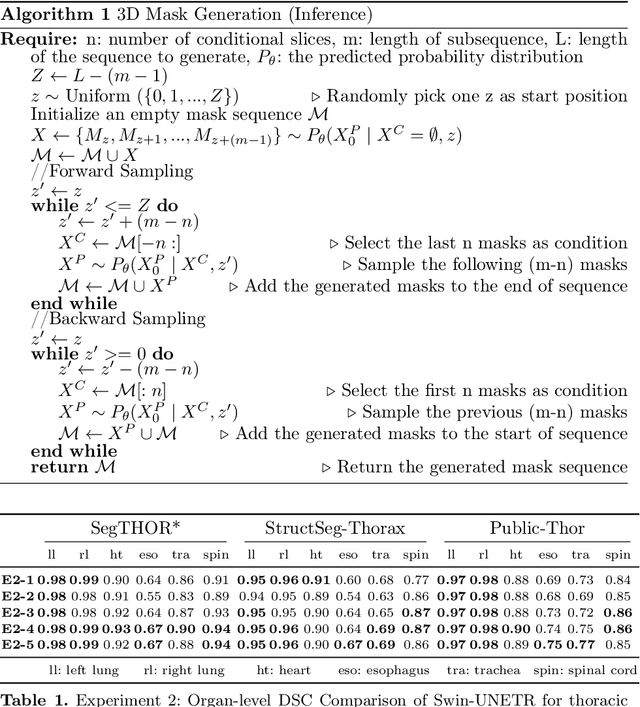

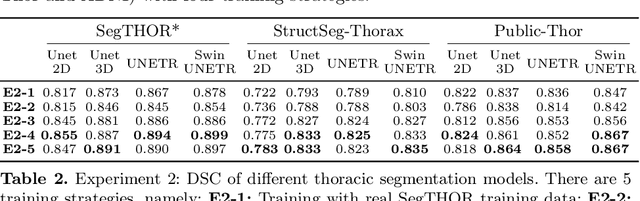
Acquiring and annotating sufficient labeled data is crucial in developing accurate and robust learning-based models, but obtaining such data can be challenging in many medical image segmentation tasks. One promising solution is to synthesize realistic data with ground-truth mask annotations. However, no prior studies have explored generating complete 3D volumetric images with masks. In this paper, we present MedGen3D, a deep generative framework that can generate paired 3D medical images and masks. First, we represent the 3D medical data as 2D sequences and propose the Multi-Condition Diffusion Probabilistic Model (MC-DPM) to generate multi-label mask sequences adhering to anatomical geometry. Then, we use an image sequence generator and semantic diffusion refiner conditioned on the generated mask sequences to produce realistic 3D medical images that align with the generated masks. Our proposed framework guarantees accurate alignment between synthetic images and segmentation maps. Experiments on 3D thoracic CT and brain MRI datasets show that our synthetic data is both diverse and faithful to the original data, and demonstrate the benefits for downstream segmentation tasks. We anticipate that MedGen3D's ability to synthesize paired 3D medical images and masks will prove valuable in training deep learning models for medical imaging tasks.