 Add to Chrome
 Add to Firefox
 Add to Edge
When Specifications Conflict: A Symmetry-Based Framework for Measuring LLM Preferences
Jul 30, 2026
Large language models (LLMs) are increasingly required to integrate multiple sources of information that may be inconsistent or conflicting. However, there is still a lack of controllable and attributable methods for analyzing how models resolve conflicts between competing specifications. We propose a controlled experimental framework for studying model preferences under conflicting specifications. By constructing specifications with explicit conflicts, the framework enables model choices between competing specifications to be directly observed and analyzed. A symmetry-based design further reduces confounding factors, allowing preferences across representation types to be compared systematically. We evaluate the framework on an executable mathematical benchmark with 550 conflict instances spanning 11 function families, comparing four representation types: pure natural language, formal language, naturalized formal language, and input--output examples. Results show systematic preference patterns rather than random behavior, with a consistent ordering: $ \text{Formal} \approx \text{Naturalized Formal} > \text{Pure Natural Language} > \text{Input--Output Examples} $. Example effects further depend on model capability and function family. We extend the framework to heterogeneous specification conflicts in Boolean algebra, code generation, and the clinical domain, demonstrating its applicability across diverse tasks and specification forms. The framework provides a unified approach for measuring how LLMs resolve conflicts between competing sources of information.

Benchmarking GPT-4 against Human Translators: A Comprehensive Evaluation Across Languages, Domains, and Expertise Levels
Nov 21, 2024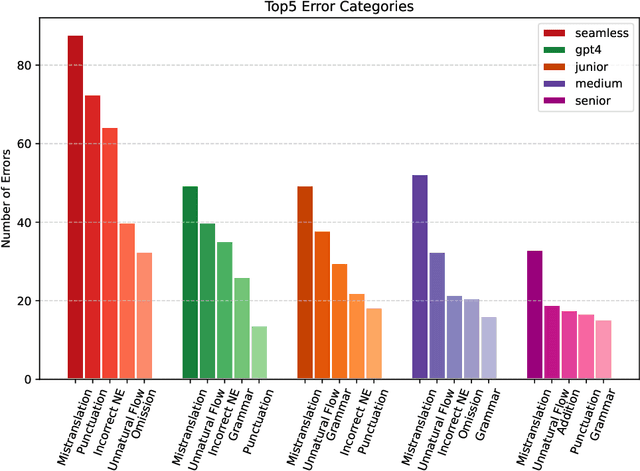
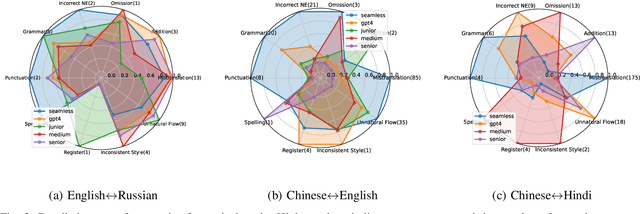
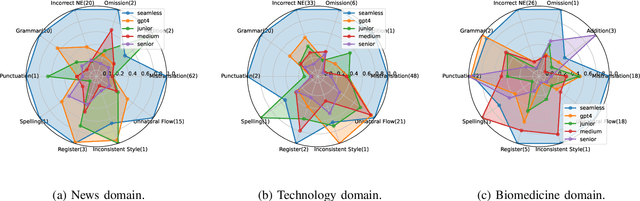
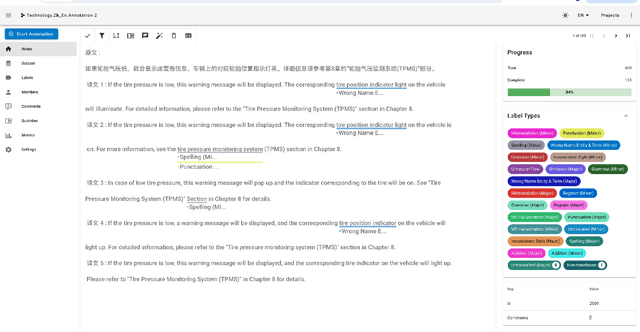
This study presents a comprehensive evaluation of GPT-4's translation capabilities compared to human translators of varying expertise levels. Through systematic human evaluation using the MQM schema, we assess translations across three language pairs (Chinese$\longleftrightarrow$English, Russian$\longleftrightarrow$English, and Chinese$\longleftrightarrow$Hindi) and three domains (News, Technology, and Biomedical). Our findings reveal that GPT-4 achieves performance comparable to junior-level translators in terms of total errors, while still lagging behind senior translators. Unlike traditional Neural Machine Translation systems, which show significant performance degradation in resource-poor language directions, GPT-4 maintains consistent translation quality across all evaluated language pairs. Through qualitative analysis, we identify distinctive patterns in translation approaches: GPT-4 tends toward overly literal translations and exhibits lexical inconsistency, while human translators sometimes over-interpret context and introduce hallucinations. This study represents the first systematic comparison between LLM and human translators across different proficiency levels, providing valuable insights into the current capabilities and limitations of LLM-based translation systems.
GPT-4 vs. Human Translators: A Comprehensive Evaluation of Translation Quality Across Languages, Domains, and Expertise Levels
Jul 04, 2024
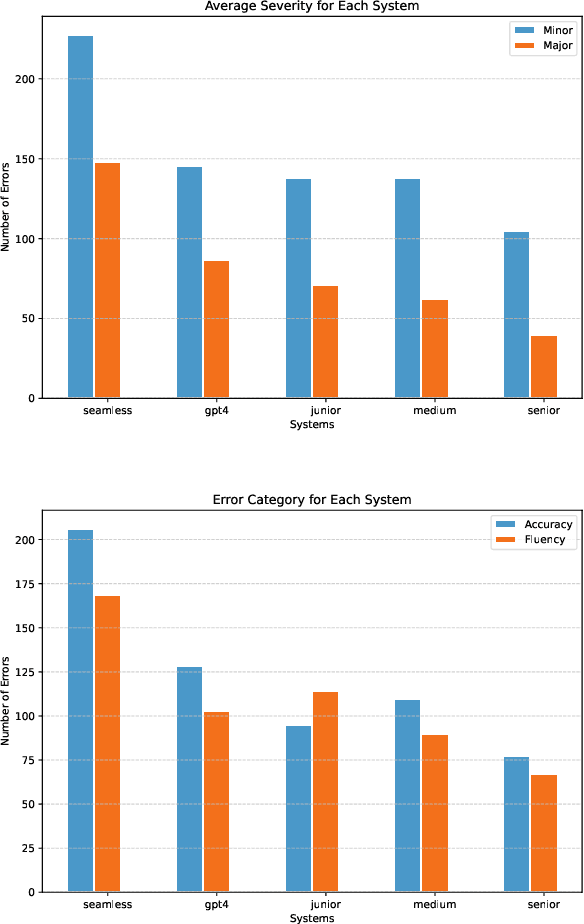


This study comprehensively evaluates the translation quality of Large Language Models (LLMs), specifically GPT-4, against human translators of varying expertise levels across multiple language pairs and domains. Through carefully designed annotation rounds, we find that GPT-4 performs comparably to junior translators in terms of total errors made but lags behind medium and senior translators. We also observe the imbalanced performance across different languages and domains, with GPT-4's translation capability gradually weakening from resource-rich to resource-poor directions. In addition, we qualitatively study the translation given by GPT-4 and human translators, and find that GPT-4 translator suffers from literal translations, but human translators sometimes overthink the background information. To our knowledge, this study is the first to evaluate LLMs against human translators and analyze the systematic differences between their outputs, providing valuable insights into the current state of LLM-based translation and its potential limitations.