 Add to Chrome
 Add to Firefox
 Add to Edge
Decision-calibrated prediction sets for robust power system operations
Jun 01, 2026
Robust optimization offers a tractable approach to balance operating costs and reliability in power systems dominated by weather-dependent renewable uncertainty, but its performance depends critically on the uncertainty set. Standard data-driven approaches often calibrate uncertainty sets to attain predictive coverage, which can produce unnecessarily large sets and costly operating decisions. In contrast, we introduce decision-calibrated prediction sets and embed them as uncertainty sets in robust optimization problems; these are conditional multivariate prediction sets where calibration is defined in terms of the reliability of downstream decisions, rather than in terms of the coverage. First, we learn these conditional prediction sets as sub-level sets of norm-based score functions represented by partially input-convex neural networks, capturing contextual information and multivariate dependence while preserving convexity and tractability in downstream robust formulations. Second, inspired by conformal risk control, we calibrate a score-threshold parameter that sets the volume of the uncertainty set, thereby controlling the expected violations of downstream operational constraints. We apply our approach to 15-minute-ahead reserve scheduling with network-constrained deliverability, which we formulate as a robust DC optimal power flow problem with affine recourse. Numerical experiments show that decision-calibrated sets attain prescribed constraint-satisfaction targets within about three percentage points, whereas standard coverage-based calibration systematically exceeds these targets by more than eleven percentage points, leading to larger sets and higher operating costs.

S3TS: Stochastic Scenario-Structured Tree Search for Advanced Planning Under Uncertainty
Jun 01, 2026Effective scheduling in the energy sector is essential to ensure the reliable operation of electrical grids and their connected assets by, for instance, optimizing the dispatch of generation units and storage systems. An effective planning strategy must (a) accommodate advanced and potentially non-linear system models -- exploiting the increasing data availability of modern grids, and (b) explicitly handle uncertainties arising, for instance, from the integration of renewable energy sources. While existing approaches can address either non-linearity (e.g., Monte Carlo Tree Search) or uncertainty (e.g., stochastic mathematical optimization), there is a lack of planning techniques capable of addressing both challenges simultaneously. To bridge this gap, we propose a Stochastic Scenario-Structured Tree Search (S3TS) algorithm that explicitly represents uncertainty through scenario trees while enabling the integration of advanced non-linear models. We evaluate S3TS on a simulated demand response signal publication problem, largely mimicking the imbalance settlement mechanism in Belgium. The results demonstrate near-optimal performance in linear, analytically tractable settings, with costs within 14% of the mathematically optimal solution conditioned to the scenario trees. In highly non-linear scenarios, S3TS significantly outperforms baseline methods, achieving cost reductions of up to 51% and 5.4% compared to a myopic algorithm and deterministic MCTS, respectively.
Stabilizing distribution-free probabilistic forecasts
May 27, 2026Multi-step-ahead forecasts are often updated as new observations become available, since shorter forecast horizons typically improve forecast quality. However, such improvements come at the cost of forecast instability, i.e., variability in forecasts for the same target period. This instability can trigger costly changes to plans formulated based on the forecasts and may erode trust in the forecasting system. In this work, we integrate forecast stability alongside forecast quality into the training of distribution-free probabilistic time-series forecasting models, allowing us to control this trade-off. We propose a method for generating stabilized forecasted conditional quantile functions using regression splines parameterized by a neural network. This approach enables joint optimization of quality and stability, as it allows us to directly penalize dissimilarities arising from forecast updates. Furthermore, it allows assigning varying importance to stabilizing different parts of the forecast distributions (e.g., central parts vs. tails) to focus on the parts most relevant for the intended downstream use (e.g., the upper tail for inventory management). We empirically evaluate the proposed method on two datasets with different statistical properties and show that it can effectively reduce forecast instability without a substantial loss in forecast quality, and that it can target stabilization effort toward specific parts of the forecast distributions.
Counter-Dyna: Data-Efficient RL-Based HVAC Control using Counterfactual Building Models
May 06, 2026Model-based reinforcement learning (MBRL) offers a promising approach for data-efficient energy management in buildings, combining the strengths of predictive modeling and reinforcement learning. While previous MBRL methods applied to HVAC control have reduced training data requirements, they still require several months of interaction with the building to learn a satisfactory control policy. A key reason is that existing surrogate models attempt to predict the entire state-space, including weather and electricity prices that are unaffected by control actions, or completely ignore these variables. Addressing these issues, we propose Counter-Dyna, a method that enhances the data-efficiency of Dyna, an MBRL method. We create data-efficient counterfactual surrogate models (CSM) by leveraging invariances in the state-space. Using a CSM in Dyna speeds up RL training measured in environment interaction data compared to previous results. In comparison with previous state-of-the-art that used 6-12 months of environment interactions, our method needs only 5 weeks. We evaluate our method in a large simulation study using the literature standard BOPTEST framework and proximal policy algorithm (PPO) as the RL algorithm. Our results show cost-saving potentials of 5.3% to 17.0% in a hypothetical deployment scenario. Our work is a significant step towards making real-world deployment of RL algorithms in HVAC control practically viable.
Value-oriented forecast reconciliation for renewables in electricity markets
Jan 27, 2025Forecast reconciliation is considered an effective method for achieving coherence and improving forecast accuracy. However, the value of reconciled forecasts in downstream decision-making tasks has been mostly overlooked. In a multi-agent setup with heterogeneous loss functions, this oversight may lead to unfair outcomes, hence resulting in conflicts during the reconciliation process. To address this, we propose a value-oriented forecast reconciliation approach that focuses on the forecast value for individual agents. Fairness is ensured through the use of a Nash bargaining framework. Specifically, we model this problem as a cooperative bargaining game, where each agent aims to optimize their own gain while contributing to the overall reconciliation process. We then present a primal-dual algorithm for parameter estimation based on empirical risk minimization. From an application perspective, we consider an aggregated wind energy trading problem, where profits are distributed using a weighted allocation rule. We demonstrate the effectiveness of our approach through several numerical experiments, showing that it consistently results in increased profits for all agents involved.
Evolving Multi-Scale Normalization for Time Series Forecasting under Distribution Shifts
Sep 29, 2024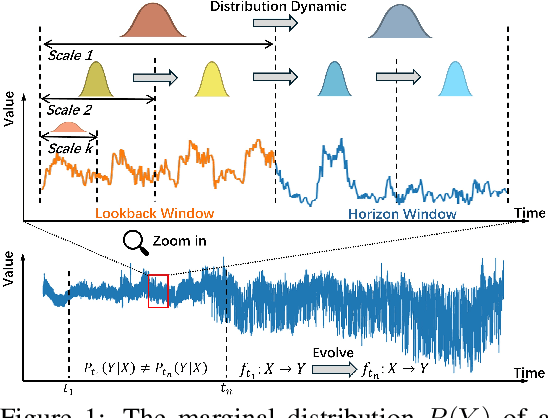
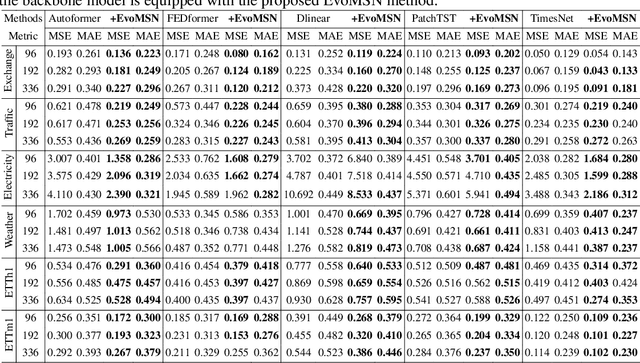
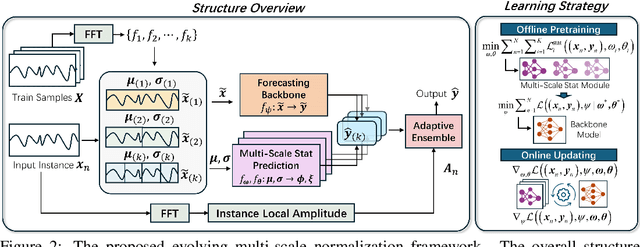
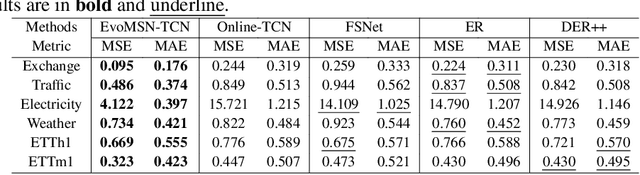
Complex distribution shifts are the main obstacle to achieving accurate long-term time series forecasting. Several efforts have been conducted to capture the distribution characteristics and propose adaptive normalization techniques to alleviate the influence of distribution shifts. However, these methods neglect the intricate distribution dynamics observed from various scales and the evolving functions of distribution dynamics and normalized mapping relationships. To this end, we propose a novel model-agnostic Evolving Multi-Scale Normalization (EvoMSN) framework to tackle the distribution shift problem. Flexible normalization and denormalization are proposed based on the multi-scale statistics prediction module and adaptive ensembling. An evolving optimization strategy is designed to update the forecasting model and statistics prediction module collaboratively to track the shifting distributions. We evaluate the effectiveness of EvoMSN in improving the performance of five mainstream forecasting methods on benchmark datasets and also show its superiority compared to existing advanced normalization and online learning approaches. The code is publicly available at https://github.com/qindalin/EvoMSN.
Data is missing again -- Reconstruction of power generation data using $k$-Nearest Neighbors and spectral graph theory
Aug 30, 2024
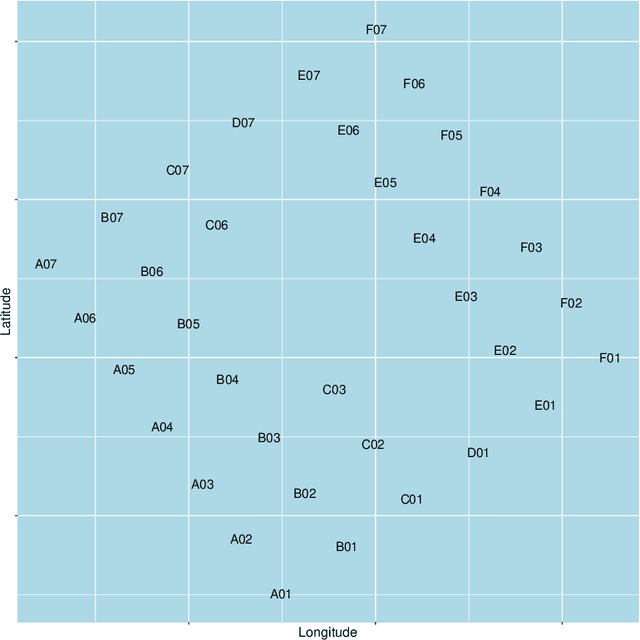

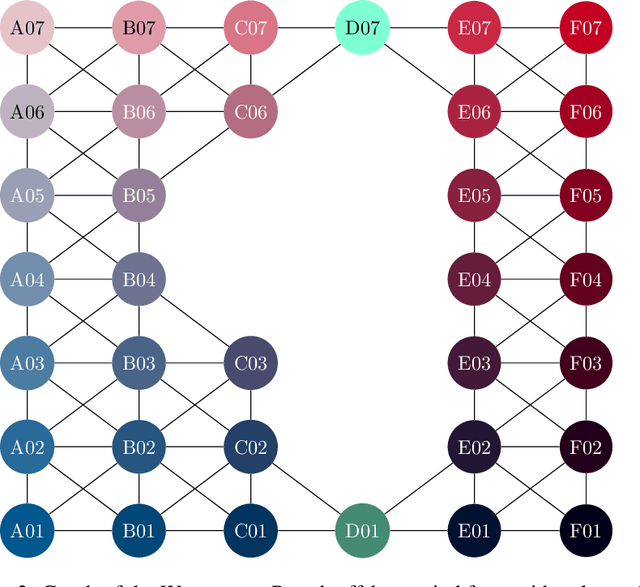
The risk of missing data and subsequent incomplete data records at wind farms increases with the number of turbines and sensors. We propose here an imputation method that blends data-driven concepts with expert knowledge, by using the geometry of the wind farm in order to provide better estimates when performing Nearest Neighbor imputation. Our method relies on learning Laplacian eigenmaps out of the graph of the wind farm through spectral graph theory. These learned representations can be based on the wind farm layout only, or additionally account for information provided by collected data. The related weighted graph is allowed to change with time and can be tracked in an online fashion. Application to the Westermost Rough offshore wind farm shows significant improvement over approaches that do not account for the wind farm layout information.
Clustering of timed sequences -- Application to the analysis of care pathways
Apr 23, 2024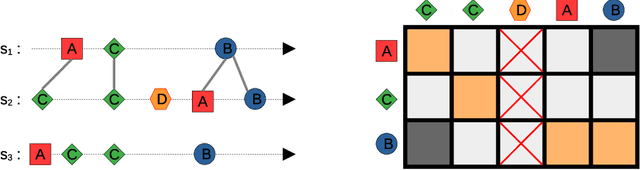

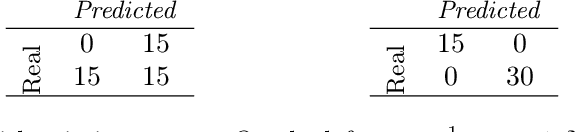
Improving the future of healthcare starts by better understanding the current actual practices in hospitals. This motivates the objective of discovering typical care pathways from patient data. Revealing homogeneous groups of care pathways can be achieved through clustering. The difficulty in clustering care pathways, represented by sequences of timestamped events, lies in defining a semantically appropriate metric and clustering algorithms. In this article, we adapt two methods developed for time series to time sequences: the drop-DTW metric and the DBA approach for the construction of averaged time sequences. These methods are then applied in clustering algorithms to propose original and sound clustering algorithms for timed sequences. This approach is experimented with and evaluated on synthetic and real use cases.
Tackling Missing Values in Probabilistic Wind Power Forecasting: A Generative Approach
Mar 06, 2024Machine learning techniques have been successfully used in probabilistic wind power forecasting. However, the issue of missing values within datasets due to sensor failure, for instance, has been overlooked for a long time. Although it is natural to consider addressing this issue by imputing missing values before model estimation and forecasting, we suggest treating missing values and forecasting targets indifferently and predicting all unknown values simultaneously based on observations. In this paper, we offer an efficient probabilistic forecasting approach by estimating the joint distribution of features and targets based on a generative model. It is free of preprocessing, and thus avoids introducing potential errors. Compared with the traditional "impute, then predict" pipeline, the proposed approach achieves better performance in terms of continuous ranked probability score.
Seamless and multi-resolution energy forecasting
Dec 28, 2023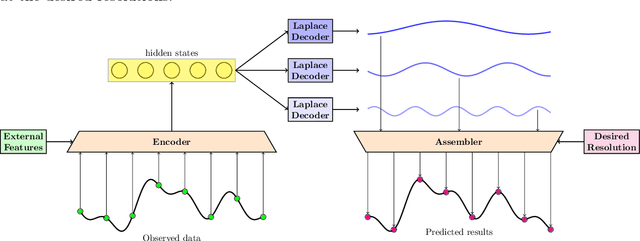
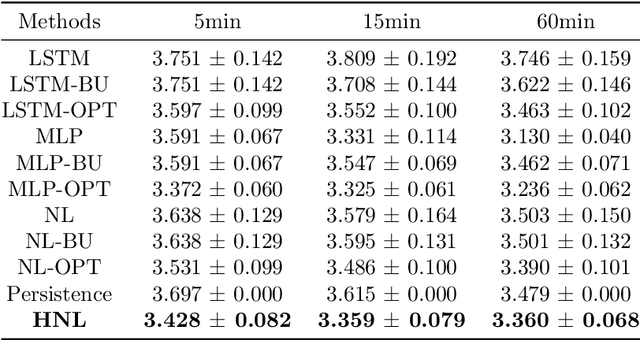
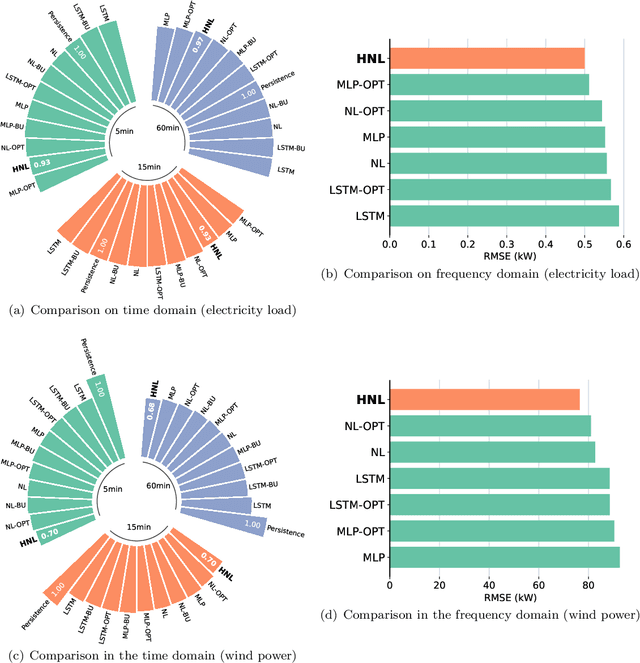
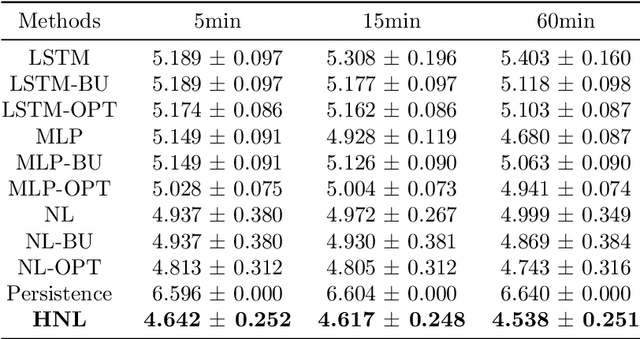
Energy forecasting is pivotal in energy systems, by providing fundamentals for operation, with different horizons and resolutions. Though energy forecasting has been widely studied for capturing temporal information, very few works concentrate on the frequency information provided by forecasts. They are consequently often limited to single-resolution applications (e.g., hourly). Here, we propose a unified energy forecasting framework based on Laplace transform in the multi-resolution context. The forecasts can be seamlessly produced at different desired resolutions without re-training or post-processing. Case studies on both energy demand and supply data show that the forecasts from our proposed method can provide accurate information in both time and frequency domains. Across the resolutions, the forecasts also demonstrate high consistency. More importantly, we explore the operational effects of our produced forecasts in the day-ahead and intra-day energy scheduling. The relationship between (i) errors in both time and frequency domains and (ii) operational value of the forecasts is analysed. Significant operational benefits are obtained.