 Add to Chrome
 Add to Firefox
 Add to Edge
Do Modern Post-Hoc Watermarking Methods Beat Broken-Arrows?
May 26, 2026
With the rapid proliferation of generative models, such as diffusion models, digital watermarking has emerged as a crucial solution for identifying AI-generated images. Modern post-hoc watermarking schemes use neural networks to achieve an extremely low false-alarm rate while remaining robust to common image transformations. However, there is a lack of comparison between these modern methods and classic ones, particularly in real-world scenarios where robustness and security take precedence over achieving an extremely low false-alarm probability. In this paper, we propose a fair comparison of robustness and security between modern and classic post-hoc watermarking across various types of classic augmentations and recent sophisticated attacks. Our experiments show that, in a realistic scenario, classic watermarking outperforms modern techniques in terms of security while maintaining robustness.

Secure Seed-Based Multi-bit Watermarking for Diffusion Models from First Principles
May 07, 2026The rapid emergence of generative image models has led to the development of specialized watermarking techniques, particularly in-generation methods such as seed-based embedding. However, current evaluations in this area remain largely empirical, making them heavily reliant on the specific model architectures used for generation and inversion. This prevents any clear conclusion on the performance of any method, especially regarding security, for which a rigorous definition is lacking. Against this approach, we argue that the effectiveness of a watermarking scheme should be established purely through a thorough theoretical analysis. This is enabled by decoupling the model-dependent part from the actual decision mechanism of the watermarking system. Using this decoupling, we introduce a formal evaluation framework based on security, robustness, and fidelity. This allows precise comparisons between watermarking systems through a characteristic surface representing the trade-off between these three quantities, independent of any generative model. Based on this framework, we propose SSB, a novel watermarking method that generalizes previous seed-based methods by allowing to reach any security-robustness-fidelity regime on its characteristic surface. This work opens the door to the design of modern watermarking systems with theoretical guarantees that do not necessitate any costly empirical evaluations.
Guidance Watermarking for Diffusion Models
Sep 26, 2025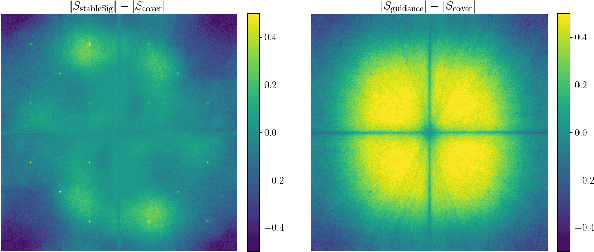
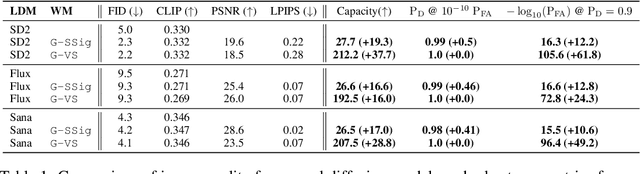

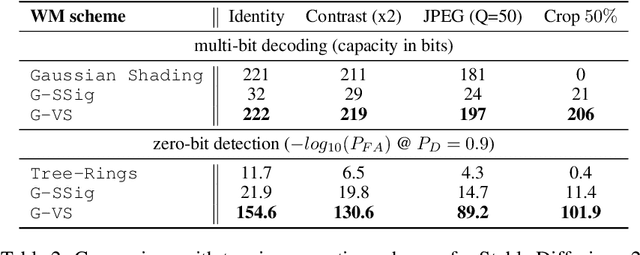
This paper introduces a novel watermarking method for diffusion models. It is based on guiding the diffusion process using the gradient computed from any off-the-shelf watermark decoder. The gradient computation encompasses different image augmentations, increasing robustness to attacks against which the decoder was not originally robust, without retraining or fine-tuning. Our method effectively convert any \textit{post-hoc} watermarking scheme into an in-generation embedding along the diffusion process. We show that this approach is complementary to watermarking techniques modifying the variational autoencoder at the end of the diffusion process. We validate the methods on different diffusion models and detectors. The watermarking guidance does not significantly alter the generated image for a given seed and prompt, preserving both the diversity and quality of generation.
Clustering of timed sequences -- Application to the analysis of care pathways
Apr 23, 2024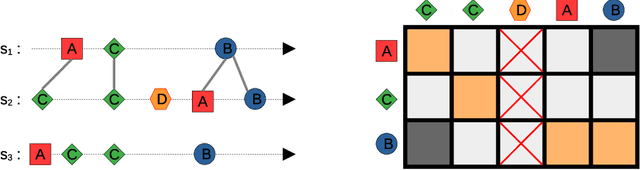

Improving the future of healthcare starts by better understanding the current actual practices in hospitals. This motivates the objective of discovering typical care pathways from patient data. Revealing homogeneous groups of care pathways can be achieved through clustering. The difficulty in clustering care pathways, represented by sequences of timestamped events, lies in defining a semantically appropriate metric and clustering algorithms. In this article, we adapt two methods developed for time series to time sequences: the drop-DTW metric and the DBA approach for the construction of averaged time sequences. These methods are then applied in clustering algorithms to propose original and sound clustering algorithms for timed sequences. This approach is experimented with and evaluated on synthetic and real use cases.