 Add to Chrome
 Add to Firefox
 Add to Edge
Thinking Like a Radiologist: A Dataset for Anatomy-Guided Interleaved Vision Language Reasoning in Chest X-ray Interpretation
Feb 13, 2026
Radiological diagnosis is a perceptual process in which careful visual inspection and language reasoning are repeatedly interleaved. Most medical large vision language models (LVLMs) perform visual inspection only once and then rely on text-only chain-of-thought (CoT) reasoning, which operates purely in the linguistic space and is prone to hallucination. Recent methods attempt to mitigate this issue by introducing visually related coordinates, such as bounding boxes. However, these remain a pseudo-visual solution: coordinates are still text and fail to preserve rich visual details like texture and density. Motivated by the interleaved nature of radiological diagnosis, we introduce MMRad-IVL-22K, the first large-scale dataset designed for natively interleaved visual language reasoning in chest X-ray interpretation. MMRad-IVL-22K reflects a repeated cycle of reasoning and visual inspection workflow of radiologists, in which visual rationales complement textual descriptions and ground each step of the reasoning process. MMRad-IVL-22K comprises 21,994 diagnostic traces, enabling systematic scanning across 35 anatomical regions. Experimental results on advanced closed-source LVLMs demonstrate that report generation guided by multimodal CoT significantly outperforms that guided by text-only CoT in clinical accuracy and report quality (e.g., 6\% increase in the RadGraph metric), confirming that high-fidelity interleaved vision language evidence is a non-substitutable component of reliable medical AI. Furthermore, benchmarking across seven state-of-the-art open-source LVLMs demonstrates that models fine-tuned on MMRad-IVL-22K achieve superior reasoning consistency and report quality compared with both general-purpose and medical-specific LVLMs. The project page is available at https://github.com/qiuzyc/thinking_like_a_radiologist.

NEARL-CLIP: Interacted Query Adaptation with Orthogonal Regularization for Medical Vision-Language Understanding
Aug 06, 2025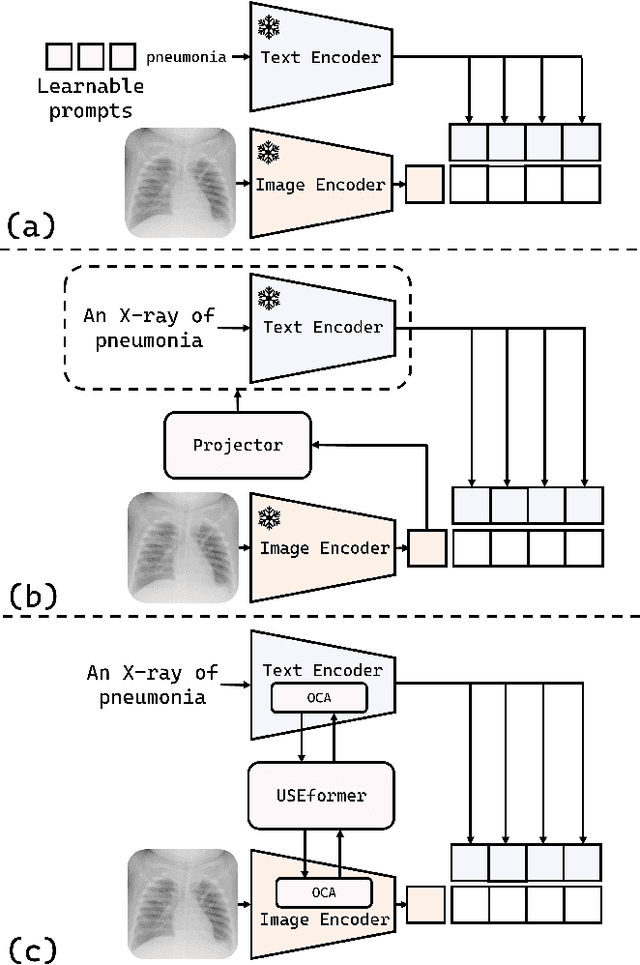
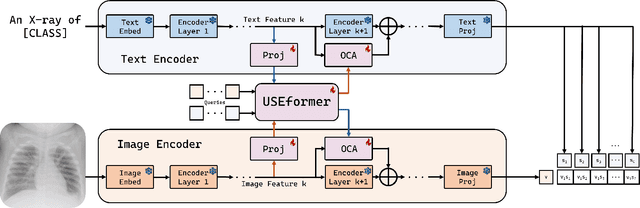
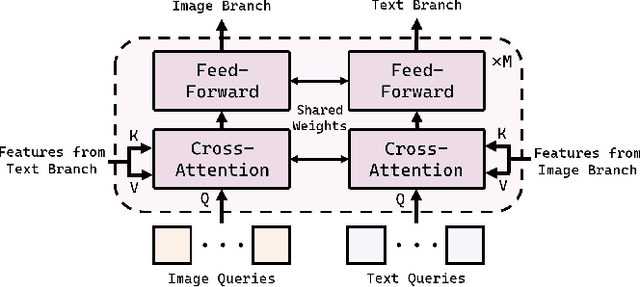
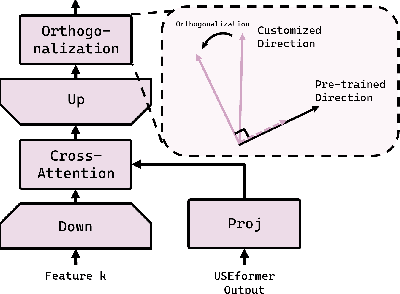
Computer-aided medical image analysis is crucial for disease diagnosis and treatment planning, yet limited annotated datasets restrict medical-specific model development. While vision-language models (VLMs) like CLIP offer strong generalization capabilities, their direct application to medical imaging analysis is impeded by a significant domain gap. Existing approaches to bridge this gap, including prompt learning and one-way modality interaction techniques, typically focus on introducing domain knowledge to a single modality. Although this may offer performance gains, it often causes modality misalignment, thereby failing to unlock the full potential of VLMs. In this paper, we propose \textbf{NEARL-CLIP} (i\underline{N}teracted qu\underline{E}ry \underline{A}daptation with o\underline{R}thogona\underline{L} Regularization), a novel cross-modality interaction VLM-based framework that contains two contributions: (1) Unified Synergy Embedding Transformer (USEformer), which dynamically generates cross-modality queries to promote interaction between modalities, thus fostering the mutual enrichment and enhancement of multi-modal medical domain knowledge; (2) Orthogonal Cross-Attention Adapter (OCA). OCA introduces an orthogonality technique to decouple the new knowledge from USEformer into two distinct components: the truly novel information and the incremental knowledge. By isolating the learning process from the interference of incremental knowledge, OCA enables a more focused acquisition of new information, thereby further facilitating modality interaction and unleashing the capability of VLMs. Notably, NEARL-CLIP achieves these two contributions in a parameter-efficient style, which only introduces \textbf{1.46M} learnable parameters.
MedSeg-R: Reasoning Segmentation in Medical Images with Multimodal Large Language Models
Jun 12, 2025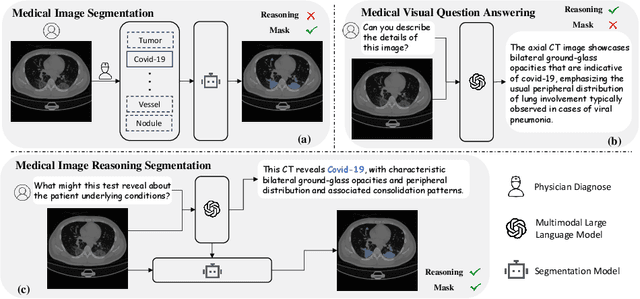
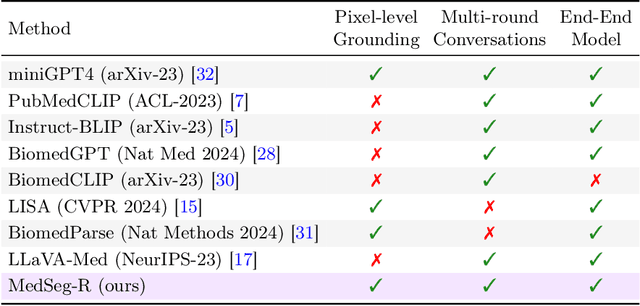
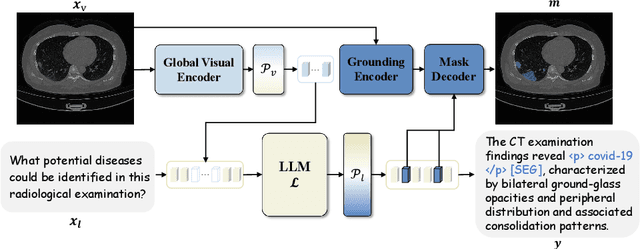
Medical image segmentation is crucial for clinical diagnosis, yet existing models are limited by their reliance on explicit human instructions and lack the active reasoning capabilities to understand complex clinical questions. While recent advancements in multimodal large language models (MLLMs) have improved medical question-answering (QA) tasks, most methods struggle to generate precise segmentation masks, limiting their application in automatic medical diagnosis. In this paper, we introduce medical image reasoning segmentation, a novel task that aims to generate segmentation masks based on complex and implicit medical instructions. To address this, we propose MedSeg-R, an end-to-end framework that leverages the reasoning abilities of MLLMs to interpret clinical questions while also capable of producing corresponding precise segmentation masks for medical images. It is built on two core components: 1) a global context understanding module that interprets images and comprehends complex medical instructions to generate multi-modal intermediate tokens, and 2) a pixel-level grounding module that decodes these tokens to produce precise segmentation masks and textual responses. Furthermore, we introduce MedSeg-QA, a large-scale dataset tailored for the medical image reasoning segmentation task. It includes over 10,000 image-mask pairs and multi-turn conversations, automatically annotated using large language models and refined through physician reviews. Experiments show MedSeg-R's superior performance across several benchmarks, achieving high segmentation accuracy and enabling interpretable textual analysis of medical images.