 Add to Chrome
 Add to Firefox
 Add to Edge
Is Variational Monte Carlo Robust? Sharp Moment Thresholds and Heavy-tailed Stochastic Optimization
Jun 24, 2026
Variational Monte Carlo (VMC) is a central algorithm in electronic structure theory and has gained renewed importance through modern neural-network ansätze such as FermiNet. At its core, VMC seeks ground states by minimizing the Rayleigh quotient by stochastic optimization. In this work, we show that the resulting stochastic optimization problem is intrinsically governed by the nodal geometry of the underlying wave function. More precisely, we establish that properties of the nodal set determine the integrability of the local energy and gradient estimators that drive VMC. For broad and practically relevant ansatz classes, including Slater-Jastrow wave functions with variable-exponent Slater-type orbitals, we prove that these estimators are generically heavy-tailed and fail to admit higher moments. At the same time, for general analytic ansätze, we prove weak moment bounds for the relevant estimators and identify precise low-moment regimes, showing how generic and degenerate nodal structures lead to different integrability thresholds. Building on this analysis, we introduce a new robust variant of VMC $\unicode{x2013}$ coined PS-Clip-VMC $\unicode{x2013}$ which is based on clipping both the local energy and the gradient random variable. We prove that PS-Clip-VMC converges both in expectation and with high probability in the weak moment regime of VMC. Preliminary experiments for training FermiNet on Atoms with up to 18 electrons suggest that PS-Clip-VMC is significantly more robust than standard methods.

The Information-Theoretic Benefit of Shared Representations under Orthogonality Constraints
Jun 14, 2026Modern deep learning architectures are increasingly multi-task and multi-modal, using a pretrained foundation model combined with task-specific, fine-tuned models. Empirically, exploiting similarity across different problems, instead of solving them individually, can significantly improve overall performance. While the generalization and sample complexity properties of multitask learning have been widely studied, the parametric complexity of joint approximation in comparison to separate approximation remains less well understood. The question is particularly relevant in modern deep learning, where models are increasingly required to satisfy structural constraints such as equivariance, conservation laws, or orthogonality. We prove lower and upper bounds on the description-length for separate and joint approximation classes, respectively, in uniform norm. We build a class of orthogonal functions by composing a shared hard feature, realized by a Rademacher-Haar wavelet series, with Sawtooth-Walsh readouts to enforce orthogonality of output coordinates. The dyadic tree structure of the Rademacher-Haar wavelet concentrates the approximation hardness in the common feature component, while the readouts act as task-specific heads. Using an information-theoretic framework, we obtain a sharp gap between the optimal approximation rates achievable by joint and separate coding. Finally, we realize this separation in a neural network model using Heaviside activations via reduction to triangle-wave approximation. Our results show that even under an orthogonality constraint joint approximation requires strictly fewer bits in compositional architectures, provided the tasks share a latent hard feature. This provides theoretical insight into the description-length-efficiency of compositional multi-output architectures and clarifies how neural networks can retain expressivity under geometric constraints.
Limitations of Learning Tanh Neural Networks with Finite Precision
Jun 09, 2026We investigate limitations of learning $\tanh$ neural networks from point evaluations under finite-precision computations and $L^p$ accuracy guarantees, building on Berner, Grohs, and Voigtländer (2023). Our approach is based on a novel construction of sharply localized bump functions via iterated $\tanh$ activations. Using this mechanism, we show that, in a finite-precision setting, no adaptive randomized algorithm based on $m$ samples can achieve a convergence rate higher than the Monte Carlo rate $O(m^{-1/p})$ in the $L^p$ norm, unless the sampling budget grows exponentially with the size of the network parameters and architecture. The results reveal fundamental limitations imposed by finite precision on the learnability of classes containing localized bump functions, extending previous results for ReLU networks to the $\tanh$ setting.
Robust and Fast Training via Per-Sample Clipping
May 04, 2026We propose a robust gradient estimator based on per-sample gradient clipping and analyze its properties both theoretically and empirically. We show that the resulting method, per-sample clipped SGD (PS-Clip-SGD), achieves optimal in-expectation convergence rates for non-convex optimization problems under heavy-tailed gradient noise. Moreover, we establish high-probability convergence guarantees that match the in-expectation rates up to polylogarithmic factors in the failure probability. We complement our theoretical results with multiple numerical experiments. In particular, we demonstrate that PS-Clip-SGD outperforms both vanilla SGD with momentum and standard gradient clipping when training AlexNet on the CIFAR-100 dataset, even after accounting for the additional computational time caused by per-sample clipping. We also empirically show that, in the presence of gradient accumulation, applying clipping at the mini-batch level can improve training performance while incurring virtually no additional computational cost. This finding is particularly interesting, as it contradicts the common practice of applying clipping only after all accumulation steps have been completed.
Accurate Ab-initio Neural-network Solutions to Large-Scale Electronic Structure Problems
Apr 08, 2025
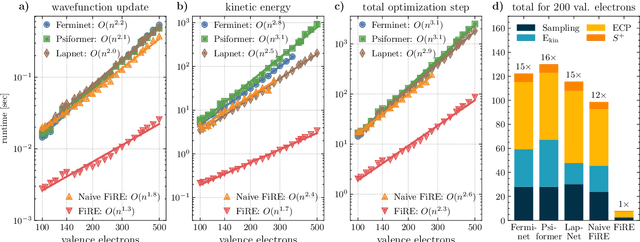
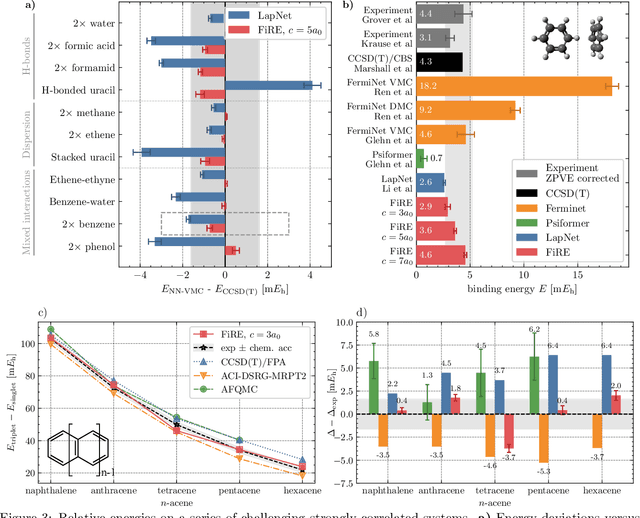
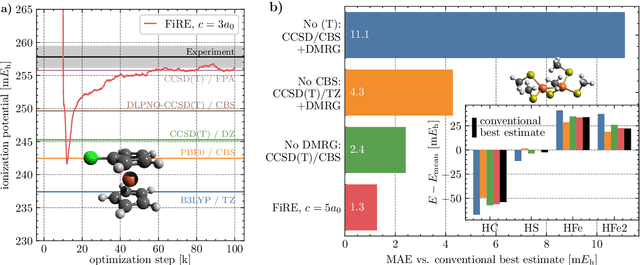
We present finite-range embeddings (FiRE), a novel wave function ansatz for accurate large-scale ab-initio electronic structure calculations. Compared to contemporary neural-network wave functions, FiRE reduces the asymptotic complexity of neural-network variational Monte Carlo (NN-VMC) by $\sim n_\text{el}$, the number of electrons. By restricting electron-electron interactions within the neural network, FiRE accelerates all key operations -- sampling, pseudopotentials, and Laplacian computations -- resulting in a real-world $10\times$ acceleration in now-feasible 180-electron calculations. We validate our method's accuracy on various challenging systems, including biochemical compounds, conjugated hydrocarbons, and organometallic compounds. On these systems, FiRE's energies are consistently within chemical accuracy of the most reliable data, including experiments, even in cases where high-accuracy methods such as CCSD(T), AFQMC, or contemporary NN-VMC fall short. With these improvements in both runtime and accuracy, FiRE represents a new `gold-standard' method for fast and accurate large-scale ab-initio calculations, potentially enabling new computational studies in fields like quantum chemistry, solid-state physics, and material design.
The sampling complexity of learning invertible residual neural networks
Nov 08, 2024In recent work it has been shown that determining a feedforward ReLU neural network to within high uniform accuracy from point samples suffers from the curse of dimensionality in terms of the number of samples needed. As a consequence, feedforward ReLU neural networks are of limited use for applications where guaranteed high uniform accuracy is required. We consider the question of whether the sampling complexity can be improved by restricting the specific neural network architecture. To this end, we investigate invertible residual neural networks which are foundational architectures in deep learning and are widely employed in models that power modern generative methods. Our main result shows that the residual neural network architecture and invertibility do not help overcome the complexity barriers encountered with simpler feedforward architectures. Specifically, we demonstrate that the computational complexity of approximating invertible residual neural networks from point samples in the uniform norm suffers from the curse of dimensionality. Similar results are established for invertible convolutional Residual neural networks.
Transferable Neural Wavefunctions for Solids
May 13, 2024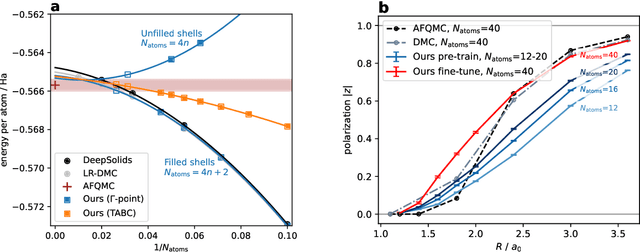
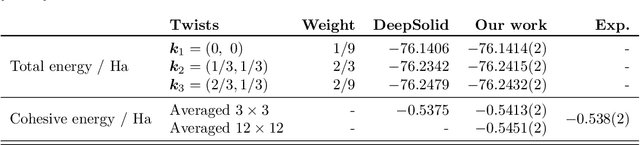
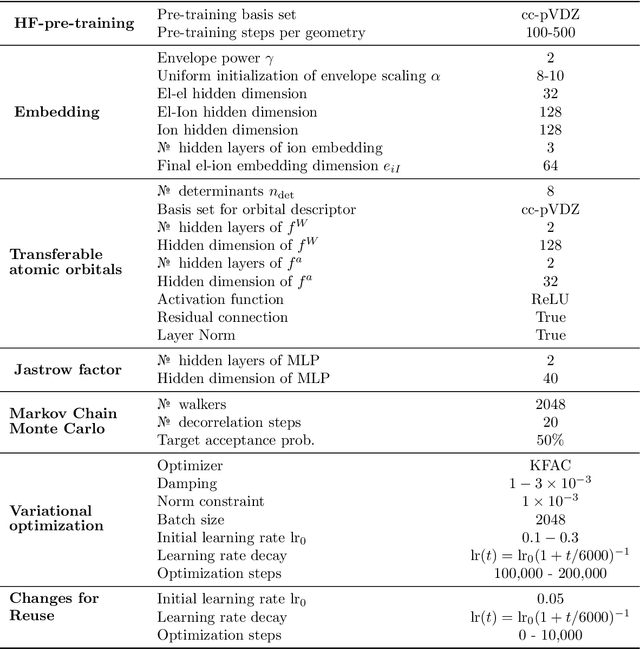
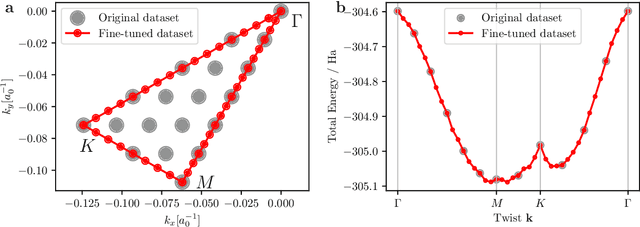
Deep-Learning-based Variational Monte Carlo (DL-VMC) has recently emerged as a highly accurate approach for finding approximate solutions to the many-electron Schr\"odinger equation. Despite its favorable scaling with the number of electrons, $\mathcal{O}(n_\text{el}^{4})$, the practical value of DL-VMC is limited by the high cost of optimizing the neural network weights for every system studied. To mitigate this problem, recent research has proposed optimizing a single neural network across multiple systems, reducing the cost per system. Here we extend this approach to solids, where similar but distinct calculations using different geometries, boundary conditions, and supercell sizes are often required. We show how to optimize a single ansatz across all of these variations, reducing the required number of optimization steps by an order of magnitude. Furthermore, we exploit the transfer capabilities of a pre-trained network. We successfully transfer a network, pre-trained on 2x2x2 supercells of LiH, to 3x3x3 supercells. This reduces the number of optimization steps required to simulate the large system by a factor of 50 compared to previous work.
Sampling Complexity of Deep Approximation Spaces
Dec 20, 2023While it is well-known that neural networks enjoy excellent approximation capabilities, it remains a big challenge to compute such approximations from point samples. Based on tools from Information-based complexity, recent work by Grohs and Voigtlaender [Journal of the FoCM (2023)] developed a rigorous framework for assessing this so-called "theory-to-practice gap". More precisely, in that work it is shown that there exist functions that can be approximated by neural networks with ReLU activation function at an arbitrary rate while requiring an exponentially growing (in the input dimension) number of samples for their numerical computation. The present study extends these findings by showing analogous results for the ReQU activation function.
Variational Monte Carlo on a Budget -- Fine-tuning pre-trained Neural Wavefunctions
Jul 15, 2023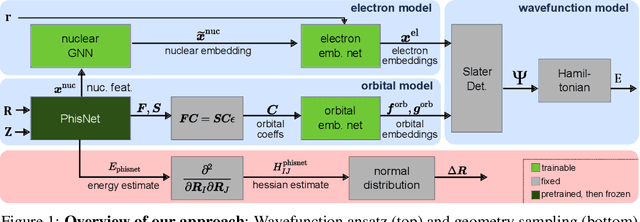
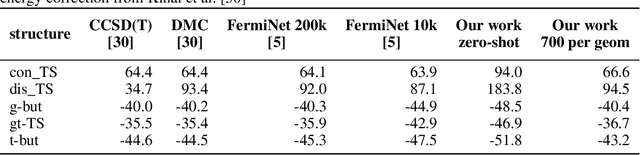
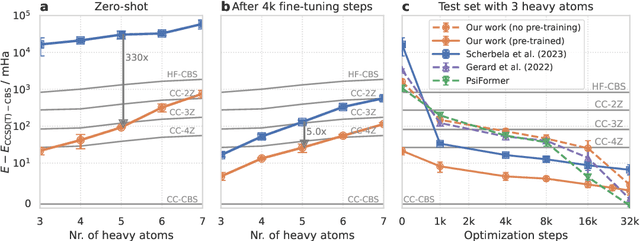
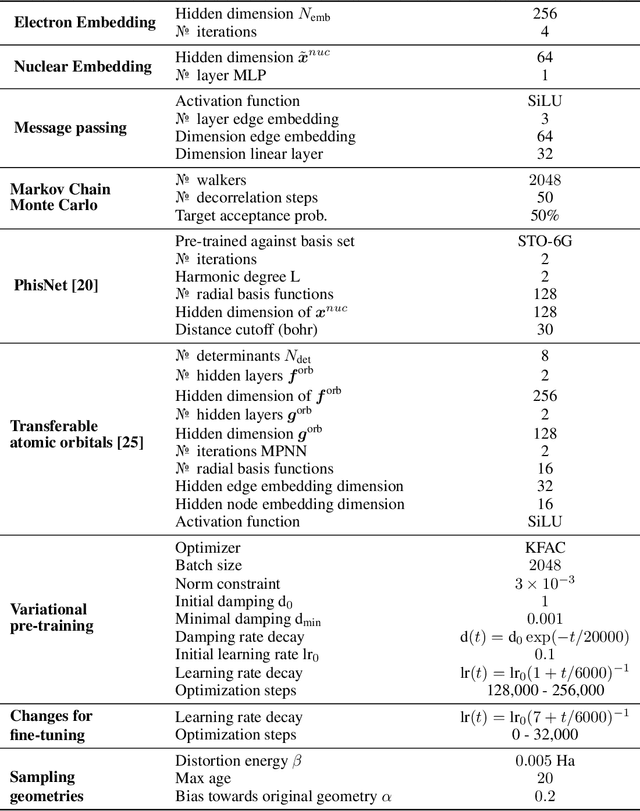
Obtaining accurate solutions to the Schr\"odinger equation is the key challenge in computational quantum chemistry. Deep-learning-based Variational Monte Carlo (DL-VMC) has recently outperformed conventional approaches in terms of accuracy, but only at large computational cost. Whereas in many domains models are trained once and subsequently applied for inference, accurate DL-VMC so far requires a full optimization for every new problem instance, consuming thousands of GPUhs even for small molecules. We instead propose a DL-VMC model which has been pre-trained using self-supervised wavefunction optimization on a large and chemically diverse set of molecules. Applying this model to new molecules without any optimization, yields wavefunctions and absolute energies that outperform established methods such as CCSD(T)-2Z. To obtain accurate relative energies, only few fine-tuning steps of this base model are required. We accomplish this with a fully end-to-end machine-learned model, consisting of an improved geometry embedding architecture and an existing SE(3)-equivariant model to represent molecular orbitals. Combining this architecture with continuous sampling of geometries, we improve zero-shot accuracy by two orders of magnitude compared to the state of the art. We extensively evaluate the accuracy, scalability and limitations of our base model on a wide variety of test systems.
FakET: Simulating Cryo-Electron Tomograms with Neural Style Transfer
Apr 04, 2023Particle localization and -classification constitute two of the most fundamental problems in computational microscopy. In recent years, deep learning based approaches have been introduced for these tasks with great success. A key shortcoming of these supervised learning methods is their need for large training data sets, typically generated from particle models in conjunction with complex numerical forward models simulating the physics of transmission electron microscopes. Computer implementations of such forward models are computationally extremely demanding and limit the scope of their applicability. In this paper we propose a simple method for simulating the forward operator of an electron microscope based on additive noise and Neural Style Transfer techniques. We evaluate the method on localization and classification tasks using one of the established state-of-the-art architectures showing performance on par with the benchmark. In contrast to previous approaches, our method accelerates the data generation process by a factor of 750 while using 33 times less memory and scales well to typical transmission electron microscope detector sizes. It utilizes GPU acceleration and parallel processing. It can be used as a stand-alone method to adapt a training data set or as a data augmentation technique. The source code is available at https://gitlab.com/deepet/faket.