 Add to Chrome
 Add to Firefox
 Add to Edge
Q-based Variational Inverse Reinforcement Learning
Aug 17, 2026
The development of safe and beneficial AI requires that systems can learn and act in accordance with human preferences. However, explicitly specifying these preferences by hand is often infeasible. Inverse reinforcement learning (IRL) addresses this challenge by inferring preferences, represented as reward functions, from expert behaviour. We introduce Q-based Variational IRL (QVIRL), a novel Bayesian IRL method that recovers a posterior distribution over rewards from expert demonstrations via primarily learning a variational distribution over optimal Q-values. Unlike previous approaches, QVIRL combines scalability with uncertainty quantification, important for safety-critical applications as well as active learning. We demonstrate QVIRL's strong performance in apprenticeship learning across various tasks, including gridworlds, Lunar Lander, the Highway Environment, and two ATARI games both with static expert data and with active learning. It is the first method for Bayesian IRL that demonstrates training from raw pixel observations.

Partner Capability Estimation for Task-Agnostic Adaptation in Ad-Hoc Teamwork
Jul 29, 2026Effective collaboration with novel and diverse partners is a crucial skill for autonomous agents. Most current ad-hoc teamwork (AHT) approaches assume that agents will collaborate on a single, fixed task and that the partner's capabilities, their ability to successfully execute the desired action, are already known. In reality, a partner's true capabilities are often hidden, and human collaborators may act sub-optimally on tasks with multiple valid strategies. To address these limitations, we extend ad-hoc teamwork into a multi-task setting by re-framing it as a problem of joint planning with decentralised execution under hidden partner capabilities. We introduce CE-CM (Capability Estimation via Contextual Models), an approximate Bayesian method that infers task-invariant capability vectors. By using simulation-based sampling, the agent estimates capabilities and induces a contextual Multi-agent Markov Decision Processes for planning. This approach requires no population pre-training and refines its beliefs online from just a few tasks. To account for human unpredictability, we propose CE-CM-Div, an extension that evaluates capability hypotheses against diverse planner rollouts rather than a single optimal trajectory. Simulated experiments demonstrate that CE-CM rapidly recovers hidden capabilities, reduces infeasible action assignments, and adapts to changes over time. Furthermore, in an offline human study of 225 trajectories from 15 participants, CE-CM-Div substantially improved capability estimates over the baseline CE-CM method. Our results suggest capability-based modelling is a promising interpretable, task-agnostic representation in the studied settings, demonstrating that accounting for behavioural diversity is essential for robust human-AI teaming.
When and Where to Step: Terrain-Aware Real-Time Footstep Location and Timing Optimization for Bipedal Robots
Feb 14, 2023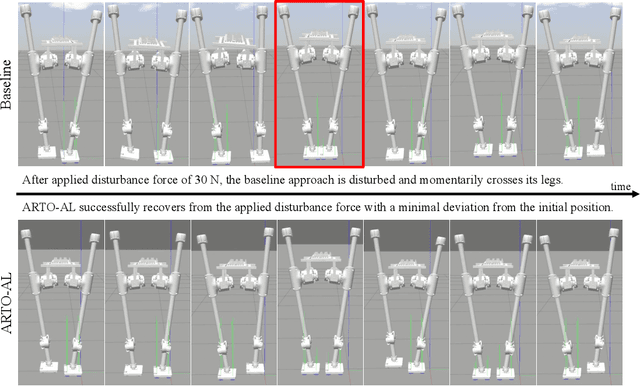

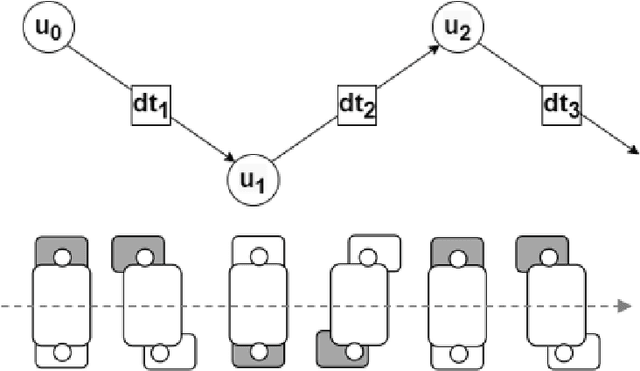
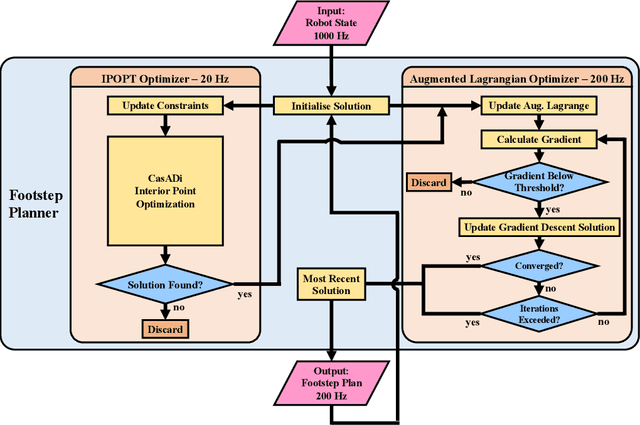
Online footstep planning is essential for bipedal walking robots, allowing them to walk in the presence of disturbances and sensory noise. Most of the literature on the topic has focused on optimizing the footstep placement while keeping the step timing constant. In this work, we introduce a footstep planner capable of optimizing footstep placement and step time online. The proposed planner, consisting of an Interior Point Optimizer (IPOPT) and an optimizer based on Augmented Lagrangian (AL) method with analytical gradient descent, solves the full dynamics of the Linear Inverted Pendulum (LIP) model in real time to optimize for footstep location as well as step timing at the rate of 200~Hz. We show that such asynchronous real-time optimization with the AL method (ARTO-AL) provides the required robustness and speed for successful online footstep planning. Furthermore, ARTO-AL can be extended to plan footsteps in 3D, allowing terrain-aware footstep planning on uneven terrains. Compared to an algorithm with no footstep time adaptation, our proposed ARTO-AL demonstrates increased stability in simulated walking experiments as it can resist pushes on flat ground and on a $10^{\circ}$ ramp up to 120 N and 100 N respectively. For the video, see https://youtu.be/ABdnvPqCUu4. For code, see https://github.com/WangKeAlchemist/ARTO-AL/tree/master.