 Add to Chrome
 Add to Firefox
 Add to Edge
GNM Head: A Generative aNthropometric Model of the human head
Jul 26, 2026
Parametric models of the human head are essential tools traditionally used in computer vision and graphics for animation, rendering, and reconstruction. More recently, they serve as crucial conditioning signals within generative large vision models, allowing for tight spatial control of generated imagery. However, existing publicly available models are typically limited in anatomical scope, modeling only outer geometry while ignoring intra-oral and ocular structures, and frequently suffer from reduced geometric quality stemming from low-fidelity input datasets. In this report we introduce a new parametric model dubbed Generative aNthropometric Model (GNM), named as a homophone of the human genome. GNM encompasses the head, face, neck, eyeballs, teeth, and tongue, and it is built on an extensive database of high-resolution 3D scans combined with high-quality anatomy specific artist-made samples. This report details the data provenance, the model architecture including the specialized sub-models for the ocular and intra-oral structures, and shows its SotA performance on fitting target 3D face scans. To foster community innovation, the complete GNM framework is made publicly available.

LookinGood: Enhancing Performance Capture with Real-time Neural Re-Rendering
Nov 12, 2018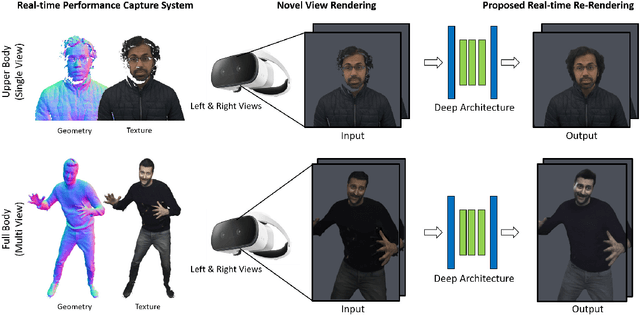

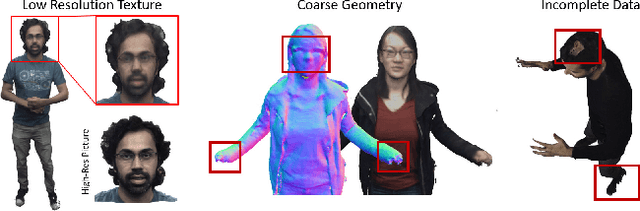
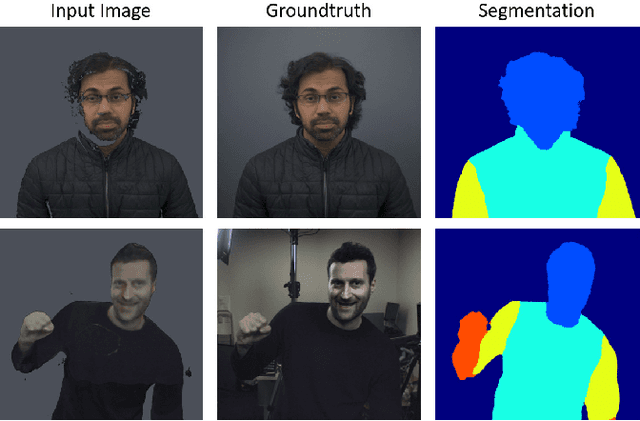
Motivated by augmented and virtual reality applications such as telepresence, there has been a recent focus in real-time performance capture of humans under motion. However, given the real-time constraint, these systems often suffer from artifacts in geometry and texture such as holes and noise in the final rendering, poor lighting, and low-resolution textures. We take the novel approach to augment such real-time performance capture systems with a deep architecture that takes a rendering from an arbitrary viewpoint, and jointly performs completion, super resolution, and denoising of the imagery in real-time. We call this approach neural (re-)rendering, and our live system "LookinGood". Our deep architecture is trained to produce high resolution and high quality images from a coarse rendering in real-time. First, we propose a self-supervised training method that does not require manual ground-truth annotation. We contribute a specialized reconstruction error that uses semantic information to focus on relevant parts of the subject, e.g. the face. We also introduce a salient reweighing scheme of the loss function that is able to discard outliers. We specifically design the system for virtual and augmented reality headsets where the consistency between the left and right eye plays a crucial role in the final user experience. Finally, we generate temporally stable results by explicitly minimizing the difference between two consecutive frames. We tested the proposed system in two different scenarios: one involving a single RGB-D sensor, and upper body reconstruction of an actor, the second consisting of full body 360 degree capture. Through extensive experimentation, we demonstrate how our system generalizes across unseen sequences and subjects. The supplementary video is available at http://youtu.be/Md3tdAKoLGU.