 Add to Chrome
 Add to Firefox
 Add to Edge
GNM Head: A Generative aNthropometric Model of the human head
Jul 26, 2026
Parametric models of the human head are essential tools traditionally used in computer vision and graphics for animation, rendering, and reconstruction. More recently, they serve as crucial conditioning signals within generative large vision models, allowing for tight spatial control of generated imagery. However, existing publicly available models are typically limited in anatomical scope, modeling only outer geometry while ignoring intra-oral and ocular structures, and frequently suffer from reduced geometric quality stemming from low-fidelity input datasets. In this report we introduce a new parametric model dubbed Generative aNthropometric Model (GNM), named as a homophone of the human genome. GNM encompasses the head, face, neck, eyeballs, teeth, and tongue, and it is built on an extensive database of high-resolution 3D scans combined with high-quality anatomy specific artist-made samples. This report details the data provenance, the model architecture including the specialized sub-models for the ocular and intra-oral structures, and shows its SotA performance on fitting target 3D face scans. To foster community innovation, the complete GNM framework is made publicly available.

Computational Design of Cold Bent Glass Façades
Sep 08, 2020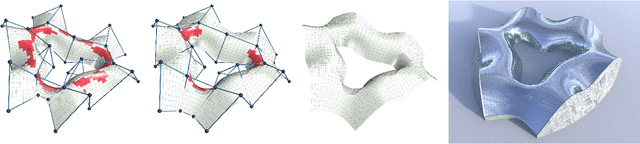
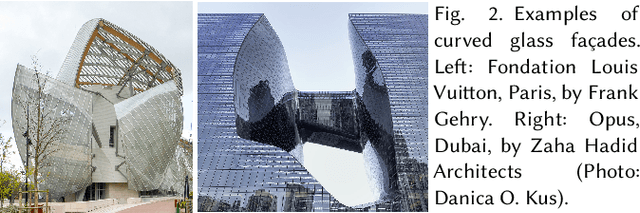
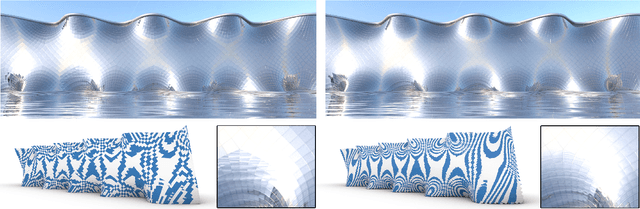
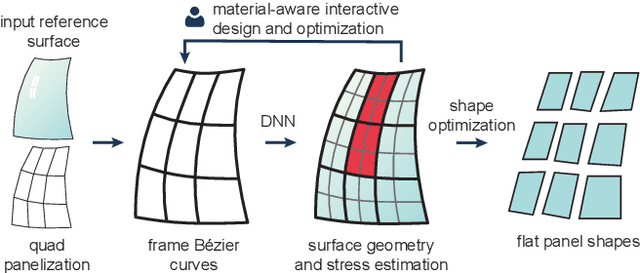
Cold bent glass is a promising and cost-efficient method for realizing doubly curved glass fa\c{c}ades. They are produced by attaching planar glass sheets to curved frames and require keeping the occurring stress within safe limits. However, it is very challenging to navigate the design space of cold bent glass panels due to the fragility of the material, which impedes the form-finding for practically feasible and aesthetically pleasing cold bent glass fa\c{c}ades. We propose an interactive, data-driven approach for designing cold bent glass fa\c{c}ades that can be seamlessly integrated into a typical architectural design pipeline. Our method allows non-expert users to interactively edit a parametric surface while providing real-time feedback on the deformed shape and maximum stress of cold bent glass panels. Designs are automatically refined to minimize several fairness criteria while maximal stresses are kept within glass limits. We achieve interactive frame rates by using a differentiable Mixture Density Network trained from more than a million simulations. Given a curved boundary, our regression model is capable of handling multistable configurations and accurately predicting the equilibrium shape of the panel and its corresponding maximal stress. We show predictions are highly accurate and validate our results with a physical realization of a cold bent glass surface.