 Add to Chrome
 Add to Firefox
 Add to Edge
VideoFlexTok: Flexible-Length Coarse-to-Fine Video Tokenization
Apr 14, 2026
Visual tokenizers map high-dimensional raw pixels into a compressed representation for downstream modeling. Beyond compression, tokenizers dictate what information is preserved and how it is organized. A de facto standard approach to video tokenization is to represent a video as a spatiotemporal 3D grid of tokens, each capturing the corresponding local information in the original signal. This requires the downstream model that consumes the tokens, e.g., a text-to-video model, to learn to predict all low-level details "pixel-by-pixel" irrespective of the video's inherent complexity, leading to high learning complexity. We present VideoFlexTok, which represents videos with a variable-length sequence of tokens structured in a coarse-to-fine manner -- where the first tokens (emergently) capture abstract information, such as semantics and motion, and later tokens add fine-grained details. The generative flow decoder enables realistic video reconstructions from any token count. This representation structure allows adapting the token count according to downstream needs and encoding videos longer than the baselines with the same budget. We evaluate VideoFlexTok on class- and text-to-video generative tasks and show that it leads to more efficient training compared to 3D grid tokens, e.g., achieving comparable generation quality (gFVD and ViCLIP Score) with a 5x smaller model (1.1B vs 5.2B). Finally, we demonstrate how VideoFlexTok can enable long video generation without prohibitive computational cost by training a text-to-video model on 10-second 81-frame videos with only 672 tokens, 8x fewer than a comparable 3D grid tokenizer.

ARKitScenes -- A Diverse Real-World Dataset For 3D Indoor Scene Understanding Using Mobile RGB-D Data
Nov 17, 2021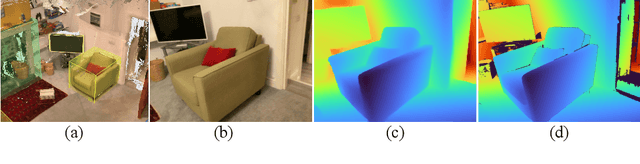
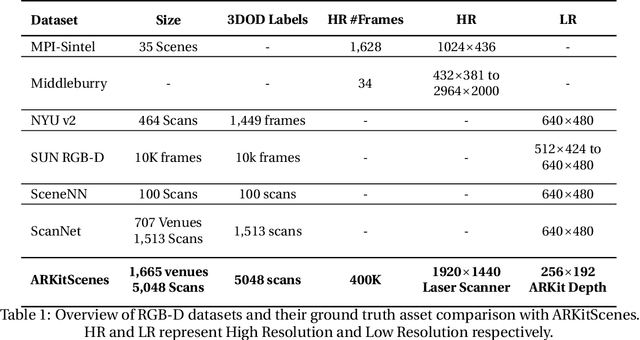
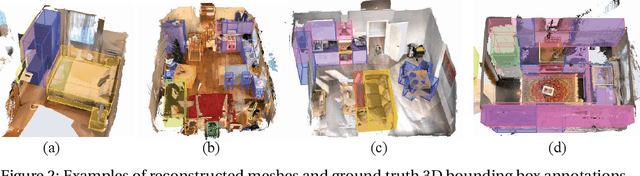
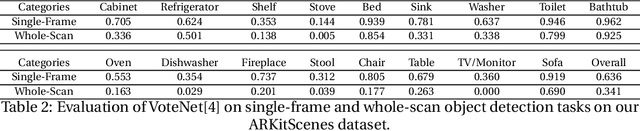
Scene understanding is an active research area. Commercial depth sensors, such as Kinect, have enabled the release of several RGB-D datasets over the past few years which spawned novel methods in 3D scene understanding. More recently with the launch of the LiDAR sensor in Apple's iPads and iPhones, high quality RGB-D data is accessible to millions of people on a device they commonly use. This opens a whole new era in scene understanding for the Computer Vision community as well as app developers. The fundamental research in scene understanding together with the advances in machine learning can now impact people's everyday experiences. However, transforming these scene understanding methods to real-world experiences requires additional innovation and development. In this paper we introduce ARKitScenes. It is not only the first RGB-D dataset that is captured with a now widely available depth sensor, but to our best knowledge, it also is the largest indoor scene understanding data released. In addition to the raw and processed data from the mobile device, ARKitScenes includes high resolution depth maps captured using a stationary laser scanner, as well as manually labeled 3D oriented bounding boxes for a large taxonomy of furniture. We further analyze the usefulness of the data for two downstream tasks: 3D object detection and color-guided depth upsampling. We demonstrate that our dataset can help push the boundaries of existing state-of-the-art methods and it introduces new challenges that better represent real-world scenarios.