 Add to Chrome
 Add to Firefox
 Add to Edge
FedCoRe: Target-Adaptive Completion for Missing Modalities in Healthcare Federated Learning
Aug 18, 2026
Federated multimodal models often assume every site has every modality, although hospitals differ in access to EHRs, chest radiographs, and ECGs. We study this setting on a MIMIC-derived respiratory deterioration task with simulated FL clients and introduce FedCoRe (Federated Cross-Modal Representation Completion). FedCoRe learns representation- or logit-space corrections rather than generating synthetic ECGs or CXR images. When a client observes a modality that may be missing at deployment, it evaluates the same example with and without that modality to obtain paired supervision. Only clients with such pairs update the completion module, and validation may retain the unchanged prediction. We freeze the trained multimodal predictor during evaluation so that measured differences come only from completion. Hiding ECG reduced AUROC by about 0.085; paired-example FedAvg restored 0.0415 AUROC, or 49.0% of the lost performance. We therefore report two distinct effects: paired-example FedAvg partially recovers the missing-ECG gap, while validation-selected completion is a task-specific classifier-logit correction rather than literal ECG recovery. For CXR, effect-aware completion recovers 52.8% of the loss in a controlled test where CXR is hidden. Paired-example FedAvg transfers part of this effect, but validation keeps the no-completion baseline for deployment cases whose inputs lack CXR. Thus, FedCoRe should be read as a validation-gated completion/correction framework: it can recover missing-modality signal in supported settings, but it should be deployed only when paired examples and validation evidence support that modality.

Auto-FL-Research: Agentic Search for Federated Learning Algorithms
Jul 01, 2026Federated learning (FL) research often depends on many small but consequential algorithmic choices: optimizer variants, server aggregation rules, local training schedules, normalization, regularization, and model architecture. These choices are expensive to explore manually and difficult to compare fairly when candidate changes can also alter the FL training or evaluation path. In this work, we present Auto-FL-Research (AFR), a constrained coding-agent workflow for FL algorithmic recipe search. Agents may propose and implement candidate training algorithms, including server aggregation rules, client update schedules, local objectives, and registered model variants, while task profiles fix the mutation surface, compute budget, communication contract, and final model evaluation. Each campaign records candidate scores, runtime, edited files, artifacts, and failure status. We evaluate AFR on five healthcare cross-silo FLamby tasks and on grouped-client profiles for the five fixed LEAF datasets plus the LEAF synthetic task. Five-seed repeat evaluations support gains on four FLamby tasks and five of six LEAF profiles, while also exposing seed-sensitive and search-selected failure cases. Same-budget controls show that several gains correspond to FL-recipe changes, whereas other improvements are recovered by fixed-surface scalar controls or fail under repeat or held-out evaluation. These mixed outcomes are part of the contribution: they show how agent-generated candidates can be separated into repeated FL mechanisms, fixed-surface tuning effects, and selected single-run artifacts.
Network-Efficient Distributed Word2vec Training System for Large Vocabularies
Jun 27, 2016
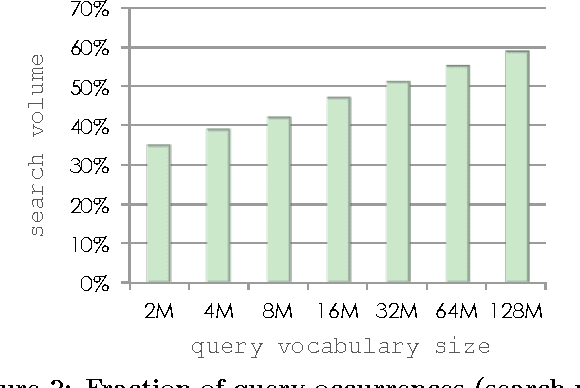

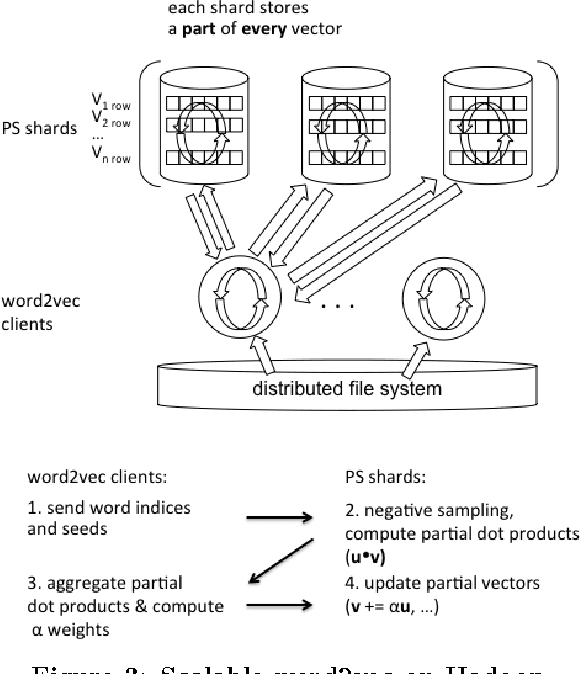
Word2vec is a popular family of algorithms for unsupervised training of dense vector representations of words on large text corpuses. The resulting vectors have been shown to capture semantic relationships among their corresponding words, and have shown promise in reducing a number of natural language processing (NLP) tasks to mathematical operations on these vectors. While heretofore applications of word2vec have centered around vocabularies with a few million words, wherein the vocabulary is the set of words for which vectors are simultaneously trained, novel applications are emerging in areas outside of NLP with vocabularies comprising several 100 million words. Existing word2vec training systems are impractical for training such large vocabularies as they either require that the vectors of all vocabulary words be stored in the memory of a single server or suffer unacceptable training latency due to massive network data transfer. In this paper, we present a novel distributed, parallel training system that enables unprecedented practical training of vectors for vocabularies with several 100 million words on a shared cluster of commodity servers, using far less network traffic than the existing solutions. We evaluate the proposed system on a benchmark dataset, showing that the quality of vectors does not degrade relative to non-distributed training. Finally, for several quarters, the system has been deployed for the purpose of matching queries to ads in Gemini, the sponsored search advertising platform at Yahoo, resulting in significant improvement of business metrics.