 Add to Chrome
 Add to Firefox
 Add to Edge
LTM: Large-scale Terrain Model for Wildfire-prone Landscapes
Jul 09, 2026
Accurate 3D terrain maps are essential for emergency response when assessing wildfire hazards. However, wildfire-prone regions often span vast areas where conventional reconstruction methods underperform. Airborne LiDAR systems provide high-resolution terrain data, but they are expensive and infrequently updated. Image-based methods offer a lower-cost alternative, but struggle due to sparse visual features and limited image overlap. We propose a multi-modal reconstruction framework leveraging outdated Digital Elevation Models (DEMs) as geometric priors for image-based 3D reconstruction. Our key innovation is physics-based pixel-pixel alignment between images and DEM data, dramatically reducing computational complexity by eliminating expensive feature matching procedures. To validate our approach, we developed a large-terrain simulator based on a real wildfire-prone area, generating realistic images enabling a comprehensive evaluation. Given posed images and legacy DEMs, our method produces high-fidelity depth maps while maintaining real-time performance. We find significant improvements in reconstruction accuracy and computational efficiency over existing techniques, offering a scalable solution for wildfire response.

AFLoRA: Adaptive Freezing of Low Rank Adaptation in Parameter Efficient Fine-Tuning of Large Models
Mar 20, 2024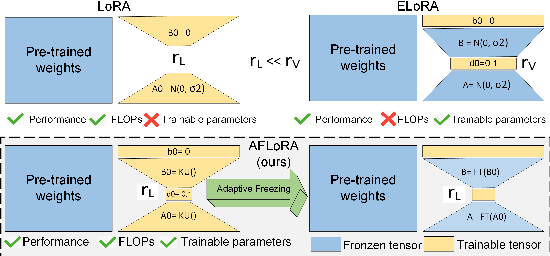
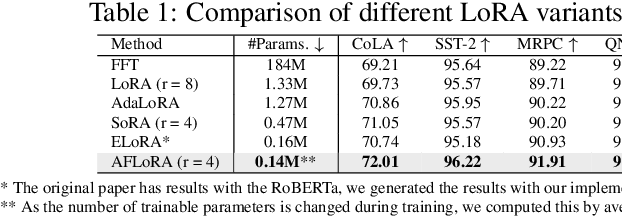


We present a novel Parameter-Efficient Fine-Tuning (PEFT) method, dubbed as Adaptive Freezing of Low Rank Adaptation (AFLoRA). Specifically, for each pre-trained frozen weight tensor, we add a parallel path of trainable low-rank matrices, namely a down-projection and an up-projection matrix, each of which is followed by a feature transformation vector. Based on a novel freezing score, we the incrementally freeze these projection matrices during fine-tuning to reduce the computation and alleviate over-fitting. Our experimental results demonstrate that we can achieve state-of-the-art performance with an average improvement of up to $0.85\%$ as evaluated on GLUE benchmark while yeilding up to $9.5\times$ fewer average trainable parameters. While compared in terms of runtime, AFLoRA can yield up to $1.86\times$ improvement as opposed to similar PEFT alternatives. Besides the practical utility of our approach, we provide insights on the trainability requirements of LoRA paths at different modules and the freezing schedule for the different projection matrices. Code will be released.
LMUFormer: Low Complexity Yet Powerful Spiking Model With Legendre Memory Units
Jan 20, 2024
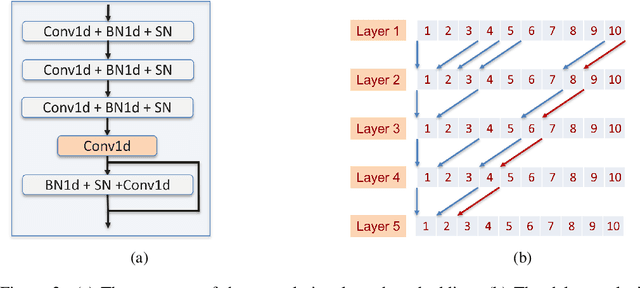
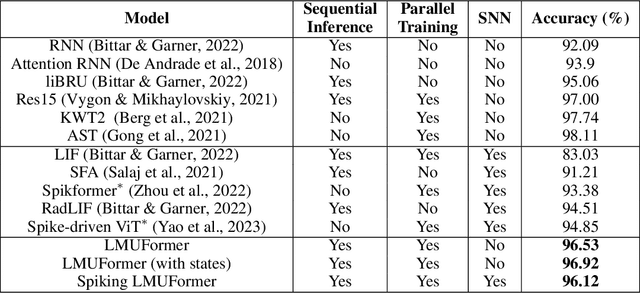
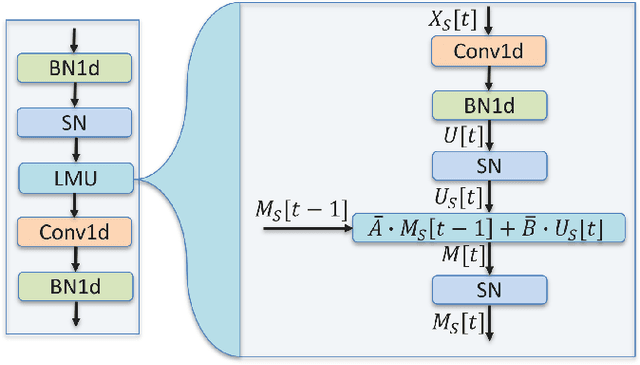
Transformer models have demonstrated high accuracy in numerous applications but have high complexity and lack sequential processing capability making them ill-suited for many streaming applications at the edge where devices are heavily resource-constrained. Thus motivated, many researchers have proposed reformulating the transformer models as RNN modules which modify the self-attention computation with explicit states. However, these approaches often incur significant performance degradation. The ultimate goal is to develop a model that has the following properties: parallel training, streaming and low-cost inference, and SOTA performance. In this paper, we propose a new direction to achieve this goal. We show how architectural modifications to a recurrent model can help push its performance toward Transformer models while retaining its sequential processing capability. Specifically, inspired by the recent success of Legendre Memory Units (LMU) in sequence learning tasks, we propose LMUFormer, which augments the LMU with convolutional patch embedding and convolutional channel mixer. Moreover, we present a spiking version of this architecture, which introduces the benefit of states within the patch embedding and channel mixer modules while simultaneously reducing the computing complexity. We evaluated our architectures on multiple sequence datasets. In comparison to SOTA transformer-based models within the ANN domain on the SCv2 dataset, our LMUFormer demonstrates comparable performance while necessitating a remarkable 53 times reduction in parameters and a substantial 65 times decrement in FLOPs. Additionally, owing to our model's proficiency in real-time data processing, we can achieve a 32.03% reduction in sequence length, all while incurring an inconsequential decline in performance. Our code is publicly available at https://github.com/zeyuliu1037/LMUFormer.git.