 Add to Chrome
 Add to Firefox
 Add to Edge
Registration-Grounded Spectral Fusion for Unregistered WLI/NBI Endoscopic Lesion Segmentation
Jul 29, 2026
White-light imaging (WLI) and narrow-band imaging (NBI) provide complementary views of endoscopic lesions, but their paired observations are often spatially misaligned due to viewpoint changes, tissue deformation, and sequential handheld acquisition. This makes direct WLI/NBI fusion prone to mixing non-corresponding regions and may even degrade segmentation around lesion boundaries. To address this problem, we propose a reliability-aware complex-domain fusion framework for paired-but-unregistered WLI/NBI lesion segmentation. The framework first establishes topology-regularized feature correspondence and further estimates where the cross-modal correspondence is reliable. Guided by this reliability, the model selectively fuses WLI and NBI features in a learnable complex representation. In this representation, WLI-derived cues mainly provide appearance-related magnitude responses, while NBI-derived cues provide structure-sensitive phase responses. Unlike conventional real-valued or symmetric multimodal fusion, the proposed method explicitly models the different roles of WLI and NBI and suppresses unreliable cross-modal interaction in locally mismatched regions. Experiments on paired WLI/NBI endoscopic datasets show that the proposed reliability-aware registration grounding and complex-domain fusion consistently improve lesion segmentation performance. Role-reversal and module ablation studies further validate the necessity of both the modality-role design and reliability-guided cross-modal interaction.

SOFTooth: Semantics-Enhanced Order-Aware Fusion for Tooth Instance Segmentation
Dec 29, 2025Three-dimensional (3D) tooth instance segmentation remains challenging due to crowded arches, ambiguous tooth-gingiva boundaries, missing teeth, and rare yet clinically important third molars. Native 3D methods relying on geometric cues often suffer from boundary leakage, center drift, and inconsistent tooth identities, especially for minority classes and complex anatomies. Meanwhile, 2D foundation models such as the Segment Anything Model (SAM) provide strong boundary-aware semantics, but directly applying them in 3D is impractical in clinical workflows. To address these issues, we propose SOFTooth, a semantics-enhanced, order-aware 2D-3D fusion framework that leverages frozen 2D semantics without explicit 2D mask supervision. First, a point-wise residual gating module injects occlusal-view SAM embeddings into 3D point features to refine tooth-gingiva and inter-tooth boundaries. Second, a center-guided mask refinement regularizes consistency between instance masks and geometric centroids, reducing center drift. Furthermore, an order-aware Hungarian matching strategy integrates anatomical tooth order and center distance into similarity-based assignment, ensuring coherent labeling even under missing or crowded dentitions. On 3DTeethSeg'22, SOFTooth achieves state-of-the-art overall accuracy and mean IoU, with clear gains on cases involving third molars, demonstrating that rich 2D semantics can be effectively transferred to 3D tooth instance segmentation without 2D fine-tuning.
MFP-CLIP: Exploring the Efficacy of Multi-Form Prompts for Zero-Shot Industrial Anomaly Detection
Mar 17, 2025Recently, zero-shot anomaly detection (ZSAD) has emerged as a pivotal paradigm for identifying defects in unseen categories without requiring target samples in training phase. However, existing ZSAD methods struggle with the boundary of small and complex defects due to insufficient representations. Most of them use the single manually designed prompts, failing to work for diverse objects and anomalies. In this paper, we propose MFP-CLIP, a novel prompt-based CLIP framework which explores the efficacy of multi-form prompts for zero-shot industrial anomaly detection. We employ an image to text prompting(I2TP) mechanism to better represent the object in the image. MFP-CLIP enhances perception to multi-scale and complex anomalies by self prompting(SP) and a multi-patch feature aggregation(MPFA) module. To precisely localize defects, we introduce the mask prompting(MP) module to guide model to focus on potential anomaly regions. Extensive experiments are conducted on two wildly used industrial anomaly detection benchmarks, MVTecAD and VisA, demonstrating MFP-CLIP's superiority in ZSAD.
A Point-Neighborhood Learning Framework for Nasal Endoscope Image Segmentation
May 30, 2024
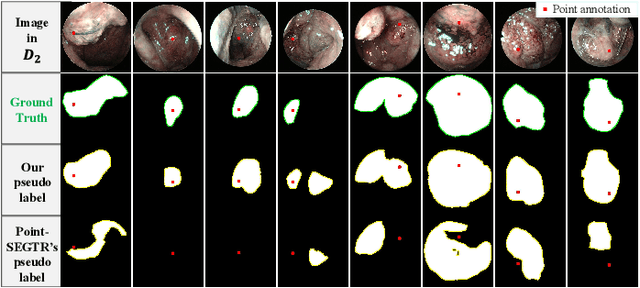

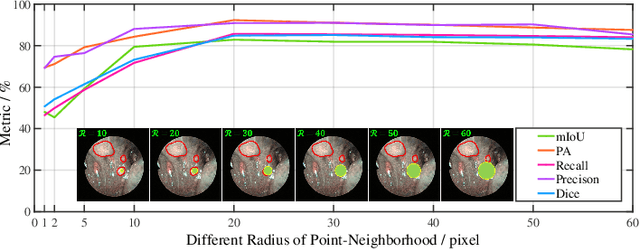
The lesion segmentation on endoscopic images is challenging due to its complex and ambiguous features. Fully-supervised deep learning segmentation methods can receive good performance based on entirely pixel-level labeled dataset but greatly increase experts' labeling burden. Semi-supervised and weakly supervised methods can ease labeling burden, but heavily strengthen the learning difficulty. To alleviate this difficulty, weakly semi-supervised segmentation adopts a new annotation protocol of adding a large number of point annotation samples into a few pixel-level annotation samples. However, existing methods only mine points' limited information while ignoring reliable prior surrounding the point annotations. In this paper, we propose a weakly semi-supervised method called Point-Neighborhood Learning (PNL) framework. To mine the prior of the pixels surrounding the annotated point, we transform a single-point annotation into a circular area named a point-neighborhood. We propose point-neighborhood supervision loss and pseudo-label scoring mechanism to enhance training supervision. Point-neighborhoods are also used to augment the data diversity. Our method greatly improves performance without changing the structure of segmentation network. Comprehensive experiments show the superiority of our method over the other existing methods, demonstrating its effectiveness in point-annotated medical images. The project code will be available on: https://github.com/ParryJay/PNL.