 Add to Chrome
 Add to Firefox
 Add to Edge
GenVideoLens: Where LVLMs Fall Short in AI-Generated Video Detection?
Mar 19, 2026
In recent years, AI-generated videos have become increasingly realistic and sophisticated. Meanwhile, Large Vision-Language Models (LVLMs) have shown strong potential for detecting such content. However, existing evaluation protocols largely treat the task as a binary classification problem and rely on coarse-grained metrics such as overall accuracy, providing limited insight into where LVLMs succeed or fail. To address this limitation, we introduce GenVideoLens, a fine-grained benchmark that enables dimension-wise evaluation of LVLM capabilities in AI-generated video detection. The benchmark contains 400 highly deceptive AI-generated videos and 100 real videos, annotated by experts across 15 authenticity dimensions covering perceptual, optical, physical, and temporal cues. We evaluate eleven representative LVLMs on this benchmark. Our analysis reveals a pronounced dimensional imbalance. While LVLMs perform relatively well on perceptual cues, they struggle with optical consistency, physical interactions, and temporal-causal reasoning. Model performance also varies substantially across dimensions, with smaller open-source models sometimes outperforming stronger proprietary models on specific authenticity cues. Temporal perturbation experiments further show that current LVLMs make limited use of temporal information. Overall, GenVideoLens provides diagnostic insights into LVLM behavior, revealing key capability gaps and offering guidance for improving future AI-generated video detection systems.

InstaStyle: Inversion Noise of a Stylized Image is Secretly a Style Adviser
Nov 25, 2023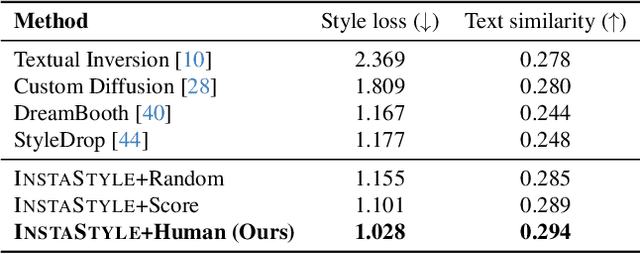
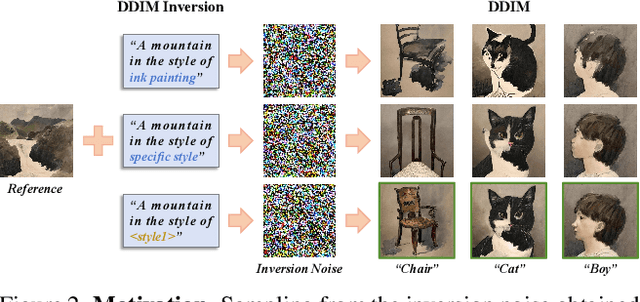
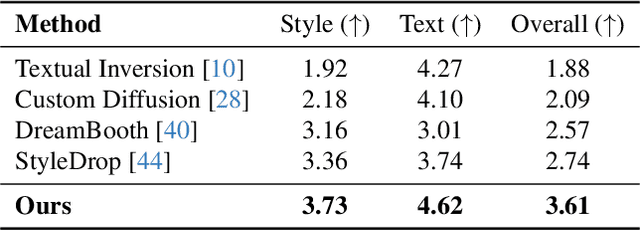
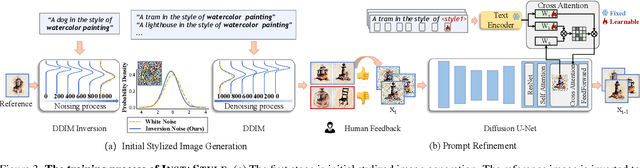
Stylized text-to-image generation focuses on creating images from textual descriptions while adhering to a style specified by a few reference images. However, subtle style variations within different reference images can hinder the model from accurately learning the target style. In this paper, we propose InstaStyle, a novel approach that excels in generating high-fidelity stylized images with only a single reference image. Our approach is based on the finding that the inversion noise from a stylized reference image inherently carries the style signal, as evidenced by their non-zero signal-to-noise ratio. We employ DDIM inversion to extract this noise from the reference image and leverage a diffusion model to generate new stylized images from the ``style" noise. Additionally, the inherent ambiguity and bias of textual prompts impede the precise conveying of style. To address this, we introduce a learnable style token via prompt refinement, which enhances the accuracy of the style description for the reference image. Qualitative and quantitative experimental results demonstrate that InstaStyle achieves superior performance compared to current benchmarks. Furthermore, our approach also showcases its capability in the creative task of style combination with mixed inversion noise.