 Add to Chrome
 Add to Firefox
 Add to Edge
Autonomous Telerehabilitation via Skeletal Motion Prediction and Joint-Level Performance Assessment
Aug 12, 2026
Autonomous rehabilitation systems must not only recognize human motion but also provide structured feedback to support users without continuous therapist supervision. This paper presents a telerehabilitation pipeline that integrates skeleton-based exercise quality assessment and short-term motion prediction into a two-module system operating on marker-free RGB video. A self-attentive Bidirectional LSTM performs exercise quality classification using MMD-NCA metric learning, while a graph-based motion prediction module computes per-joint position errors between predicted and observed poses, generating spatially localized deviation signals. Each module is evaluated independently on established benchmarks: the classifier achieves 96.45% mean-class accuracy on squat sequences from the PROZIS dataset, and the adopted STARS predictor achieves a mean MPJPE of 75.8 mm at 560 ms on Human3.6M, outperforming graph and recurrent baselines across all prediction horizons. The framework is designed for eventual deployment in assistive robotics and home-based rehabilitation contexts; end-to-end integration and clinical validation are important directions for future work. By combining motion recognition and prediction in a single system, this work contributes a step toward autonomous, feedback-driven telerehabilitation, for more accessible and scalable rehabilitation solutions.

Beyond Reprojection Error: Camera Calibration with 3D Targets
Aug 05, 2026In 3D reconstruction, camera calibration is an essential element for achieving high fidelity and accuracy of the reconstructed geometry. While existing approaches rely upon 2D planar calibration, this work proposes a framework tailored for 3D reconstruction that is based on predicting scene rays, which adds flexibility to the reconstruction pipeline and enables the use of recent advances in camera models. Novel metrics, reconstruction and intersection error, derived from predicted scene rays are employed in combination with a bootstrapping procedure that statistically evaluates different calibration objects and calibration pipelines for both intrinsic and extrinsic camera parameters. The results show that the generalized distortion model more faithfully captures physical camera effects and yields an improvement in calibration accuracy. Reprojection error is shown to be a potentially misleading indicator of 3D accuracy, and the proposed ray-based metrics provide a more holistic assessment. An icosahedron calibration target is designed to enrich calibration information for 3D reconstruction together with a ring-feature-based detector. The icosahedral target yields approximately 40% lower mean intersection and more stable calibration across bootstrap trials on synthetic data, while real-data performance demands very tight fabrication tolerances.
QuadRocket: An Aerial Robotic Testbed for Adaptive Thrust-Vector Control of Rocket-Like Vehicles
Jul 02, 2026This paper presents QuadRocket, a quadrotor-based rocket prototype that provides a low-cost, low-risk platform for validating advanced thrust-vector control strategies for launch vehicle-type systems. The prototype consists of a cylindrical main body mounted on top of a quadrotor through a universal joint, forming a flying inverted pendulum with non-negligible inertia. For control design, the coupled system is modeled as a single axisymmetric rigid body actuated by a vectored force applied along its longitudinal axis. A reduced-attitude representation on the two sphere is adopted to explicitly exploit the vehicle's axial symmetry and to decouple yaw from the thrust-vector direction. On this model, we derive an adaptive backstepping controller that achieves almost global trajectory tracking in the presence of unknown constant disturbances, while a control-point transformation mitigates non minimum-phase behavior. The quadrotor is then treated as a thrust vector actuator, and a dynamic-surface-based attitude controller is designed to track the desired thrust-vector, accounting for actuation dynamics and avoiding explicit differentiation of virtual control signals. The complete architecture is evaluated in simulation and validated experimentally in an indoor motion-capture arena. Results demonstrate accurate trajectory tracking, effective disturbance compensation, and confirm the suitability of the QuadRocket as a versatile testbed for thrust-vector-controlled robotic vehicles.
Secure Visual Data Processing via Federated Learning
Feb 09, 2025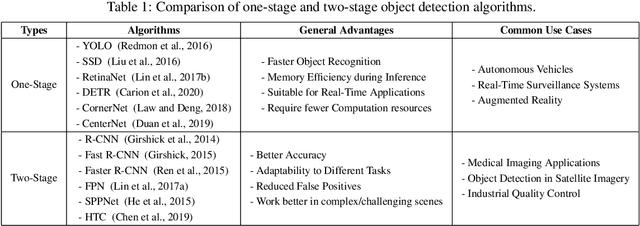
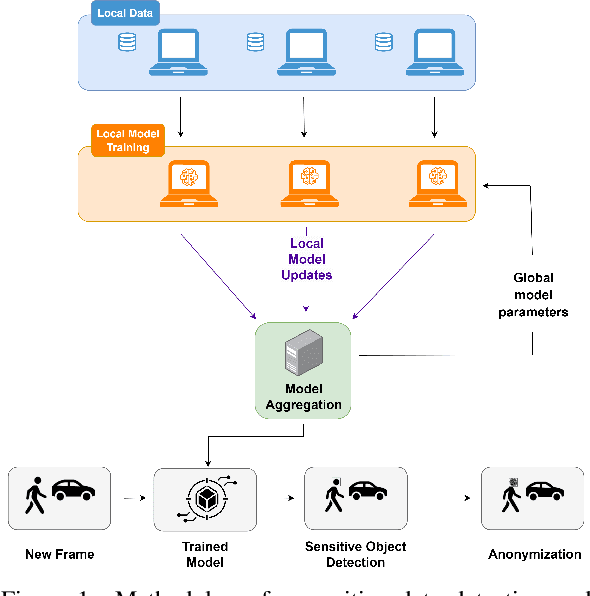
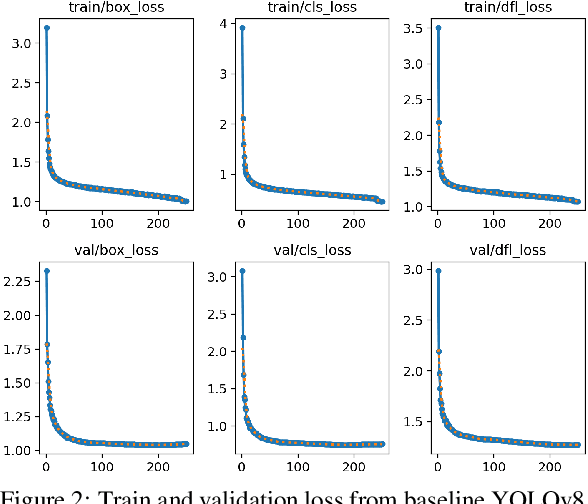
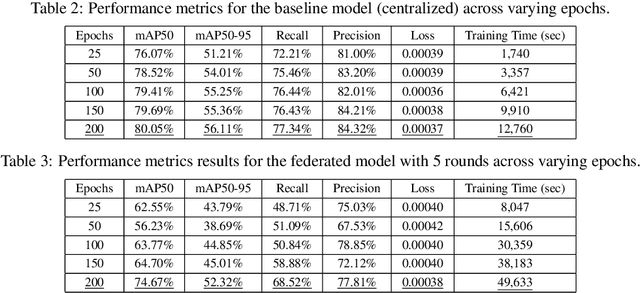
As the demand for privacy in visual data management grows, safeguarding sensitive information has become a critical challenge. This paper addresses the need for privacy-preserving solutions in large-scale visual data processing by leveraging federated learning. Although there have been developments in this field, previous research has mainly focused on integrating object detection with either anonymization or federated learning. However, these pairs often fail to address complex privacy concerns. On the one hand, object detection with anonymization alone can be vulnerable to reverse techniques. On the other hand, federated learning may not provide sufficient privacy guarantees. Therefore, we propose a new approach that combines object detection, federated learning and anonymization. Combining these three components aims to offer a robust privacy protection strategy by addressing different vulnerabilities in visual data. Our solution is evaluated against traditional centralized models, showing that while there is a slight trade-off in accuracy, the privacy benefits are substantial, making it well-suited for privacy sensitive applications.
Anxolotl, an Anxiety Companion App -- Stress Detection
Jan 03, 2023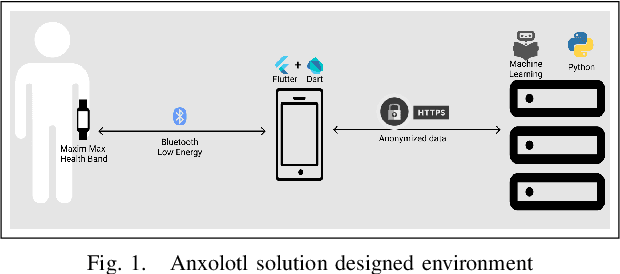
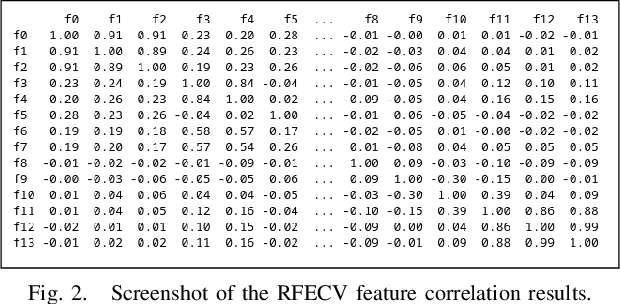
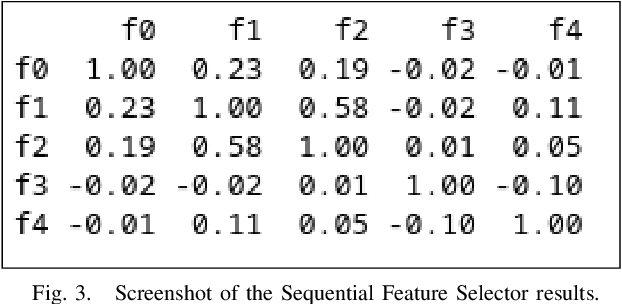
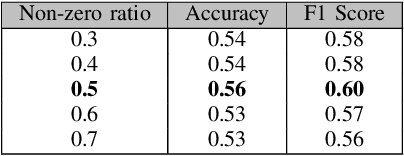
Stress has a great effect on people's lives that can not be understated. While it can be good, since it helps humans to adapt to new and different situations, it can also be harmful when not dealt with properly, leading to chronic stress. The objective of this paper is developing a stress monitoring solution, that can be used in real life, while being able to tackle this challenge in a positive way. The SMILE data set was provided to team Anxolotl, and all it was needed was to develop a robust model. We developed a supervised learning model for classification in Python, presenting the final result of 64.1% in accuracy and a f1-score of 54.96%. The resulting solution stood the robustness test, presenting low variation between runs, which was a major point for it's possible integration in the Anxolotl app in the future.