 Add to Chrome
 Add to Firefox
 Add to Edge
TinyDETR-Pose: Towards End-to-End Real-Time Single-Stage 6DoF Object Pose Estimation with Lightweight Transformers
Aug 15, 2026
Real-time 6DoF object pose estimation on resource-constrained hardware remains challenging, as accurate correspondence-based and refinement pipelines typically rely on non-differentiable PnP/RANSAC stages or costly iterative refinement, while recent foundation-model-based approaches incur inference costs that are prohibitive for edge deployment. We present TinyDETR-Pose, a lightweight, end-to-end, single-stage framework that jointly detects objects and regresses their full 6D pose in a single forward pass. Built on the efficient LW-DETR architecture, TinyDETR-Pose formulates detection and pose estimation as a set-prediction problem and attaches dedicated MLP heads for rotation, monocular depth, and projected object center regression to each decoder query, eliminating the need for PnP, NMS (non-maximum suppression), or iterative pose refinement. Object symmetries are handled through a ADD-S loss applied uniformly to all objects, without the need for object-specific loss schedules or separate geodesic/ADD supervision. In addition, predictions are assigned to ground truth using a symmetry-safe Hungarian matcher based on class and 2D spatial cues, yielding stable assignment under symmetry and depth ambiguity. On YCB-V, TinyDETR-Pose achieves a comparable ADD-S AUC of 85.9, while requiring up to 72.7% fewer parameters than other DETR-based single-stage pose-estimation approaches. Due to its compact design, TinyDETR-Pose runs in real time and achieves an inference latency of only ~4.5 ms per frame on an NVIDIA Jetson Nano using TensorRT, demonstrating that accurate end-to-end transformer-based 6D pose estimation can be made practical for edge deployment.

Beyond Reprojection Error: Camera Calibration with 3D Targets
Aug 05, 2026In 3D reconstruction, camera calibration is an essential element for achieving high fidelity and accuracy of the reconstructed geometry. While existing approaches rely upon 2D planar calibration, this work proposes a framework tailored for 3D reconstruction that is based on predicting scene rays, which adds flexibility to the reconstruction pipeline and enables the use of recent advances in camera models. Novel metrics, reconstruction and intersection error, derived from predicted scene rays are employed in combination with a bootstrapping procedure that statistically evaluates different calibration objects and calibration pipelines for both intrinsic and extrinsic camera parameters. The results show that the generalized distortion model more faithfully captures physical camera effects and yields an improvement in calibration accuracy. Reprojection error is shown to be a potentially misleading indicator of 3D accuracy, and the proposed ray-based metrics provide a more holistic assessment. An icosahedron calibration target is designed to enrich calibration information for 3D reconstruction together with a ring-feature-based detector. The icosahedral target yields approximately 40% lower mean intersection and more stable calibration across bootstrap trials on synthetic data, while real-data performance demands very tight fabrication tolerances.
RangeSAM: Leveraging Visual Foundation Models for Range-View repesented LiDAR segmentation
Sep 19, 2025Point cloud segmentation is central to autonomous driving and 3D scene understanding. While voxel- and point-based methods dominate recent research due to their compatibility with deep architectures and ability to capture fine-grained geometry, they often incur high computational cost, irregular memory access, and limited real-time efficiency. In contrast, range-view methods, though relatively underexplored - can leverage mature 2D semantic segmentation techniques for fast and accurate predictions. Motivated by the rapid progress in Visual Foundation Models (VFMs) for captioning, zero-shot recognition, and multimodal tasks, we investigate whether SAM2, the current state-of-the-art VFM for segmentation tasks, can serve as a strong backbone for LiDAR point cloud segmentation in the range view. We present , to our knowledge, the first range-view framework that adapts SAM2 to 3D segmentation, coupling efficient 2D feature extraction with standard projection/back-projection to operate on point clouds. To optimize SAM2 for range-view representations, we implement several architectural modifications to the encoder: (1) a novel module that emphasizes horizontal spatial dependencies inherent in LiDAR range images, (2) a customized configuration of tailored to the geometric properties of spherical projections, and (3) an adapted mechanism in the encoder backbone specifically designed to capture the unique spatial patterns and discontinuities present in range-view pseudo-images. Our approach achieves competitive performance on SemanticKITTI while benefiting from the speed, scalability, and deployment simplicity of 2D-centric pipelines. This work highlights the viability of VFMs as general-purpose backbones for 3D perception and opens a path toward unified, foundation-model-driven LiDAR segmentation. Results lets us conclude that range-view segmentation methods using VFMs leads to promising results.
Neural Restoration of Greening Defects in Historical Autochrome Photographs Based on Purely Synthetic Data
May 28, 2025The preservation of early visual arts, particularly color photographs, is challenged by deterioration caused by aging and improper storage, leading to issues like blurring, scratches, color bleeding, and fading defects. In this paper, we present the first approach for the automatic removal of greening color defects in digitized autochrome photographs. Our main contributions include a method based on synthetic dataset generation and the use of generative AI with a carefully designed loss function for the restoration of visual arts. To address the lack of suitable training datasets for analyzing greening defects in damaged autochromes, we introduce a novel approach for accurately simulating such defects in synthetic data. We also propose a modified weighted loss function for the ChaIR method to account for color imbalances between defected and non-defected areas. While existing methods struggle with accurately reproducing original colors and may require significant manual effort, our method allows for efficient restoration with reduced time requirements.
Semantic Segmentation of Transparent and Opaque Drinking Glasses with the Help of Zero-shot Learning
Mar 19, 2025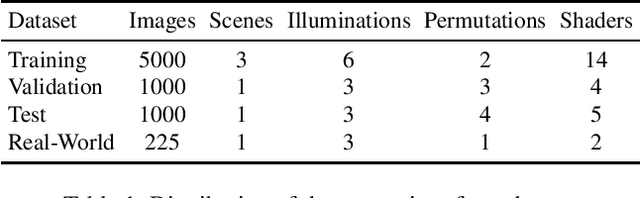
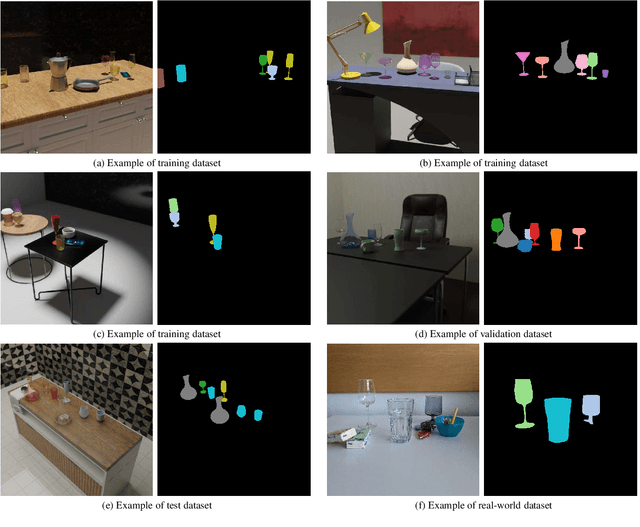
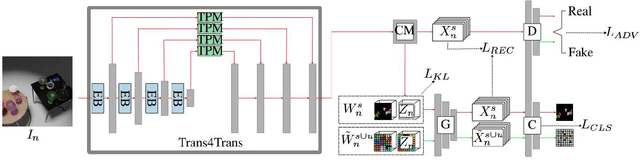
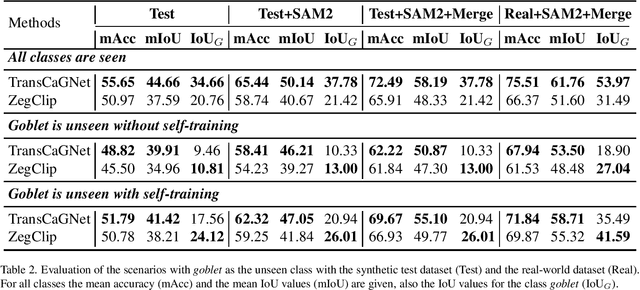
Segmenting transparent structures in images is challenging since they are difficult to distinguish from the background. Common examples are drinking glasses, which are a ubiquitous part of our lives and appear in many different shapes and sizes. In this work we propose TransCaGNet, a modified version of the zero-shot model CaGNet. We exchange the segmentation backbone with the architecture of Trans4Trans to be capable of segmenting transparent objects. Since some glasses are rarely captured, we use zeroshot learning to be able to create semantic segmentations of glass categories not given during training. We propose a novel synthetic dataset covering a diverse set of different environmental conditions. Additionally we capture a real-world evaluation dataset since most applications take place in the real world. Comparing our model with Zeg-Clip we are able to show that TransCaGNet produces better mean IoU and accuracy values while ZegClip outperforms it mostly for unseen classes. To improve the segmentation results, we combine the semantic segmentation of the models with the segmentation results of SAM 2. Our evaluation emphasizes that distinguishing between different classes is challenging for the models due to similarity, points of view, or coverings. Taking this behavior into account, we assign glasses multiple possible categories. The modification leads to an improvement up to 13.68% for the mean IoU and up to 17.88% for the mean accuracy values on the synthetic dataset. Using our difficult synthetic dataset for training, the models produce even better results on the real-world dataset. The mean IoU is improved up to 5.55% and the mean accuracy up to 5.72% on the real-world dataset.
Improving 6D Object Pose Estimation of metallic Household and Industry Objects
Mar 05, 2025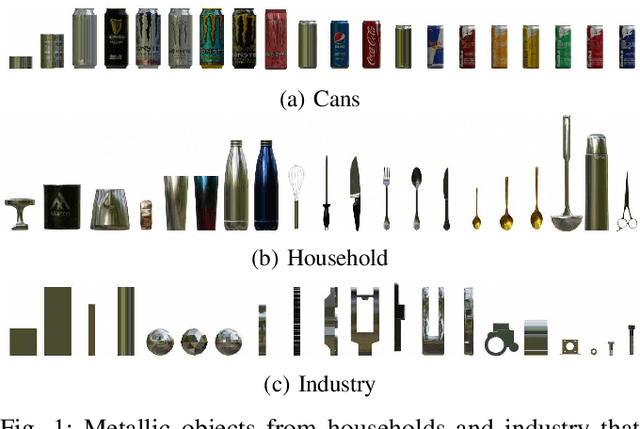
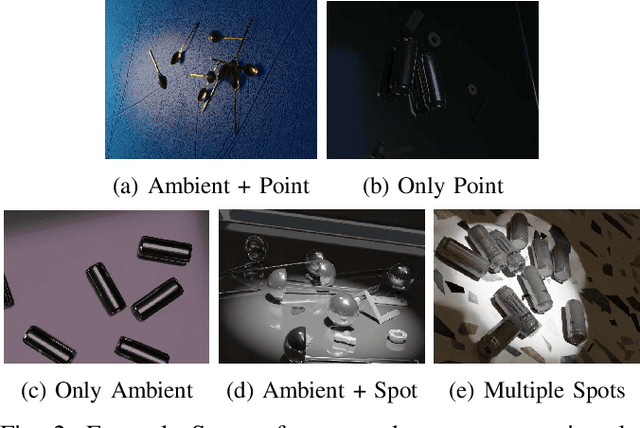
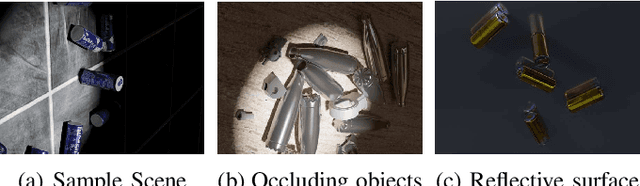
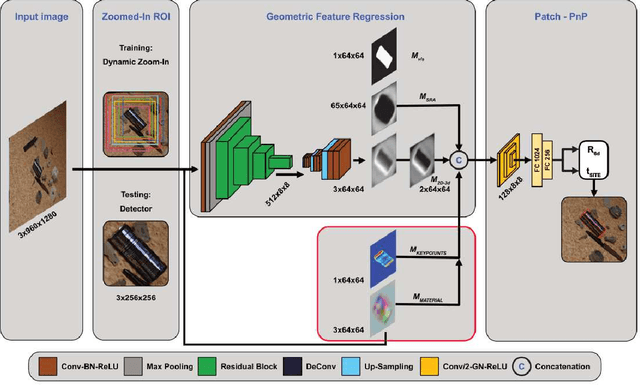
6D object pose estimation suffers from reduced accuracy when applied to metallic objects. We set out to improve the state-of-the-art by addressing challenges such as reflections and specular highlights in industrial applications. Our novel BOP-compatible dataset, featuring a diverse set of metallic objects (cans, household, and industrial items) under various lighting and background conditions, provides additional geometric and visual cues. We demonstrate that these cues can be effectively leveraged to enhance overall performance. To illustrate the usefulness of the additional features, we improve upon the GDRNPP algorithm by introducing an additional keypoint prediction and material estimator head in order to improve spatial scene understanding. Evaluations on the new dataset show improved accuracy for metallic objects, supporting the hypothesis that additional geometric and visual cues can improve learning.
EfficientPose 6D: Scalable and Efficient 6D Object Pose Estimation
Feb 19, 2025In industrial applications requiring real-time feedback, such as quality control and robotic manipulation, the demand for high-speed and accurate pose estimation remains critical. Despite advances improving speed and accuracy in pose estimation, finding a balance between computational efficiency and accuracy poses significant challenges in dynamic environments. Most current algorithms lack scalability in estimation time, especially for diverse datasets, and the state-of-the-art (SOTA) methods are often too slow. This study focuses on developing a fast and scalable set of pose estimators based on GDRNPP to meet or exceed current benchmarks in accuracy and robustness, particularly addressing the efficiency-accuracy trade-off essential in real-time scenarios. We propose the AMIS algorithm to tailor the utilized model according to an application-specific trade-off between inference time and accuracy. We further show the effectiveness of the AMIS-based model choice on four prominent benchmark datasets (LM-O, YCB-V, T-LESS, and ITODD).
Leveraging CAM Algorithms for Explaining Medical Semantic Segmentation
Sep 30, 2024

Convolutional neural networks (CNNs) achieve prevailing results in segmentation tasks nowadays and represent the state-of-the-art for image-based analysis. However, the understanding of the accurate decision-making process of a CNN is rather unknown. The research area of explainable artificial intelligence (xAI) primarily revolves around understanding and interpreting this black-box behavior. One way of interpreting a CNN is the use of class activation maps (CAMs) that represent heatmaps to indicate the importance of image areas for the prediction of the CNN. For classification tasks, a variety of CAM algorithms exist. But for segmentation tasks, only one CAM algorithm for the interpretation of the output of a CNN exist. We propose a transfer between existing classification- and segmentation-based methods for more detailed, explainable, and consistent results which show salient pixels in semantic segmentation tasks. The resulting Seg-HiRes-Grad CAM is an extension of the segmentation-based Seg-Grad CAM with the transfer to the classification-based HiRes CAM. Our method improves the previously-mentioned existing segmentation-based method by adjusting it to recently published classification-based methods. Especially for medical image segmentation, this transfer solves existing explainability disadvantages.
* Accepted for publication at the Journal of Machine Learning for Biomedical Imaging (MELBA) https://melba-journal.org/2024:023
End-to-End Probabilistic Geometry-Guided Regression for 6DoF Object Pose Estimation
Sep 18, 20246D object pose estimation is the problem of identifying the position and orientation of an object relative to a chosen coordinate system, which is a core technology for modern XR applications. State-of-the-art 6D object pose estimators directly predict an object pose given an object observation. Due to the ill-posed nature of the pose estimation problem, where multiple different poses can correspond to a single observation, generating additional plausible estimates per observation can be valuable. To address this, we reformulate the state-of-the-art algorithm GDRNPP and introduce EPRO-GDR (End-to-End Probabilistic Geometry-Guided Regression). Instead of predicting a single pose per detection, we estimate a probability density distribution of the pose. Using the evaluation procedure defined by the BOP (Benchmark for 6D Object Pose Estimation) Challenge, we test our approach on four of its core datasets and demonstrate superior quantitative results for EPRO-GDR on LM-O, YCB-V, and ITODD. Our probabilistic solution shows that predicting a pose distribution instead of a single pose can improve state-of-the-art single-view pose estimation while providing the additional benefit of being able to sample multiple meaningful pose candidates.
Influence of Water Droplet Contamination for Transparency Segmentation
May 21, 2024Computer vision techniques are on the rise for industrial applications, like process supervision and autonomous agents, e.g., in the healthcare domain and dangerous environments. While the general usability of these techniques is high, there are still challenging real-world use-cases. Especially transparent structures, which can appear in the form of glass doors, protective casings or everyday objects like glasses, pose a challenge for computer vision methods. This paper evaluates the combination of transparent objects in conjunction with (naturally occurring) contamination through environmental effects like hazing. We introduce a novel publicly available dataset containing 489 images incorporating three grades of water droplet contamination on transparent structures and examine the resulting influence on transparency handling. Our findings show, that contaminated transparent objects are easier to segment and that we are able to distinguish between different severity levels of contamination with a current state-of-the art machine-learning model. This in turn opens up the possibility to enhance computer vision systems regarding resilience against, e.g., datashifts through contaminated protection casings or implement an automated cleaning alert.