 Add to Chrome
 Add to Firefox
 Add to Edge
What Does the AI Doctor Value? Auditing Pluralism in the Clinical Ethics of Language Models
May 18, 2026
Medicine is inherently pluralistic. Principles such as autonomy, beneficence, nonmaleficence, and justice routinely conflict, and such ethical dilemmas often sharply divide reasonable physicians. Good clinical practice navigates these tensions in concert with each patient's values rather than imposing a single ethical stance. The ethical values that large language models bring to medical advice, however, have not been systematically examined. We present a framework for auditing value pluralism in medical AI, comprising a benchmark of clinician-verified dilemmas and an attribution method that recovers value priorities directly from decisions. The ecosystem of frontier models spans physician-level value heterogeneity, and models discuss competing values in their reasoning (Overton pluralism) before committing to a decision. However, individual model decisions are near-deterministic across repeated sampling and semantic variations, failing to reproduce the distributional pluralism of the physician panel. Across benchmark cases, these consistent decisions reflect committed, systematic value preferences. While most model priorities fall within the natural range of inter-physician variation, some significantly underweight patient autonomy. A single LLM deployed without regard for its value priorities could amplify those priorities at scale to every patient it serves. Without explicit efforts to balance ethical perspectives with one or multiple models, these tools risk replacing clinical pluralism with a deployment monoculture.

EveryQuery: Zero-Shot Clinical Prediction via Task-Conditioned Pretraining over Electronic Health Records
Mar 09, 2026Foundation models pretrained on electronic health records (EHR) have demonstrated zero-shot clinical prediction capabilities by generating synthetic patient futures and aggregating statistics over sampled trajectories. However, this autoregressive inference procedure is computationally expensive, statistically noisy, and not natively promptable because users cannot directly condition predictions on specific clinical questions. In this preliminary work, we introduce EveryQuery, an EHR foundation model that achieves zero-shot inference through task-conditioned pre-training. Rather than generating future events, EveryQuery takes as input a patient's history and a structured query specifying a clinical task, and directly estimates the likelihood of the outcome occurring in the future window via a single forward pass. EveryQuery realizes this capability by pre-training over randomly sampled combinations of query tasks and patient contexts, directly training the model to produce correct answers to arbitrary input prompts. This enables zero-shot prediction for any task in the query space without finetuning, linear probing, or trajectory generation. On MIMIC-IV, EveryQuery outperforms an autoregressive baseline on 82% of 39 randomly sampled prediction tasks, with a mean AUC improvement of +0.16 (95% CI: [0.10,0.22]). This advantage remains consistent on tasks that were explicitly held out from the pre-training distribution. Further, EveryQuery's performance gains are most pronounced for rare clinical events, affirming and demonstrating a solution to the fundamental limitation of autoregressive inference for low-prevalence outcomes. However, at present, EveryQuery underperforms on tasks requiring disjunctive reasoning over multiple codes, such as 30-day readmission, exposing a concrete expressiveness limitation of the current query language.
Event-Based Contrastive Learning for Medical Time Series
Dec 16, 2023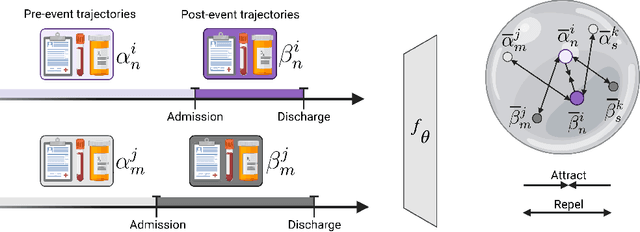
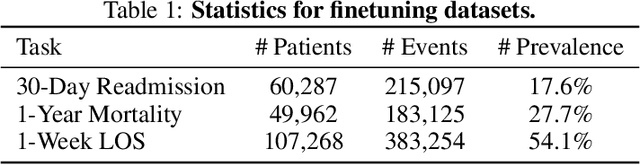

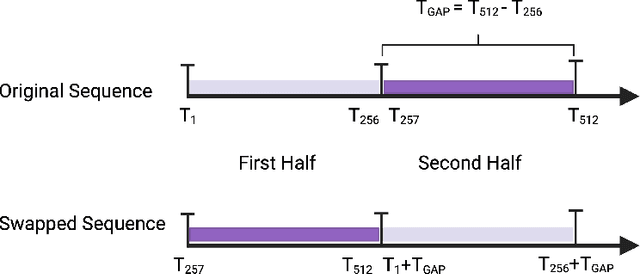
In clinical practice, one often needs to identify whether a patient is at high risk of adverse outcomes after some key medical event; e.g., the short-term risk of death after an admission for heart failure. This task, however, remains challenging due to the complexity, variability, and heterogeneity of longitudinal medical data, especially for individuals suffering from chronic diseases like heart failure. In this paper, we introduce Event-Based Contrastive Learning (EBCL) - a method for learning embeddings of heterogeneous patient data that preserves temporal information before and after key index events. We demonstrate that EBCL produces models that yield better fine-tuning performance on critical downstream tasks including 30-day readmission, 1-year mortality, and 1-week length of stay relative to other representation learning methods that do not exploit temporal information surrounding key medical events.
Sequential Multi-Dimensional Self-Supervised Learning for Clinical Time Series
Jul 20, 2023

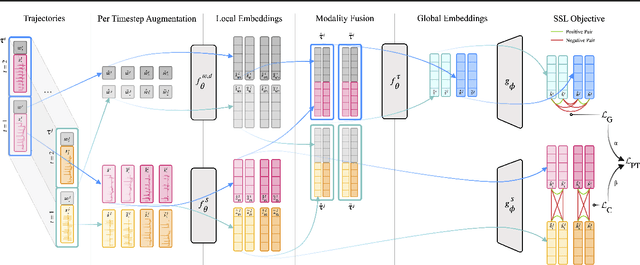
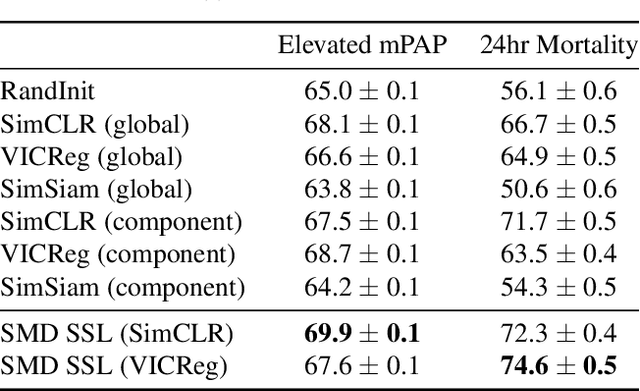
Self-supervised learning (SSL) for clinical time series data has received significant attention in recent literature, since these data are highly rich and provide important information about a patient's physiological state. However, most existing SSL methods for clinical time series are limited in that they are designed for unimodal time series, such as a sequence of structured features (e.g., lab values and vitals signs) or an individual high-dimensional physiological signal (e.g., an electrocardiogram). These existing methods cannot be readily extended to model time series that exhibit multimodality, with structured features and high-dimensional data being recorded at each timestep in the sequence. In this work, we address this gap and propose a new SSL method -- Sequential Multi-Dimensional SSL -- where a SSL loss is applied both at the level of the entire sequence and at the level of the individual high-dimensional data points in the sequence in order to better capture information at both scales. Our strategy is agnostic to the specific form of loss function used at each level -- it can be contrastive, as in SimCLR, or non-contrastive, as in VICReg. We evaluate our method on two real-world clinical datasets, where the time series contains sequences of (1) high-frequency electrocardiograms and (2) structured data from lab values and vitals signs. Our experimental results indicate that pre-training with our method and then fine-tuning on downstream tasks improves performance over baselines on both datasets, and in several settings, can lead to improvements across different self-supervised loss functions.