 Add to Chrome
 Add to Firefox
 Add to Edge
EveryQuery: Zero-Shot Clinical Prediction via Task-Conditioned Pretraining over Electronic Health Records
Mar 09, 2026
Foundation models pretrained on electronic health records (EHR) have demonstrated zero-shot clinical prediction capabilities by generating synthetic patient futures and aggregating statistics over sampled trajectories. However, this autoregressive inference procedure is computationally expensive, statistically noisy, and not natively promptable because users cannot directly condition predictions on specific clinical questions. In this preliminary work, we introduce EveryQuery, an EHR foundation model that achieves zero-shot inference through task-conditioned pre-training. Rather than generating future events, EveryQuery takes as input a patient's history and a structured query specifying a clinical task, and directly estimates the likelihood of the outcome occurring in the future window via a single forward pass. EveryQuery realizes this capability by pre-training over randomly sampled combinations of query tasks and patient contexts, directly training the model to produce correct answers to arbitrary input prompts. This enables zero-shot prediction for any task in the query space without finetuning, linear probing, or trajectory generation. On MIMIC-IV, EveryQuery outperforms an autoregressive baseline on 82% of 39 randomly sampled prediction tasks, with a mean AUC improvement of +0.16 (95% CI: [0.10,0.22]). This advantage remains consistent on tasks that were explicitly held out from the pre-training distribution. Further, EveryQuery's performance gains are most pronounced for rare clinical events, affirming and demonstrating a solution to the fundamental limitation of autoregressive inference for low-prevalence outcomes. However, at present, EveryQuery underperforms on tasks requiring disjunctive reasoning over multiple codes, such as 30-day readmission, exposing a concrete expressiveness limitation of the current query language.

DEPICT: Diffusion-Enabled Permutation Importance for Image Classification Tasks
Jul 19, 2024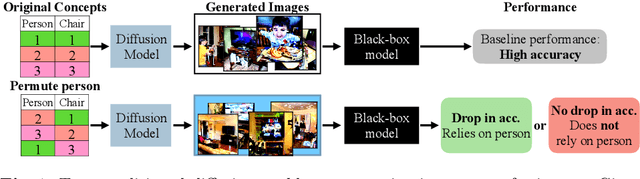

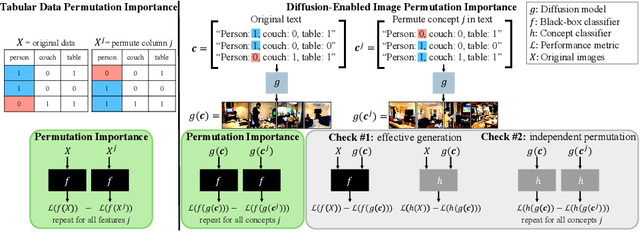
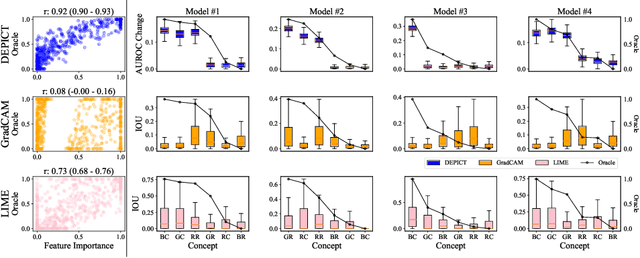
We propose a permutation-based explanation method for image classifiers. Current image-model explanations like activation maps are limited to instance-based explanations in the pixel space, making it difficult to understand global model behavior. In contrast, permutation based explanations for tabular data classifiers measure feature importance by comparing model performance on data before and after permuting a feature. We propose an explanation method for image-based models that permutes interpretable concepts across dataset images. Given a dataset of images labeled with specific concepts like captions, we permute a concept across examples in the text space and then generate images via a text-conditioned diffusion model. Feature importance is then reflected by the change in model performance relative to unpermuted data. When applied to a set of concepts, the method generates a ranking of feature importance. We show this approach recovers underlying model feature importance on synthetic and real-world image classification tasks.