 Add to Chrome
 Add to Firefox
 Add to Edge
A Fast and Energy-Efficient Latch-Based Memristive Analog Content-Addressable Memory
May 12, 2026
Analog content-addressable memories (aCAMs) based on memristors provide a promising pathway toward energy-efficient large-scale associative computing for Edge AI and embedded intelligence applications. They have been successfully applied to decision-tree inference and extend the capabilities of compute-in-memory (CIM) architectures beyond conventional vector-matrix multiplication. However, conventional designs such as the 6T2M architecture suffer from static search power, limited voltage gain, and pronounced match-line crosstalk, constraining analog precision and scalability. We introduce a strong-arm latched memristor (SALM) aCAM cell that replaces static voltage division with a dynamic current-race comparator, enabling high regenerative gain, intrinsic result latching, and near-zero static search power. Compared to 6T2M, SALM reduces read energy by 33% at identical latency while eliminating the gain and crosstalk limitations that prevent 6T2M from scaling to large arrays. SALM further enables scalable sequential and parallel latch sharing, and a dataset-aware optimization framework exposes an explicit energy-latency tradeoff, achieving up to 50% energy reduction at 3x latency across representative workloads. To enable architectural exploration, we develop a circuit-accurate behavioral model derived from SPICE lookup tables in 22 nm FD-SOI technology, capturing match-line dynamics and crosstalk. Integrated into the X-TIME decision-tree compiler, this framework demonstrates that SALM maintains near-software accuracy for high-dimensional datasets, whereas baseline designs degrade due to limited gain and cumulative crosstalk.

Analog In-Memory Computing Attention Mechanism for Fast and Energy-Efficient Large Language Models
Sep 28, 2024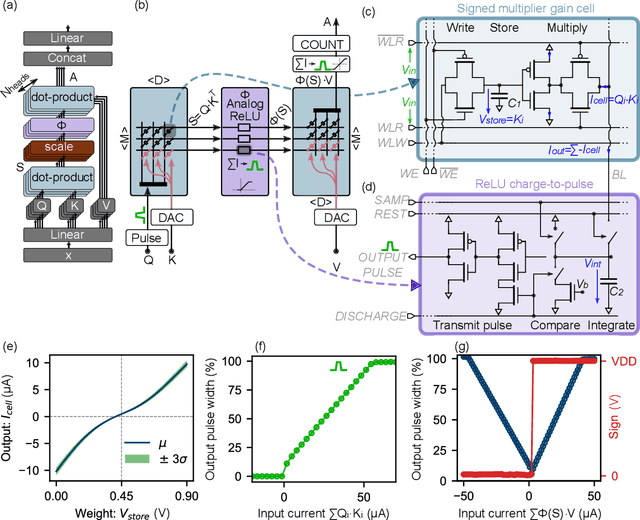

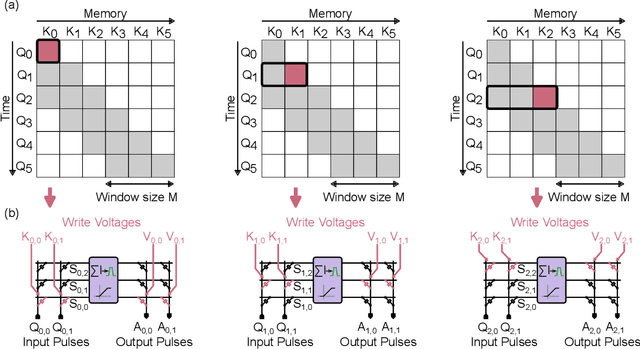
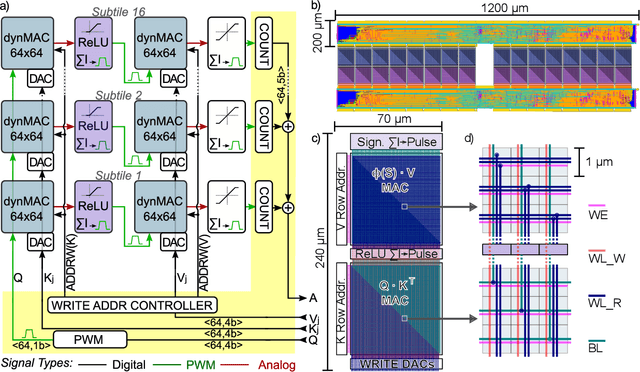
Transformer neural networks, driven by self-attention mechanisms, are core components of foundational and Large Language Models. In generative transformers, self-attention uses cache memory to store token projections, avoiding recomputation at each time step. However, GPU-stored projections must be loaded into SRAM for each new generation step, causing latency and energy bottlenecks for long sequences. In this work, we propose a fast and energy-efficient hardware implementation of self-attention using analog in-memory computing based on gain cell memories. Volatile gain cell memories can be efficiently written to store new tokens during sequence generation, while performing analog signed weight multiplications to compute the dot-products required for self-attention. We implement Sliding Window Attention, which keeps memory of a finite set of past steps. A charge-to-pulse converter for array readout eliminates the need for analog-to-digital conversion between self-attention stages. Using a co-designed initialization algorithm to adapt pre-trained weights to gain cell non-idealities, we achieve NLP performance comparable to ChatGPT-2 with minimal training iterations, despite hardware constraints. Our end-to-end hardware design includes digital controls, estimating area, latency, and energy. The system reduces attention latency by up to two orders of magnitude and energy consumption by up to five orders compared to GPUs, marking a significant step toward ultra-fast, low-power sequence generation in Large Language Models.
Analog Feedback-Controlled Memristor programming Circuit for analog Content Addressable Memory
Apr 21, 2023Recent breakthroughs in associative memories suggest that silicon memories are coming closer to human memories, especially for memristive Content Addressable Memories (CAMs) which are capable to read and write in analog values. However, the Program-Verify algorithm, the state-of-the-art memristor programming algorithm, requires frequent switching between verifying and programming memristor conductance, which brings many defects such as high dynamic power and long programming time. Here, we propose an analog feedback-controlled memristor programming circuit that makes use of a novel look-up table-based (LUT-based) programming algorithm. With the proposed algorithm, the programming and the verification of a memristor can be performed in a single-direction sequential process. Besides, we also integrated a single proposed programming circuit with eight analog CAM (aCAM) cells to build an aCAM array. We present SPICE simulations on TSMC 28nm process. The theoretical analysis shows that 1. A memristor conductance within an aCAM cell can be converted to an output boundary voltage in aCAM searching operations and 2. An output boundary voltage in aCAM searching operations can be converted to a programming data line voltage in aCAM programming operations. The simulation results of the proposed programming circuit prove the theoretical analysis and thus verify the feasibility to program memristors without frequently switching between verifying and programming the conductance. Besides, the simulation results of the proposed aCAM array show that the proposed programming circuit can be integrated into a large array architecture.