 Add to Chrome
 Add to Firefox
 Add to Edge
Training Hybrid Block Diffusion Language Models with Partial Bidirectionality
Jul 02, 2026
High-throughput long-context generation is one of the central challenges for large language models. Generation is typically memory-bandwidth-bound rather than compute-bound: each decoding step must stream the accumulated key/value (KV) cache from memory, so bandwidth demand grows with context length while only one token is emitted. Two parallel approaches have therefore emerged: reducing memory access with efficient attention variants and linear-time mixers such as Mamba, or increasing parallel computation by generating blocks of tokens at once. However, technical challenges arise when combining these two ideas. Earlier hybrid diffusion models such as DiffuMamba use bidirectional Mamba mixing, including a reverse-direction scan relative to causal generation. This reverse scan needs to scan the entire sequence, so its states are not prefix-only and cannot be precisely reused as a cache even when diffusion is performed block by block. We propose a BDLM Mamba--attention hybrid that addresses this challenge by restricting the reverse Mamba scan to the active denoising block, which enables exact caching across blocks. In an 87M-parameter DCLM sweep, BDLM Mamba-H achieves the best C4-en validation perplexity compared to BDLM attention and full-sequence baselines. At 350M parameters, it remains competitive with BDLM attention. For long-context inference, BDLM Mamba-H reaches 19.7x the throughput of full-sequence DiffuMamba-H at 65K tokens and 3.7x the throughput of BDLM attention at 262K, showing that Mamba hybrids are a potential long-context diffusion architecture.

RelBench v2: A Large-Scale Benchmark and Repository for Relational Data
Feb 13, 2026Relational deep learning (RDL) has emerged as a powerful paradigm for learning directly on relational databases by modeling entities and their relationships across multiple interconnected tables. As this paradigm evolves toward larger models and relational foundation models, scalable and realistic benchmarks are essential for enabling systematic evaluation and progress. In this paper, we introduce RelBench v2, a major expansion of the RelBench benchmark for RDL. RelBench v2 adds four large-scale relational datasets spanning scholarly publications, enterprise resource planning, consumer platforms, and clinical records, increasing the benchmark to 11 datasets comprising over 22 million rows across 29 tables. We further introduce autocomplete tasks, a new class of predictive objectives that require models to infer missing attribute values directly within relational tables while respecting temporal constraints, expanding beyond traditional forecasting tasks constructed via SQL queries. In addition, RelBench v2 expands beyond its native datasets by integrating external benchmarks and evaluation frameworks: we translate event streams from the Temporal Graph Benchmark into relational schemas for unified relational-temporal evaluation, interface with ReDeLEx to provide uniform access to 70+ real-world databases suitable for pretraining, and incorporate 4DBInfer datasets and tasks to broaden multi-table prediction coverage. Experimental results demonstrate that RDL models consistently outperform single-table baselines across autocomplete, forecasting, and recommendation tasks, highlighting the importance of modeling relational structure explicitly.
Token Sequence Compression for Efficient Multimodal Computing
Apr 24, 2025

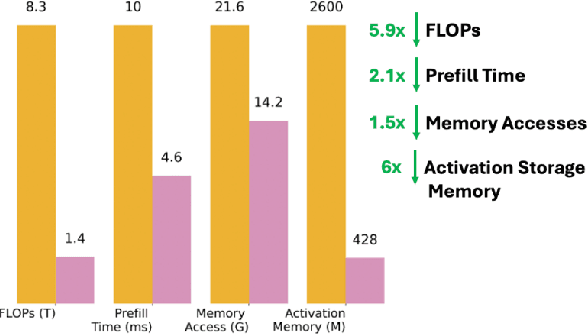

The exponential growth of Large Multimodal Models (LMMs) has driven advancements in cross-modal reasoning but at significant computational costs. In this work, we focus on visual language models. We highlight the redundancy and inefficiency in current vision encoders, and seek to construct an adaptive compression method for multimodal data. In this work, we characterize a panoply of visual token selection and merging approaches through both benchmarking and qualitative analysis. In particular, we demonstrate that simple cluster-level token aggregation outperforms prior state-of-the-art works in token selection and merging, including merging at the vision encoder level and attention-based approaches. We underline the redundancy in current vision encoders, and shed light on several puzzling trends regarding principles of visual token selection through cross-modal attention visualizations. This work is a first effort towards more effective encoding and processing of high-dimensional data, and paves the way for more scalable and sustainable multimodal systems.