 Add to Chrome
 Add to Firefox
 Add to Edge
Learning from Acceptance: Cumulative Regret in the Game of Coding
May 10, 2026
Classical coding-theoretic guarantees often rely on trust assumptions, such as requiring sufficiently many honest nodes compared with adversarial ones. These assumptions are difficult to enforce in open decentralized systems where participants are not centrally certified. At the same time, such environments often contain incentive mechanisms: participants may be rewarded only when their submitted data are accepted and the system remains functional. This changes the role of an adversary. Rather than acting as a pure saboteur, a strategic adversary may submit data that are consistent enough to be accepted while still degrading the quality of the final estimate. The game-of-coding framework models this strategic interaction between a data collector (DC) and an adversary. Existing works on the game of coding mostly consider the complete-information case, where the DC knows how the adversary trades off acceptance and estimation error. In this paper, we study an incomplete-information version of the game of coding in which the DC, acting as a Stackelberg leader, does not know the adversary's utility trade-off and must learn through repeated interaction. Prior work on the unknown-adversary setting considered an explore-then-commit objective, where only the final selected acceptance rule is evaluated. In contrast, we study the full learning trajectory: every acceptance rule used during the algorithm is executed and contributes to performance. We propose an algorithm that refines its search around promising acceptance rules, prove that it achieves sublinear cumulative regret, and evaluate its performance through numerical experiments.

Adversarial Robustness of Nonparametric Regression
May 23, 2025In this paper, we investigate the adversarial robustness of regression, a fundamental problem in machine learning, under the setting where an adversary can arbitrarily corrupt a subset of the input data. While the robustness of parametric regression has been extensively studied, its nonparametric counterpart remains largely unexplored. We characterize the adversarial robustness in nonparametric regression, assuming the regression function belongs to the second-order Sobolev space (i.e., it is square integrable up to its second derivative). The contribution of this paper is two-fold: (i) we establish a minimax lower bound on the estimation error, revealing a fundamental limit that no estimator can overcome, and (ii) we show that, perhaps surprisingly, the classical smoothing spline estimator, when properly regularized, exhibits robustness against adversarial corruption. These results imply that if $o(n)$ out of $n$ samples are corrupted, the estimation error of the smoothing spline vanishes as $n \to \infty$. On the other hand, when a constant fraction of the data is corrupted, no estimator can guarantee vanishing estimation error, implying the optimality of the smoothing spline in terms of maximum tolerable number of corrupted samples.
General Coded Computing: Adversarial Settings
Feb 12, 2025Conventional coded computing frameworks are predominantly tailored for structured computations, such as matrix multiplication and polynomial evaluation. Such tasks allow the reuse of tools and techniques from algebraic coding theory to improve the reliability of distributed systems in the presence of stragglers and adversarial servers. This paper lays the foundation for general coded computing, which extends the applicability of coded computing to handle a wide class of computations. In addition, it particularly addresses the challenging problem of managing adversarial servers. We demonstrate that, in the proposed scheme, for a system with $N$ servers, where $\mathcal{O}(N^a)$, $a \in [0,1)$, are adversarial, the supremum of the average approximation error over all adversarial strategies decays at a rate of $N^{\frac{6}{5}(a-1)}$, under minimal assumptions on the computing tasks. Furthermore, we show that within a general framework, the proposed scheme achieves optimal adversarial robustness, in terms of maximum number of adversarial servers it can tolerate. This marks a significant step toward practical and reliable general coded computing. Implementation results further validate the effectiveness of the proposed method in handling various computations, including inference in deep neural networks.
Game of Coding With an Unknown Adversary
Feb 10, 2025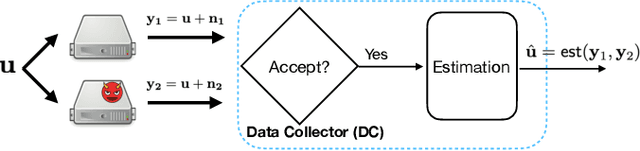
Motivated by emerging decentralized applications, the \emph{game of coding} framework has been recently introduced to address scenarios where the adversary's control over coded symbols surpasses the fundamental limits of traditional coding theory. Still, the reward mechanism available in decentralized systems, motivates the adversary to act rationally. While the decoder, as the data collector (DC), has an acceptance and rejection mechanism, followed by an estimation module, the adversary aims to maximize its utility, as an increasing function of (1) the chance of acceptance (to increase the reward), and (2) estimation error. On the other hand, the decoder also adjusts its acceptance rule to maximize its own utility, as (1) an increasing function of the chance of acceptance (to keep the system functional), (2) decreasing function of the estimation error. Prior works within this framework rely on the assumption that the game is complete, that is, both the DC and the adversary are fully aware of each other's utility functions. However, in practice, the decoder is often unaware of the utility of the adversary. To address this limitation, we develop an algorithm enabling the DC to commit to a strategy that achieves within the vicinity of the equilibrium, without knowledge of the adversary's utility function. Our approach builds on an observation that at the equilibrium, the relationship between the probability of acceptance and the mean squared error (MSE) follows a predetermined curve independent of the specific utility functions of the players. By exploiting this invariant relationship, the DC can iteratively refine its strategy based on observable parameters, converging to a near-optimal solution. We provide theoretical guarantees on sample complexity and accuracy of the proposed scheme.
Private, Augmentation-Robust and Task-Agnostic Data Valuation Approach for Data Marketplace
Nov 01, 2024
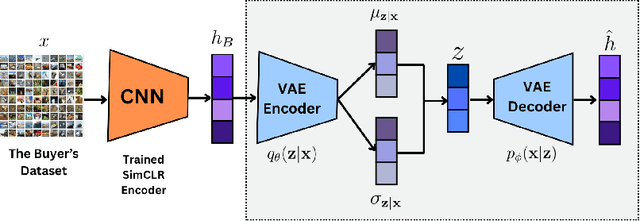
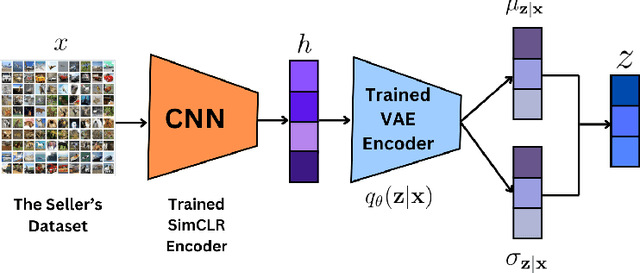
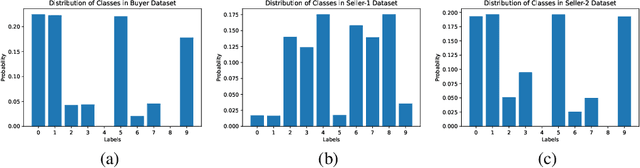
Evaluating datasets in data marketplaces, where the buyer aim to purchase valuable data, is a critical challenge. In this paper, we introduce an innovative task-agnostic data valuation method called PriArTa which is an approach for computing the distance between the distribution of the buyer's existing dataset and the seller's dataset, allowing the buyer to determine how effectively the new data can enhance its dataset. PriArTa is communication-efficient, enabling the buyer to evaluate datasets without needing access to the entire dataset from each seller. Instead, the buyer requests that sellers perform specific preprocessing on their data and then send back the results. Using this information and a scoring metric, the buyer can evaluate the dataset. The preprocessing is designed to allow the buyer to compute the score while preserving the privacy of each seller's dataset, mitigating the risk of information leakage before the purchase. A key feature of PriArTa is its robustness to common data transformations, ensuring consistent value assessment and reducing the risk of purchasing redundant data. The effectiveness of PriArTa is demonstrated through experiments on real-world image datasets, showing its ability to perform privacy-preserving, augmentation-robust data valuation in data marketplaces.
Coded Computing: A Learning-Theoretic Framework
Jun 01, 2024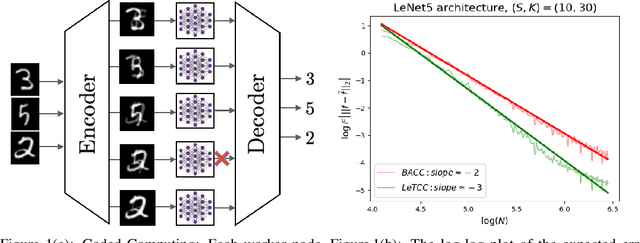

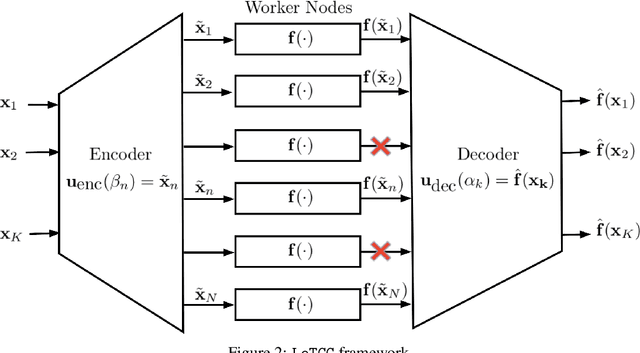

Coded computing has emerged as a promising framework for tackling significant challenges in large-scale distributed computing, including the presence of slow, faulty, or compromised servers. In this approach, each worker node processes a combination of the data, rather than the raw data itself. The final result then is decoded from the collective outputs of the worker nodes. However, there is a significant gap between current coded computing approaches and the broader landscape of general distributed computing, particularly when it comes to machine learning workloads. To bridge this gap, we propose a novel foundation for coded computing, integrating the principles of learning theory, and developing a new framework that seamlessly adapts with machine learning applications. In this framework, the objective is to find the encoder and decoder functions that minimize the loss function, defined as the mean squared error between the estimated and true values. Facilitating the search for the optimum decoding and functions, we show that the loss function can be upper-bounded by the summation of two terms: the generalization error of the decoding function and the training error of the encoding function. Focusing on the second-order Sobolev space, we then derive the optimal encoder and decoder. We show that in the proposed solution, the mean squared error of the estimation decays with the rate of $O(S^4 N^{-3})$ and $O(S^{\frac{8}{5}}N^{\frac{-3}{5}})$ in noiseless and noisy computation settings, respectively, where $N$ is the number of worker nodes with at most $S$ slow servers (stragglers). Finally, we evaluate the proposed scheme on inference tasks for various machine learning models and demonstrate that the proposed framework outperforms the state-of-the-art in terms of accuracy and rate of convergence.
NeRCC: Nested-Regression Coded Computing for Resilient Distributed Prediction Serving Systems
Feb 08, 2024


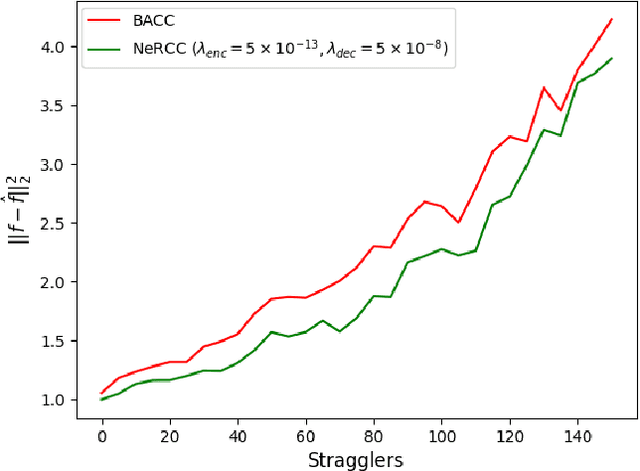
Resilience against stragglers is a critical element of prediction serving systems, tasked with executing inferences on input data for a pre-trained machine-learning model. In this paper, we propose NeRCC, as a general straggler-resistant framework for approximate coded computing. NeRCC includes three layers: (1) encoding regression and sampling, which generates coded data points, as a combination of original data points, (2) computing, in which a cluster of workers run inference on the coded data points, (3) decoding regression and sampling, which approximately recovers the predictions of the original data points from the available predictions on the coded data points. We argue that the overall objective of the framework reveals an underlying interconnection between two regression models in the encoding and decoding layers. We propose a solution to the nested regressions problem by summarizing their dependence on two regularization terms that are jointly optimized. Our extensive experiments on different datasets and various machine learning models, including LeNet5, RepVGG, and Vision Transformer (ViT), demonstrate that NeRCC accurately approximates the original predictions in a wide range of stragglers, outperforming the state-of-the-art by up to 23%.
Memory-Based Graph Networks
Feb 21, 2020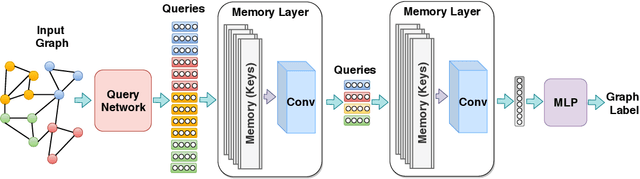
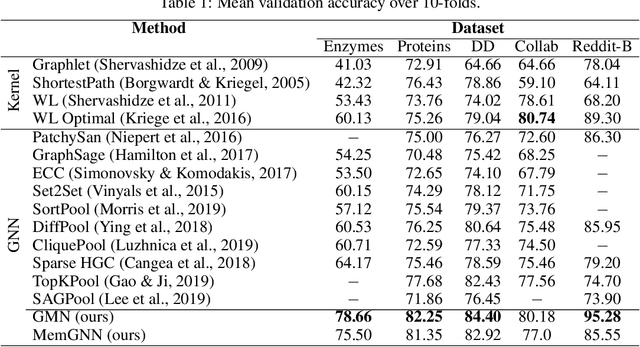
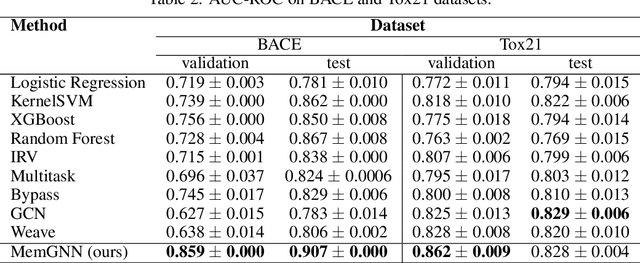
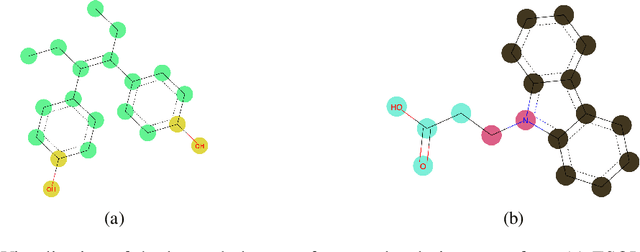
Graph neural networks (GNNs) are a class of deep models that operate on data with arbitrary topology represented as graphs. We introduce an efficient memory layer for GNNs that can jointly learn node representations and coarsen the graph. We also introduce two new networks based on this layer: memory-based GNN (MemGNN) and graph memory network (GMN) that can learn hierarchical graph representations. The experimental results shows that the proposed models achieve state-of-the-art results in eight out of nine graph classification and regression benchmarks. We also show that the learned representations could correspond to chemical features in the molecule data. Code and reference implementations are released at: https://github.com/amirkhas/GraphMemoryNet