 Add to Chrome
 Add to Firefox
 Add to Edge
LLM4CodeRE: Generative AI for Code Decompilation Analysis and Reverse Engineering
Apr 07, 2026
Code decompilation analysis is a fundamental yet challenging task in malware reverse engineering, particularly due to the pervasive use of sophisticated obfuscation techniques. Although recent large language models (LLMs) have shown promise in translating low-level representations into high-level source code, most existing approaches rely on generic code pretraining and lack adaptation to malicious software. We propose LLM4CodeRE, a domain-adaptive LLM framework for bidirectional code reverse engineering that supports both assembly-to-source decompilation and source-to-assembly translation within a unified model. To enable effective task adaptation, we introduce two complementary fine-tuning strategies: (i) a Multi-Adapter approach for task-specific syntactic and semantic alignment, and (ii) a Seq2Seq Unified approach using task-conditioned prefixes to enforce end-to-end generation constraints. Experimental results demonstrate that LLM4CodeRE outperforms existing decompilation tools and general-purpose code models, achieving robust bidirectional generalization.

Automated Malware Family Classification using Weighted Hierarchical Ensembles of Large Language Models
Apr 02, 2026Malware family classification remains a challenging task in automated malware analysis, particularly in real-world settings characterized by obfuscation, packing, and rapidly evolving threats. Existing machine learning and deep learning approaches typically depend on labeled datasets, handcrafted features, supervised training, or dynamic analysis, which limits their scalability and effectiveness in open-world scenarios. This paper presents a zero-label malware family classification framework based on a weighted hierarchical ensemble of pretrained large language models (LLMs). Rather than relying on feature-level learning or model retraining, the proposed approach aggregates decision-level predictions from multiple LLMs with complementary reasoning strengths. Model outputs are weighted using empirically derived macro-F1 scores and organized hierarchically, first resolving coarse-grained malicious behavior before assigning fine-grained malware families. This structure enhances robustness, reduces individual model instability, and aligns with analyst-style reasoning.
Large Language Model (LLM) for Software Security: Code Analysis, Malware Analysis, Reverse Engineering
Apr 07, 2025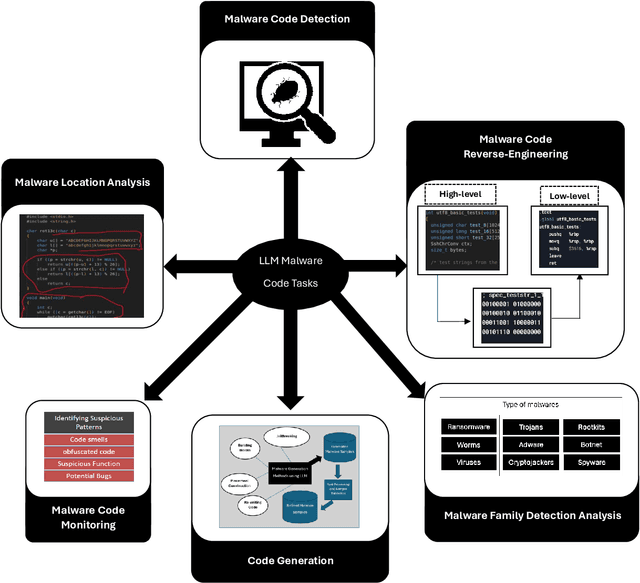
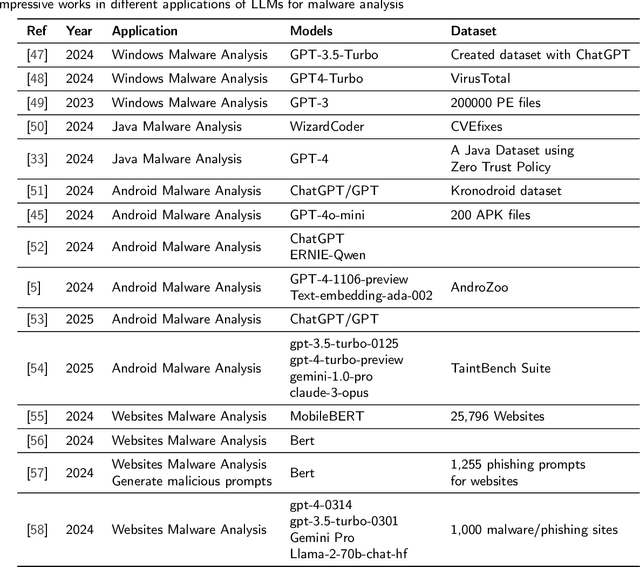
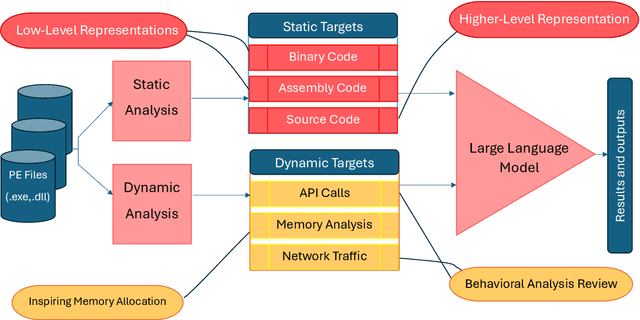
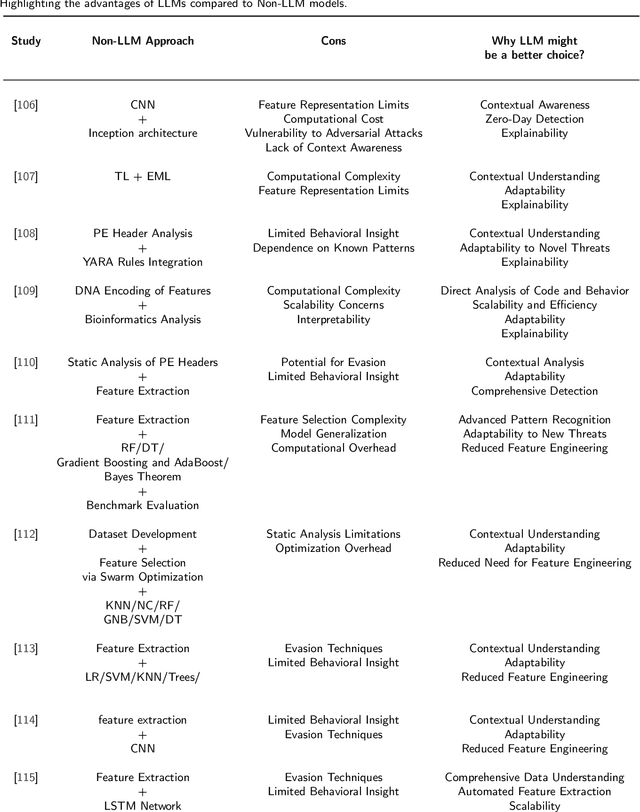
Large Language Models (LLMs) have recently emerged as powerful tools in cybersecurity, offering advanced capabilities in malware detection, generation, and real-time monitoring. Numerous studies have explored their application in cybersecurity, demonstrating their effectiveness in identifying novel malware variants, analyzing malicious code structures, and enhancing automated threat analysis. Several transformer-based architectures and LLM-driven models have been proposed to improve malware analysis, leveraging semantic and structural insights to recognize malicious intent more accurately. This study presents a comprehensive review of LLM-based approaches in malware code analysis, summarizing recent advancements, trends, and methodologies. We examine notable scholarly works to map the research landscape, identify key challenges, and highlight emerging innovations in LLM-driven cybersecurity. Additionally, we emphasize the role of static analysis in malware detection, introduce notable datasets and specialized LLM models, and discuss essential datasets supporting automated malware research. This study serves as a valuable resource for researchers and cybersecurity professionals, offering insights into LLM-powered malware detection and defence strategies while outlining future directions for strengthening cybersecurity resilience.
Federated Continual Learning: Concepts, Challenges, and Solutions
Feb 10, 2025Federated Continual Learning (FCL) has emerged as a robust solution for collaborative model training in dynamic environments, where data samples are continuously generated and distributed across multiple devices. This survey provides a comprehensive review of FCL, focusing on key challenges such as heterogeneity, model stability, communication overhead, and privacy preservation. We explore various forms of heterogeneity and their impact on model performance. Solutions to non-IID data, resource-constrained platforms, and personalized learning are reviewed in an effort to show the complexities of handling heterogeneous data distributions. Next, we review techniques for ensuring model stability and avoiding catastrophic forgetting, which are critical in non-stationary environments. Privacy-preserving techniques are another aspect of FCL that have been reviewed in this work. This survey has integrated insights from federated learning and continual learning to present strategies for improving the efficacy and scalability of FCL systems, making it applicable to a wide range of real-world scenarios.