 Add to Chrome
 Add to Firefox
 Add to Edge
Security Threat Modeling for Emerging AI-Agent Protocols: A Comparative Analysis of MCP, A2A, Agora, and ANP
Feb 11, 2026
The rapid development of the AI agent communication protocols, including the Model Context Protocol (MCP), Agent2Agent (A2A), Agora, and Agent Network Protocol (ANP), is reshaping how AI agents communicate with tools, services, and each other. While these protocols support scalable multi-agent interaction and cross-organizational interoperability, their security principles remain understudied, and standardized threat modeling is limited; no protocol-centric risk assessment framework has been established yet. This paper presents a systematic security analysis of four emerging AI agent communication protocols. First, we develop a structured threat modeling analysis that examines protocol architectures, trust assumptions, interaction patterns, and lifecycle behaviors to identify protocol-specific and cross-protocol risk surfaces. Second, we introduce a qualitative risk assessment framework that identifies twelve protocol-level risks and evaluates security posture across the creation, operation, and update phases through systematic assessment of likelihood, impact, and overall protocol risk, with implications for secure deployment and future standardization. Third, we provide a measurement-driven case study on MCP that formalizes the risk of missing mandatory validation/attestation for executable components as a falsifiable security claim by quantifying wrong-provider tool execution under multi-server composition across representative resolver policies. Collectively, our results highlight key design-induced risk surfaces and provide actionable guidance for secure deployment and future standardization of agent communication ecosystems.

Large Language Model (LLM) for Software Security: Code Analysis, Malware Analysis, Reverse Engineering
Apr 07, 2025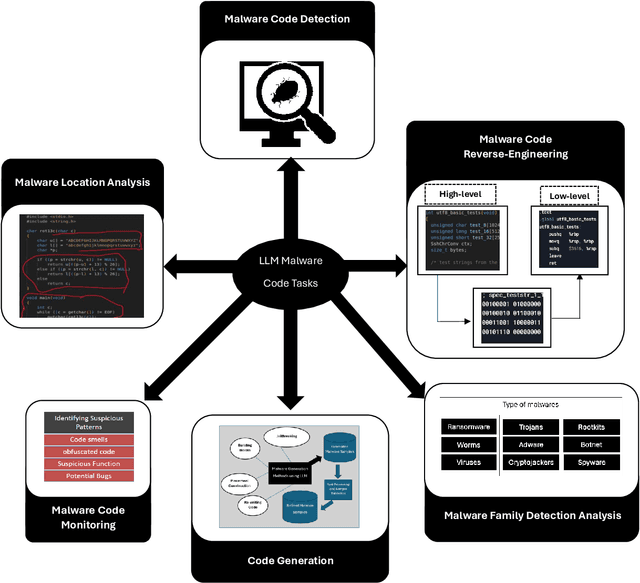
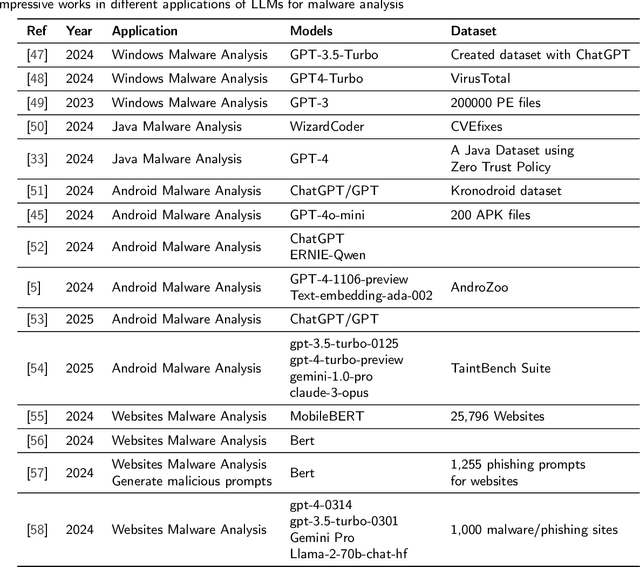
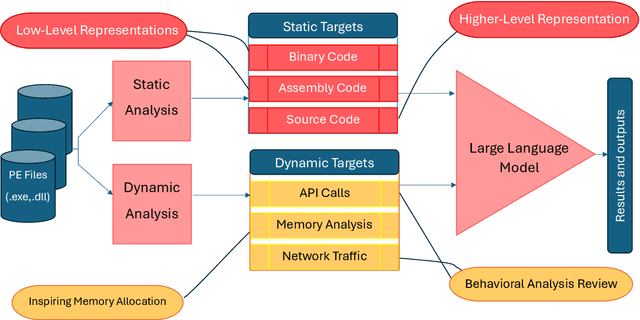
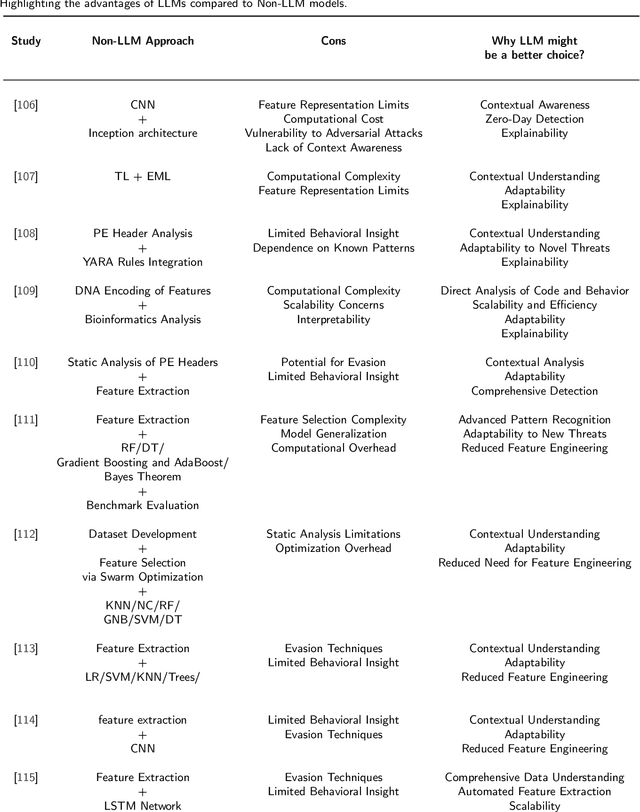
Large Language Models (LLMs) have recently emerged as powerful tools in cybersecurity, offering advanced capabilities in malware detection, generation, and real-time monitoring. Numerous studies have explored their application in cybersecurity, demonstrating their effectiveness in identifying novel malware variants, analyzing malicious code structures, and enhancing automated threat analysis. Several transformer-based architectures and LLM-driven models have been proposed to improve malware analysis, leveraging semantic and structural insights to recognize malicious intent more accurately. This study presents a comprehensive review of LLM-based approaches in malware code analysis, summarizing recent advancements, trends, and methodologies. We examine notable scholarly works to map the research landscape, identify key challenges, and highlight emerging innovations in LLM-driven cybersecurity. Additionally, we emphasize the role of static analysis in malware detection, introduce notable datasets and specialized LLM models, and discuss essential datasets supporting automated malware research. This study serves as a valuable resource for researchers and cybersecurity professionals, offering insights into LLM-powered malware detection and defence strategies while outlining future directions for strengthening cybersecurity resilience.