 Add to Chrome
 Add to Firefox
 Add to Edge
Optimized Scheduling and Positioning of Mobile Manipulators in Collaborative Applications
Dec 19, 2025
The growing integration of mobile robots in shared workspaces requires efficient path planning and coordination between the agents, accounting for safety and productivity. In this work, we propose a digital model-based optimization framework for mobile manipulators in human-robot collaborative environments, in order to determine the sequence of robot base poses and the task scheduling for the robot. The complete problem is treated as black-box, and Particle Swarm Optimization (PSO) is employed to balance conflicting Key-Performance Indicators (KPIs). We demonstrate improvements in cycle time, task sequencing, and adaptation to human presence in a collaborative box-packing scenario.

On Using Neural Networks to Learn Safety Speed Reduction in Human-Robot Collaboration: A Comparative Analysis
Dec 19, 2025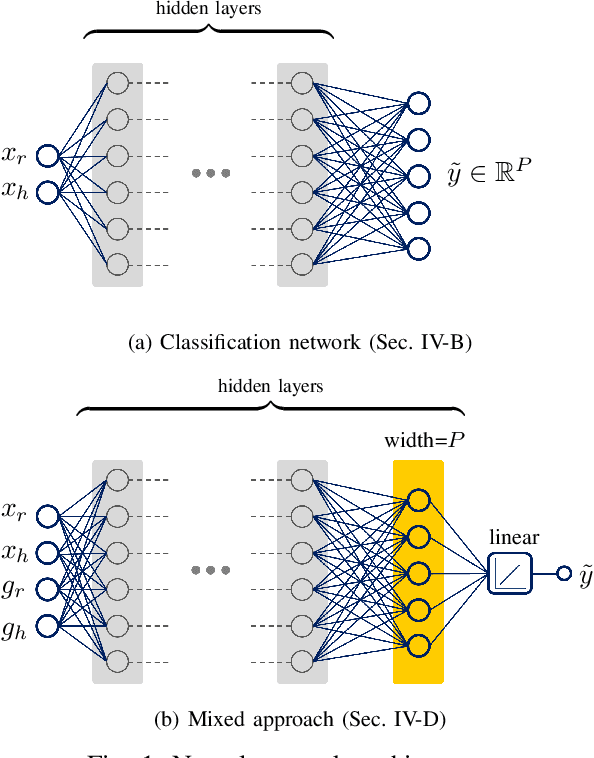
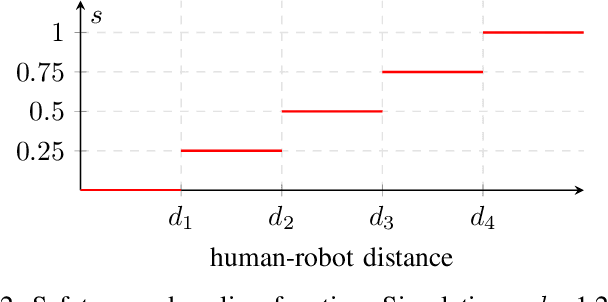
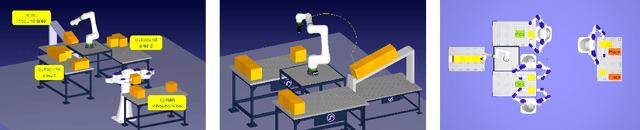
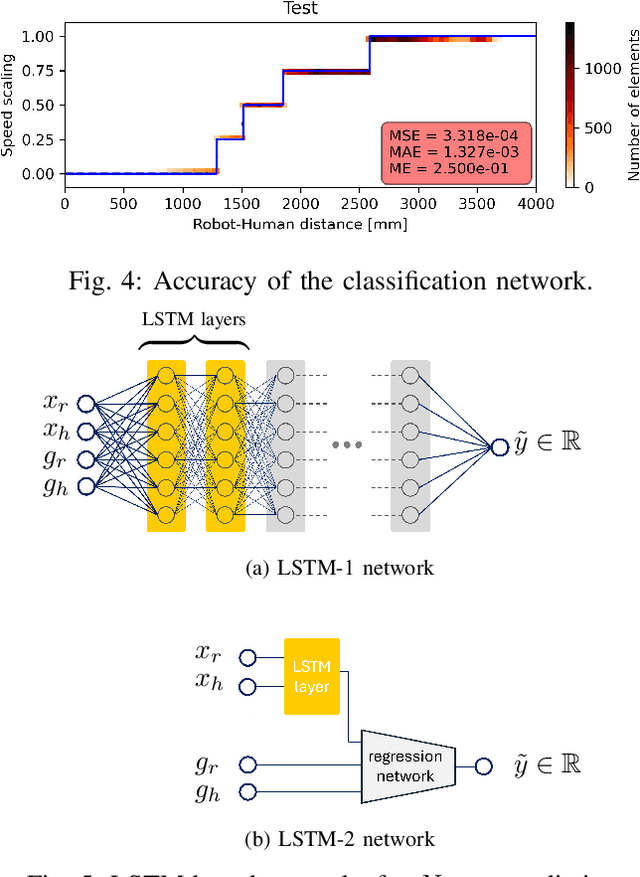
In Human-Robot Collaboration, safety mechanisms such as Speed and Separation Monitoring and Power and Force Limitation dynamically adjust the robot's speed based on human proximity. While essential for risk reduction, these mechanisms introduce slowdowns that makes cycle time estimation a hard task and impact job scheduling efficiency. Existing methods for estimating cycle times or designing schedulers often rely on predefined safety models, which may not accurately reflect real-world safety implementations, as these depend on case-specific risk assessments. In this paper, we propose a deep learning approach to predict the robot's safety scaling factor directly from process execution data. We analyze multiple neural network architectures and demonstrate that a simple feed-forward network effectively estimates the robot's slowdown. This capability is crucial for improving cycle time predictions and designing more effective scheduling algorithms in collaborative robotic environments.
Uncertainty-aware Planning with Inaccurate Models for Robotized Liquid Handling
Jul 28, 2025Physics-based simulations and learning-based models are vital for complex robotics tasks like deformable object manipulation and liquid handling. However, these models often struggle with accuracy due to epistemic uncertainty or the sim-to-real gap. For instance, accurately pouring liquid from one container to another poses challenges, particularly when models are trained on limited demonstrations and may perform poorly in novel situations. This paper proposes an uncertainty-aware Monte Carlo Tree Search (MCTS) algorithm designed to mitigate these inaccuracies. By incorporating estimates of model uncertainty, the proposed MCTS strategy biases the search towards actions with lower predicted uncertainty. This approach enhances the reliability of planning under uncertain conditions. Applied to a liquid pouring task, our method demonstrates improved success rates even with models trained on minimal data, outperforming traditional methods and showcasing its potential for robust decision-making in robotics.
Force-Driven Validation for Collaborative Robotics in Automated Avionics Testing
May 15, 2025ARTO is a project combining collaborative robots (cobots) and Artificial Intelligence (AI) to automate functional test procedures for civilian and military aircraft certification. This paper proposes a Deep Learning (DL) and eXplainable AI (XAI) approach, equipping ARTO with interaction analysis capabilities to verify and validate the operations on cockpit components. During these interactions, forces, torques, and end effector poses are recorded and preprocessed to filter disturbances caused by low performance force controllers and embedded Force Torque Sensors (FTS). Convolutional Neural Networks (CNNs) then classify the cobot actions as Success or Fail, while also identifying and reporting the causes of failure. To improve interpretability, Grad CAM, an XAI technique for visual explanations, is integrated to provide insights into the models decision making process. This approach enhances the reliability and trustworthiness of the automated testing system, facilitating the diagnosis and rectification of errors that may arise during testing.
Low Resolution Next Best View for Robot Packing
May 07, 2025Automating the packing of objects with robots is a key challenge in industrial automation, where efficient object perception plays a fundamental role. This paper focuses on scenarios where precise 3D reconstruction is not required, prioritizing cost-effective and scalable solutions. The proposed Low-Resolution Next Best View (LR-NBV) algorithm leverages a utility function that balances pose redundancy and acquisition density, ensuring efficient object reconstruction. Experimental validation demonstrates that LR-NBV consistently outperforms standard NBV approaches, achieving comparable accuracy with significantly fewer poses. This method proves highly suitable for applications requiring efficiency, scalability, and adaptability without relying on high-precision sensing.
Automating Box Folding: Sequence Extraction and Ranking Methodologies
May 07, 2025Box folding represents a crucial challenge for automated packaging systems. This work bridges the gap between existing methods for folding sequence extraction and approaches focused on the adaptability of automated systems to specific box types. An innovative method is proposed to identify and rank folding sequences, enabling the transformation of a box from an initial state to a desired final configuration. The system evaluates and ranks these sequences based on their feasibility and compatibility with available hardware, providing recommendations for real-world implementations. Finally, an illustrative use case is presented, where a robot performs the folding of a box.
Digital Model-Driven Genetic Algorithm for Optimizing Layout and Task Allocation in Human-Robot Collaborative Assemblies
Mar 04, 2025


This paper addresses the optimization of human-robot collaborative work-cells before their physical deployment. Most of the times, such environments are designed based on the experience of the system integrators, often leading to sub-optimal solutions. Accurate simulators of the robotic cell, accounting for the presence of the human as well, are available today and can be used in the pre-deployment. We propose an iterative optimization scheme where a digital model of the work-cell is updated based on a genetic algorithm. The methodology focuses on the layout optimization and task allocation, encoding both the problems simultaneously in the design variables handled by the genetic algorithm, while the task scheduling problem depends on the result of the upper-level one. The final solution balances conflicting objectives in the fitness function and is validated to show the impact of the objectives with respect to a baseline, which represents possible initial choices selected based on the human judgment.
Optimizing Collaborative Robotics since Pre-Deployment via Cyber-Physical Systems' Digital Twins
Oct 18, 2024
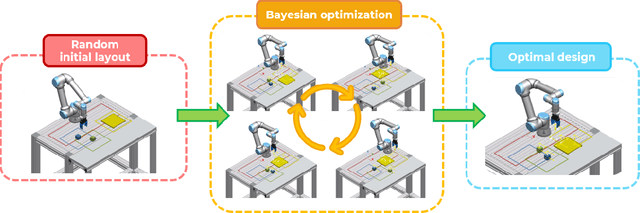


The collaboration between humans and robots re-quires a paradigm shift not only in robot perception, reasoning, and action, but also in the design of the robotic cell. This paper proposes an optimization framework for designing collaborative robotics cells using a digital twin during the pre-deployment phase. This approach mitigates the limitations of experience-based sub-optimal designs by means of Bayesian optimization to find the optimal layout after a certain number of iterations. By integrating production KPIs into a black-box optimization frame-work, the digital twin supports data-driven decision-making, reduces the need for costly prototypes, and ensures continuous improvement thanks to the learning nature of the algorithm. The paper presents a case study with preliminary results that show how this methodology can be applied to obtain safer, more efficient, and adaptable human-robot collaborative environments.
Deep Functional Predictive Control for Strawberry Cluster Manipulation using Tactile Prediction
Mar 09, 2023This paper introduces a novel approach to address the problem of Physical Robot Interaction (PRI) during robot pushing tasks. The approach uses a data-driven forward model based on tactile predictions to inform the controller about potential future movements of the object being pushed, such as a strawberry stem, using a robot tactile finger. The model is integrated into a Deep Functional Predictive Control (d-FPC) system to control the displacement of the stem on the tactile finger during pushes. Pushing an object with a robot finger along a desired trajectory in 3D is a highly nonlinear and complex physical robot interaction, especially when the object is not stably grasped. The proposed approach controls the stem movements on the tactile finger in a prediction horizon. The effectiveness of the proposed FPC is demonstrated in a series of tests involving a real robot pushing a strawberry in a cluster. The results indicate that the d-FPC controller can successfully control PRI in robotic manipulation tasks beyond the handling of strawberries. The proposed approach offers a promising direction for addressing the challenging PRI problem in robotic manipulation tasks. Future work will explore the generalisation of the approach to other objects and tasks.
Whole-Body MPC and Dynamic Occlusion Avoidance: A Maximum Likelihood Visibility Approach
Mar 04, 2022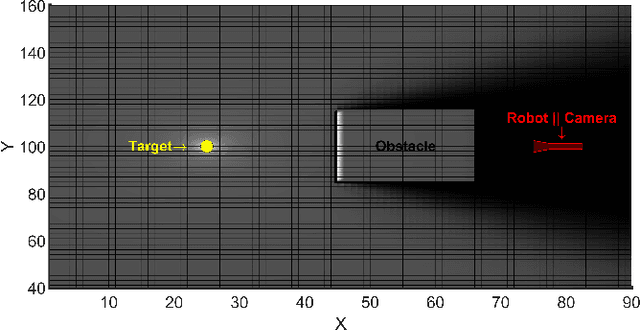
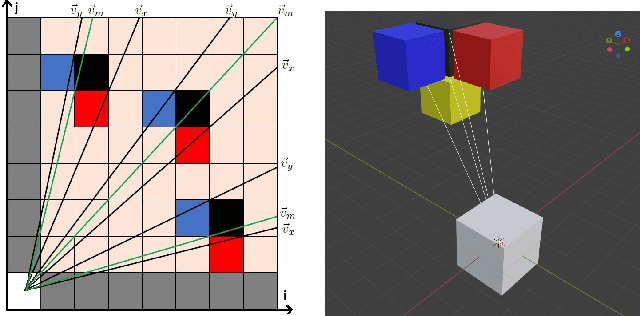
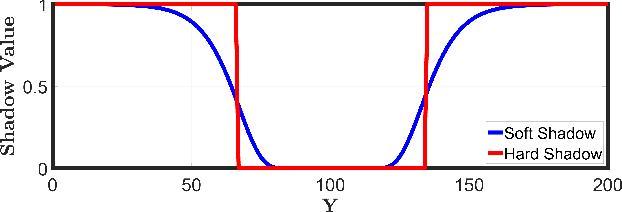
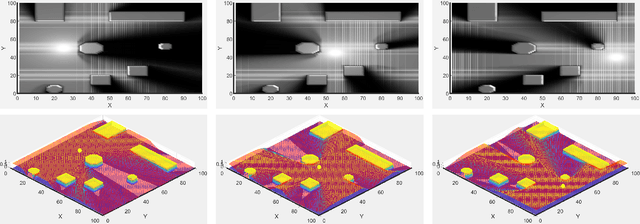
This paper introduces a novel approach for whole-body motion planning and dynamic occlusion avoidance. The proposed approach reformulates the visibility constraint as a likelihood maximization of visibility probability. In this formulation, we augment the primary cost function of a whole-body model predictive control scheme through a relaxed log barrier function yielding a relaxed log-likelihood maximization formulation of visibility probability. The visibility probability is computed through a probabilistic shadow field that quantifies point light source occlusions. We provide the necessary algorithms to obtain such a field for both 2D and 3D cases. We demonstrate 2D implementations of this field in simulation and 3D implementations through real-time hardware experiments. We show that due to the linear complexity of our shadow field algorithm to the map size, we can achieve high update rates, which facilitates onboard execution on mobile platforms with limited computational power. Lastly, we evaluate the performance of the proposed MPC reformulation in simulation for a quadrupedal mobile manipulator.