 Add to Chrome
 Add to Firefox
 Add to Edge
Diffuse to Compress: Leveraging Diffusion LMs for Lossless Compression
Aug 04, 2026
We study the problem of lossless text compression, motivated by the rapid growth in the collection and storage of digital textual data - including plain text, source code, and structured formats such as XML - and by recent advances in neural language model-based compression. In particular, recent LLM-based approaches, whether built on symbol-ranking pipelines or paired with a statistical compressor, have demonstrated compression ratios significantly superior to general-purpose compressors such as zstd, gzip, or bzip on text and code. However, these neural approaches suffer from severe throughput limitations, making them not yet practically usable. For the first time in the context of lossless neural text compression, we introduce Diffusion Language Models (DLMs) as an alternative inference paradigm to autoregressive LLM-based approaches. We argue that replacing autoregressive LLMs with DLMs within the same compression framework could overcome the throughput bottleneck caused by their one-symbol-per-step limitation. However, achieving these improvements requires addressing algorithmic challenges introduced by applying DLMs to lossless compression, where the architecture allows the number and positions of symbols encoded at each forward pass to be decided independently. We design efficient and effective strategies to solve these challenges and evaluate them experimentally against LLM-based and general-purpose compressors on enwik8, a well-established textual benchmark. Our results show that the newly proposed DLM-based framework advances the state of the art in lossless text compression. Moreover, as DLMs are still a relatively young paradigm, recent advances toward increasingly capable and efficient models suggest substantial room for further improvements.

Extended Depth-First Representations of $k^2$-trees
Jul 30, 2026In this paper, we study static, computation-friendly, lossless compression formats for graphs, focusing on memory locality and operational efficiency of $k^2$-trees. We observe that their traditional level-wise layouts suffer from poor cache performance due to weak locality, especially in operations such as matrix-vector and matrix-matrix operations. To address this limitation, we propose four depth-first representations of $k^2$-trees: a plain depth-first layout (EDF-1), a balanced-parenthesis representation (BP), and their compressed variants (CEDF and CBP). We further introduce a linear-time compression method based on suffix and LCP arrays to identify and compress identical subtrees. We experimentally evaluate the execution time, the disk space, and the peak-memory usage of our approaches against classical level-wise $k^2$-trees and DFUDS-based representations across two real and one synthetic dataset (i.e., Web Graphs, Wikidata, and random adjacency matrices) over the above linear-algebra operations. Results show that our depth-first layouts are competitive and often superior than known approaches: CEDF achieves the best compression in most settings, EDF-1 and CEDF reduce the peak memory usage consistently, and performance varies by workload, with different layouts excelling in different operations and data regimes. Overall, this work demonstrates that depth-first layouts of $k^2$-trees provide a practical and efficient alternative to traditional layouts, improving both compression and computational performance in matrix operations.
LLM-based Source Code Compression via Thresholded Symbol Ranking
Jul 27, 2026We study the problem of lossless compression of source code, motivated by the storage demands of large-scale software archives, such as Software Heritage (https://www.softwareheritage.org/). General-purpose compressors (e.g., zstd, bzip2) offer a good trade-off between compression ratio and speed, but fail to exploit all special regularities inherent in source code. Recent approaches leverage Large Language Models (LLMs) within Shannon's symbol-ranking framework, relying on a scheme in which the predicted rank can grow arbitrarily. While effective at reducing space, this setting incurs significant throughput degradation, and leaves open the question whether it is necessary to explicitly encode all ranks. In this work, we introduce LLM-based compressors deploying two novel symbol-ranking variants that bound predictions to the top-$T$ ranks ($T=1$ or $63$), with out-of-threshold symbols stored as exceptions and compressed jointly with the rank stream via general-purpose compressors. We conduct the first large-scale evaluation of LLM-based source code compression across 30 LLMs, including general-domain, code-specialized, and quantized models. Our $T$-bounded approach outperforms prior LLM-based compressors both in compression ratio (up to 37% relative improvement) and compression throughput (40% faster). Compared to general-purpose compressors (e.g., zstd, bzip2), we obtain up to 82% relative compression gain but at a lower speed, thus offering a new trade-off point in the compression-speed spectrum. We also show that these gains are stronger on source code than on natural language, suggesting an interesting indication, namely that source code exposes regularities captured by LLMs but missed by general-purpose exact-match-based compressors. We conclude by commenting on open problems that offer theoretical and practical avenues of research.
Recall Before Rerank: Benchmarking Deep Learning Models for Large-Scale Code-to-Code Retrieval
Jun 24, 2026Semantic code search and clone detection are essential for software development, maintenance, and reuse. This paper evaluates the effectiveness, efficiency, and scalability of contemporary deep learning models for first-stage recall in large-scale code-to-code search engines. Benchmarking across multiple programming languages and datasets reveals critical limits in the precision and scalability of these models on Terabyte-scale source-code collections. We present LLM-based code normalisation and query-rewriting schemes that yield significant gains in precision for lower-performing models. Our results question the sustainability of resource-constrained deployment and the assumed robustness of current code-specialised LLMs across datasets. We conclude with actionable insights for building scalable, efficient code-retrieval systems.
Learned Compression of Nonlinear Time Series With Random Access
Dec 20, 2024Time series play a crucial role in many fields, including finance, healthcare, industry, and environmental monitoring. The storage and retrieval of time series can be challenging due to their unstoppable growth. In fact, these applications often sacrifice precious historical data to make room for new data. General-purpose compressors can mitigate this problem with their good compression ratios, but they lack efficient random access on compressed data, thus preventing real-time analyses. Ad-hoc streaming solutions, instead, typically optimise only for compression and decompression speed, while giving up compression effectiveness and random access functionality. Furthermore, all these methods lack awareness of certain special regularities of time series, whose trends over time can often be described by some linear and nonlinear functions. To address these issues, we introduce NeaTS, a randomly-accessible compression scheme that approximates the time series with a sequence of nonlinear functions of different kinds and shapes, carefully selected and placed by a partitioning algorithm to minimise the space. The approximation residuals are bounded, which allows storing them in little space and thus recovering the original data losslessly, or simply discarding them to obtain a lossy time series representation with maximum error guarantees. Our experiments show that NeaTS improves the compression ratio of the state-of-the-art lossy compressors that use linear or nonlinear functions (or both) by up to 14%. Compared to lossless compressors, NeaTS emerges as the only approach to date providing, simultaneously, compression ratios close to or better than the best existing compressors, a much faster decompression speed, and orders of magnitude more efficient random access, thus enabling the storage and real-time analysis of massive and ever-growing amounts of (historical) time series data.
An interactive dashboard for searching and comparing soccer performance scores
May 11, 2021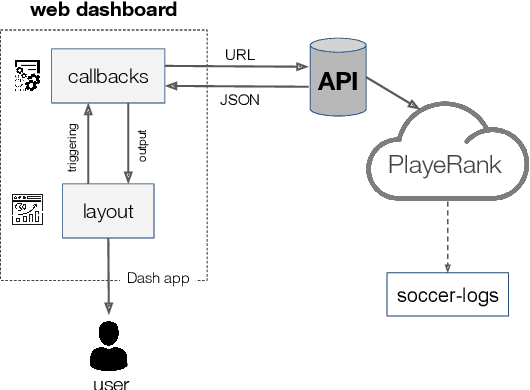
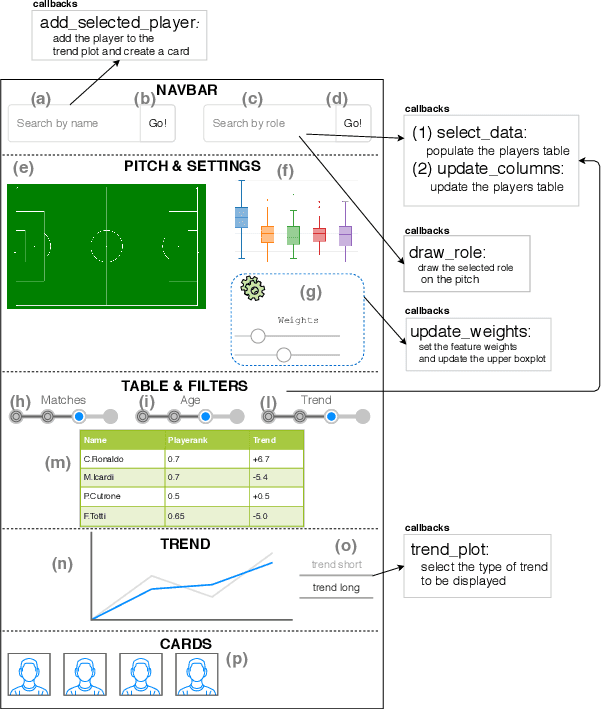
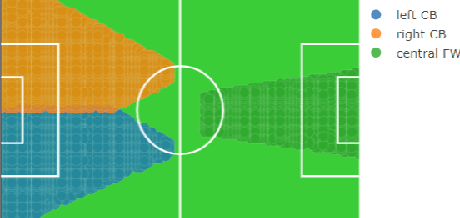
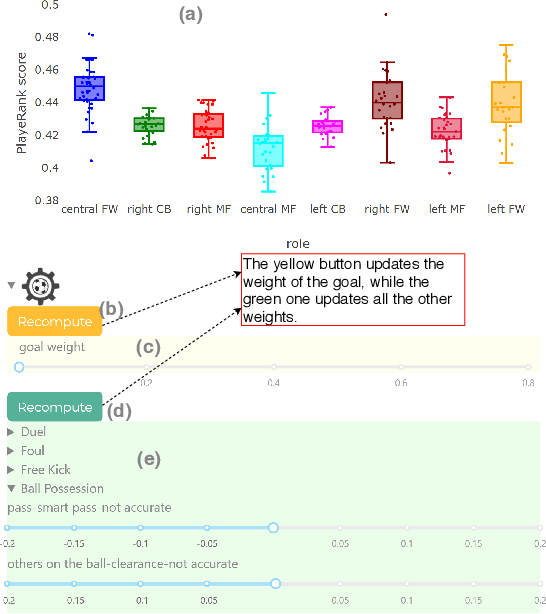
The performance of soccer players is one of most discussed aspects by many actors in the soccer industry: from supporters to journalists, from coaches to talent scouts. Unfortunately, the dashboards available online provide no effective way to compare the evolution of the performance of players or to find players behaving similarly on the field. This paper describes the design of a web dashboard that interacts via APIs with a performance evaluation algorithm and provides graphical tools that allow the user to perform many tasks, such as to search or compare players by age, role or trend of growth in their performance, find similar players based on their pitching behavior, change the algorithm's parameters to obtain customized performance scores. We also describe an example of how a talent scout can interact with the dashboard to find young, promising talents.
The PGM-index: a multicriteria, compressed and learned approach to data indexing
Oct 14, 2019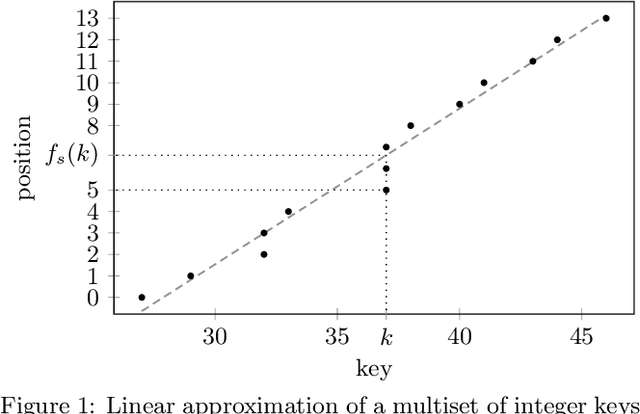

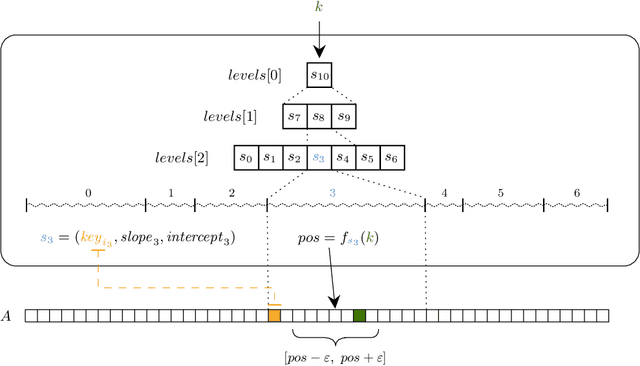
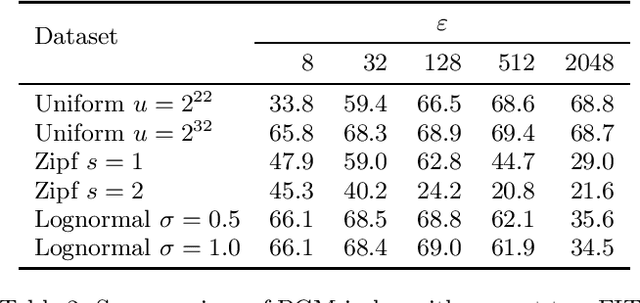
The recent introduction of learned indexes has shaken the foundations of the decades-old field of indexing data structures. Combining, or even replacing, classic design elements such as B-tree nodes with machine learning models has proven to give outstanding improvements in the space footprint and time efficiency of data systems. However, these novel approaches are based on heuristics, thus they lack any guarantees both in their time and space requirements. We propose the Piecewise Geometric Model index (shortly, PGM-index), which achieves guaranteed I/O-optimality in query operations, learns an optimal number of linear models, and its peculiar recursive construction makes it a purely learned data structure, rather than a hybrid of traditional and learned indexes (such as RMI and FITing-tree). We show that the PGM-index improves the space of the FITing-tree by 63.3% and of the B-tree by more than four orders of magnitude, while achieving their same or even better query time efficiency. We complement this result by proposing three variants of the PGM-index. First, we design a compressed PGM-index that further reduces its space footprint by exploiting the repetitiveness at the level of the learned linear models it is composed of. Second, we design a PGM-index that adapts itself to the distribution of the queries, thus resulting in the first known distribution-aware learned index to date. Finally, given its flexibility in the offered space-time trade-offs, we propose the multicriteria PGM-index that efficiently auto-tune itself in a few seconds over hundreds of millions of keys to the possibly evolving space-time constraints imposed by the application of use. We remark to the reader that this paper is an extended and improved version of our previous paper titled "Superseding traditional indexes by orchestrating learning and geometry" (arXiv:1903.00507).
PlayeRank: Multi-dimensional and role-aware rating of soccer player performance
Feb 16, 2018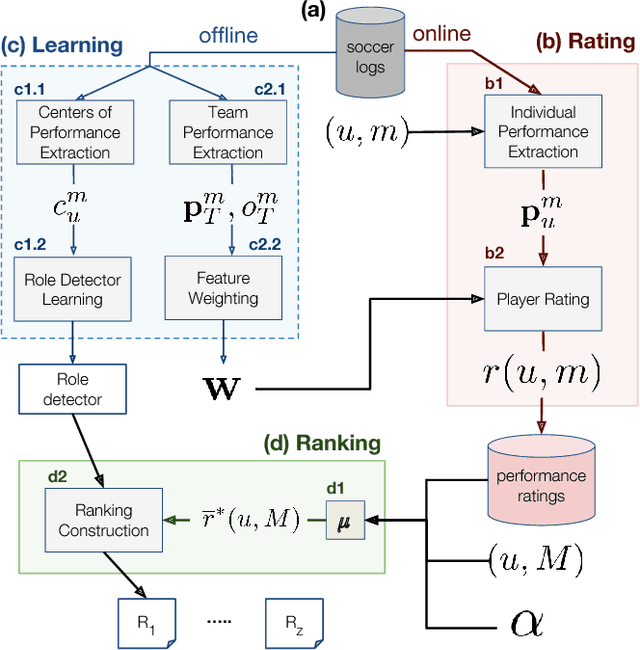
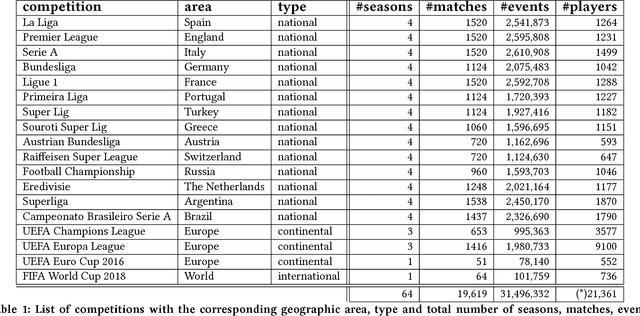
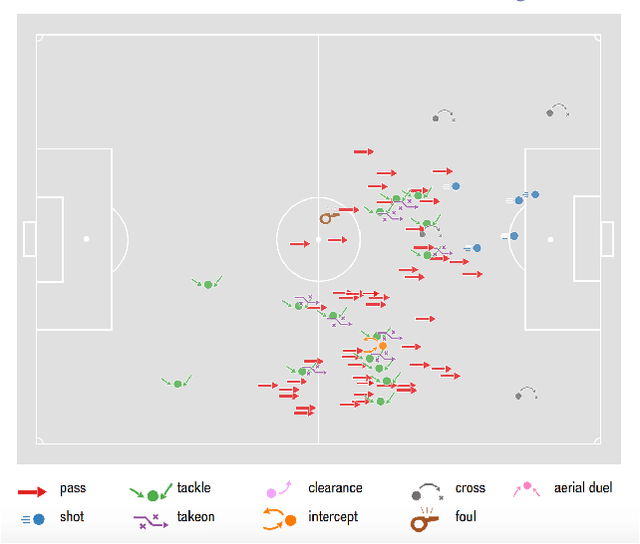
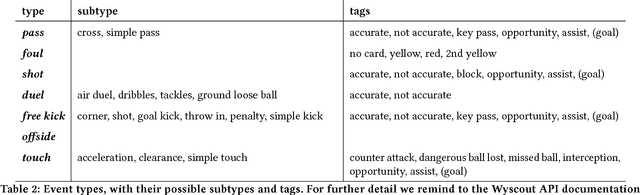
The problem of rating the performance of soccer players is attracting the interest of many companies, websites, and the scientific community, thanks to the availability of massive data capturing all the events generated during a game (e.g., tackles, passes, shots, etc.). Existing approaches fail to fully exploit the richness of the available data and lack of a proper validation. In this paper, we design and implement PlayeRank, a data-driven framework that offers a principled multi-dimensional and role-aware evaluation of the performance of soccer players. We validate the framework through an experimental analysis advised by soccer experts, based on a massive dataset of millions of events pertaining four seasons of the five prominent European leagues. Experiments show that PlayeRank is robust in agreeing with the experts' evaluation of players, significantly improving the state of the art. We also explore an application of PlayeRank --- i.e. searching players --- by introducing a special form of spatial query on the soccer field. This shows its flexibility and efficiency, which makes it worth to be used in the design of a scalable platform for soccer analytics.