 Add to Chrome
 Add to Firefox
 Add to Edge
Recall Before Rerank: Benchmarking Deep Learning Models for Large-Scale Code-to-Code Retrieval
Jun 24, 2026
Semantic code search and clone detection are essential for software development, maintenance, and reuse. This paper evaluates the effectiveness, efficiency, and scalability of contemporary deep learning models for first-stage recall in large-scale code-to-code search engines. Benchmarking across multiple programming languages and datasets reveals critical limits in the precision and scalability of these models on Terabyte-scale source-code collections. We present LLM-based code normalisation and query-rewriting schemes that yield significant gains in precision for lower-performing models. Our results question the sustainability of resource-constrained deployment and the assumed robustness of current code-specialised LLMs across datasets. We conclude with actionable insights for building scalable, efficient code-retrieval systems.

Investigating the Scalability of Approximate Sparse Retrieval Algorithms to Massive Datasets
Jan 20, 2025

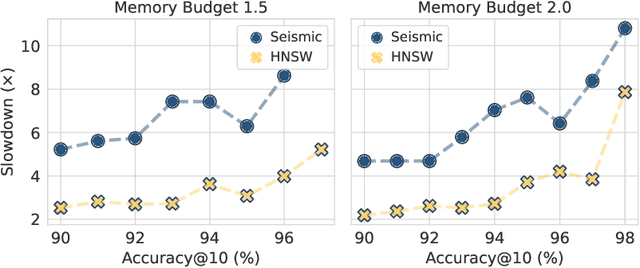
Learned sparse text embeddings have gained popularity due to their effectiveness in top-k retrieval and inherent interpretability. Their distributional idiosyncrasies, however, have long hindered their use in real-world retrieval systems. That changed with the recent development of approximate algorithms that leverage the distributional properties of sparse embeddings to speed up retrieval. Nonetheless, in much of the existing literature, evaluation has been limited to datasets with only a few million documents such as MSMARCO. It remains unclear how these systems behave on much larger datasets and what challenges lurk in larger scales. To bridge that gap, we investigate the behavior of state-of-the-art retrieval algorithms on massive datasets. We compare and contrast the recently-proposed Seismic and graph-based solutions adapted from dense retrieval. We extensively evaluate Splade embeddings of 138M passages from MsMarco-v2 and report indexing time and other efficiency and effectiveness metrics.