 Add to Chrome
 Add to Firefox
 Add to Edge
Observational Policy Ranking for SMB Financial Guidance from Multi-Action Accounting Logs
Aug 10, 2026
Small and medium-sized businesses need timely financial guidance, yet historical accounting logs record self-selected and often co-occurring business changes rather than randomized recommendations. We formulate this setting as observational policy ranking: from pre-decision financial information, a policy selects one of 34 ledger-derived business-change categories for a target financial KPI. Using 85,078 company-month observations from 7,505 firms, we introduce Covariate-Adjusted Residual Policy Learning (CAR-PL), an action-wise R-learner that operates directly on multi-hot logs and regularizes selection by observational support. We compare CAR-PL with an uplift T-Learner, a conservative contextual value model, a zero-shot LLM, and non-personalized references on company-disjoint held-out firms under a shared model-assisted scoring rule. CAR-PL has the highest Gross Profit point estimate (0.084), the T-Learner has the highest Revenue point estimate (0.085), and the contextual value model has the highest Quick Ratio point estimate (0.062). CAR-PL and the T-Learner are not statistically separated on either growth KPI in matched company-clustered comparisons, while CAR-PL selects 33-34 categories and produces less concentrated selections across the catalog. Outcome-model-only scoring retains the same KPI-level point-estimate leader or top pair, and category rankings remain similar when the all-zero treatment reference is replaced by the most common training co-action pattern. These findings support objective-specific ranking of SMB financial guidance from multi-action accounting logs.

Textual Belief States for World Models: Identifiable Representation Learning Under Strict Mediation
Jun 26, 2026World models in partially observed environments rely on latent representations that summarize interaction history, but in many modern LLM-based architectures predictive performance fails to reflect representation quality due to history bypass, rendering the latent state unidentifiable. Strict latent state mediation, requiring predictions to depend only on the latent state and action, is a classical principle that resolves this, but enforcing it in text-based settings is an open challenge: textual latent states are discrete and non-differentiable, precluding variational training, and expressive LLM decoders readily ignore the bottleneck. We show how to make strict mediation work in the text domain. We formalize why it is necessary, showing that strict mediation makes representation quality empirically testable while history-leaky architectures break this connection. We then introduce textual latent states, which are discrete, interpretable, and variable-length, and factorized GRPO (fGRPO), a tree-structured reinforcement learning method that enforces strict mediation during training. Experiments on TextWorld and ScienceWorld show preserved one-step prediction accuracy alongside up to 57\% gains in representation quality and 98\% improvements in rollout performance, increasing with task complexity and horizon.
Executable Schema Contracts: From Automatic Ingestion to Multi-Source Retrieval
Jun 03, 2026Real-world data spans tables, documents, and semi-structured files with implicit semantics. Querying this data requires integrating evidence across inconsistent schemas and formats, yet existing approaches either demand costly manual engineering or bypass structure entirely. We present a system that automatically discovers an executable schema from raw multi-source data and uses it as a shared contract for knowledge graph construction and query-time retrieval. A closed-world field catalog constrains LLM-based schema discovery to attested fields; deterministic structural analysis infers identity keys, foreign keys, and source hierarchy; and the resulting schema drives extraction, deduplication, and cross-source linking into a provenance-aware knowledge graph. At query time the schema -- optionally extended via a monotonic protocol -- conditions a multi-tool agent routing retrieval across structured lookup, graph traversal, and vector search, returning grounded answers with traceable citations. In controlled zero-shot comparisons using the same LLM, data, and evaluation harness, the system improves over retrieval-only and decomposition-based baselines across four QA benchmarks, with ablations showing that schema-conditioned routing, structural intelligence, and schema-guided construction each contribute to the gains.
Ada-VSR: Adaptive Video Super-Resolution with Meta-Learning
Aug 05, 2021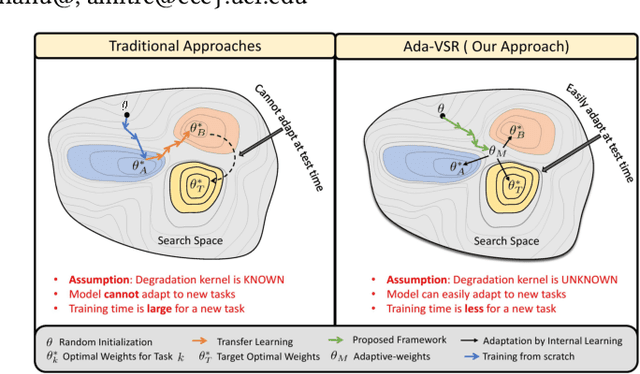
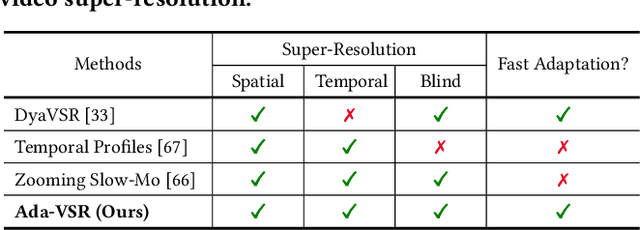
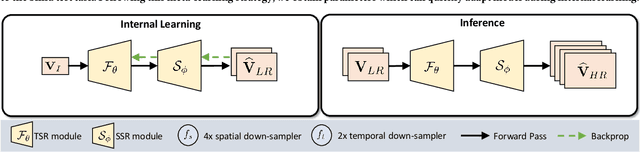
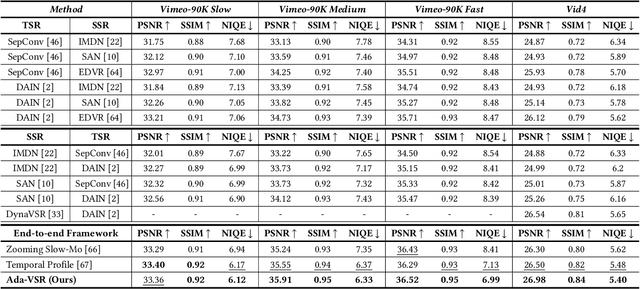
Most of the existing works in supervised spatio-temporal video super-resolution (STVSR) heavily rely on a large-scale external dataset consisting of paired low-resolution low-frame rate (LR-LFR)and high-resolution high-frame-rate (HR-HFR) videos. Despite their remarkable performance, these methods make a prior assumption that the low-resolution video is obtained by down-scaling the high-resolution video using a known degradation kernel, which does not hold in practical settings. Another problem with these methods is that they cannot exploit instance-specific internal information of video at testing time. Recently, deep internal learning approaches have gained attention due to their ability to utilize the instance-specific statistics of a video. However, these methods have a large inference time as they require thousands of gradient updates to learn the intrinsic structure of the data. In this work, we presentAdaptiveVideoSuper-Resolution (Ada-VSR) which leverages external, as well as internal, information through meta-transfer learning and internal learning, respectively. Specifically, meta-learning is employed to obtain adaptive parameters, using a large-scale external dataset, that can adapt quickly to the novel condition (degradation model) of the given test video during the internal learning task, thereby exploiting external and internal information of a video for super-resolution. The model trained using our approach can quickly adapt to a specific video condition with only a few gradient updates, which reduces the inference time significantly. Extensive experiments on standard datasets demonstrate that our method performs favorably against various state-of-the-art approaches.
SAGE: Sequential Attribute Generator for Analyzing Glioblastomas using Limited Dataset
May 14, 2020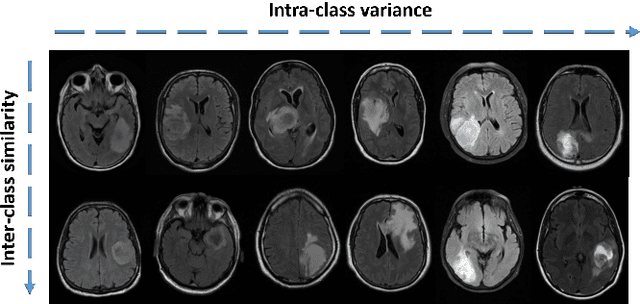
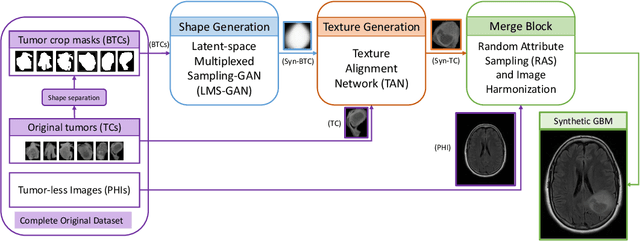
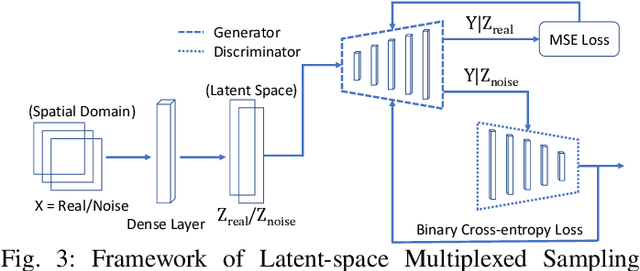
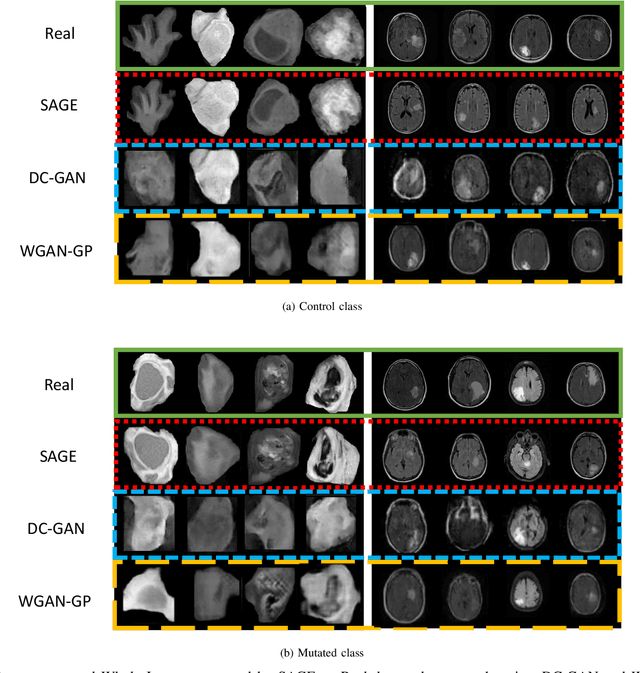
While deep learning approaches have shown remarkable performance in many imaging tasks, most of these methods rely on availability of large quantities of data. Medical image data, however, is scarce and fragmented. Generative Adversarial Networks (GANs) have recently been very effective in handling such datasets by generating more data. If the datasets are very small, however, GANs cannot learn the data distribution properly, resulting in less diverse or low-quality results. One such limited dataset is that for the concurrent gain of 19 and 20 chromosomes (19/20 co-gain), a mutation with positive prognostic value in Glioblastomas (GBM). In this paper, we detect imaging biomarkers for the mutation to streamline the extensive and invasive prognosis pipeline. Since this mutation is relatively rare, i.e. small dataset, we propose a novel generative framework - the Sequential Attribute GEnerator (SAGE), that generates detailed tumor imaging features while learning from a limited dataset. Experiments show that not only does SAGE generate high quality tumors when compared to standard Deep Convolutional GAN (DC-GAN) and Wasserstein GAN with Gradient Penalty (WGAN-GP), it also captures the imaging biomarkers accurately.