 Add to Chrome
 Add to Firefox
 Add to Edge
Cardiac Output Prediction from Echocardiograms: Self-Supervised Learning with Limited Data
Feb 14, 2026
Cardiac Output (CO) is a key parameter in the diagnosis and management of cardiovascular diseases. However, its accurate measurement requires right-heart catheterization, an invasive and time-consuming procedure, motivating the development of reliable non-invasive alternatives using echocardiography. In this work, we propose a self-supervised learning (SSL) pretraining strategy based on SimCLR to improve CO prediction from apical four-chamber echocardiographic videos. The pretraining is performed using the same limited dataset available for the downstream task, demonstrating the potential of SSL even under data scarcity. Our results show that SSL mitigates overfitting and improves representation learning, achieving an average Pearson correlation of 0.41 on the test set and outperforming PanEcho, a model trained on over one million echocardiographic exams. Source code is available at https://github.com/EIDOSLAB/cardiac-output.

Detection of subclinical atherosclerosis by image-based deep learning on chest x-ray
Mar 27, 2024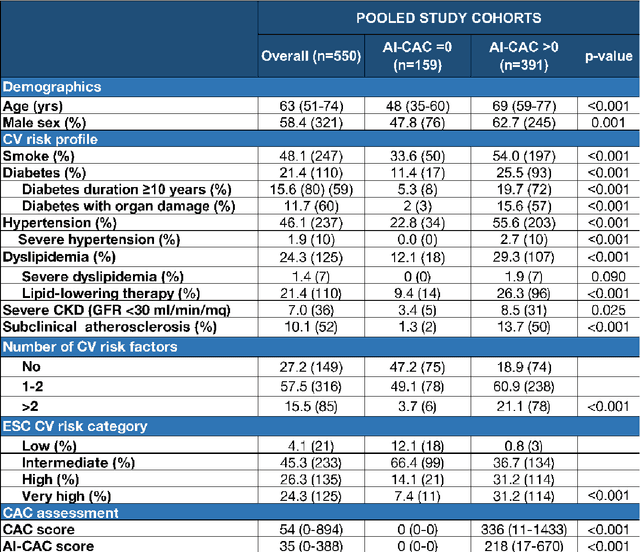
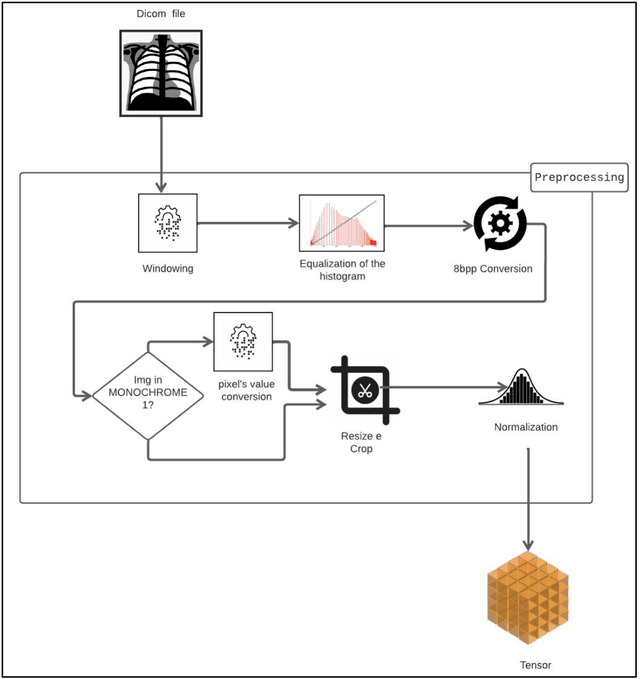

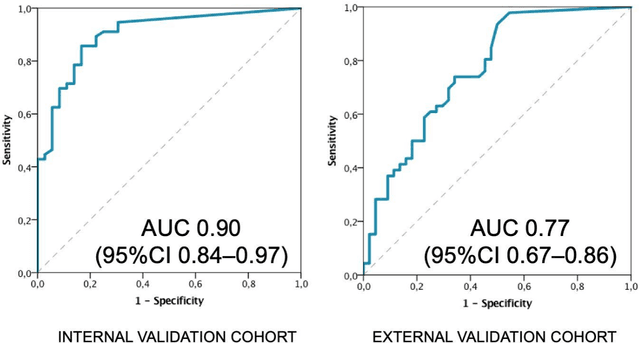
Aims. To develop a deep-learning based system for recognition of subclinical atherosclerosis on a plain frontal chest x-ray. Methods and Results. A deep-learning algorithm to predict coronary artery calcium (CAC) score (the AI-CAC model) was developed on 460 chest x-ray (80% training cohort, 20% internal validation cohort) of primary prevention patients (58.4% male, median age 63 [51-74] years) with available paired chest x-ray and chest computed tomography (CT) indicated for any clinical reason and performed within 3 months. The CAC score calculated on chest CT was used as ground truth. The model was validated on an temporally-independent cohort of 90 patients from the same institution (external validation). The diagnostic accuracy of the AI-CAC model assessed by the area under the curve (AUC) was the primary outcome. Overall, median AI-CAC score was 35 (0-388) and 28.9% patients had no AI-CAC. AUC of the AI-CAC model to identify a CAC>0 was 0.90 in the internal validation cohort and 0.77 in the external validation cohort. Sensitivity was consistently above 92% in both cohorts. In the overall cohort (n=540), among patients with AI-CAC=0, a single ASCVD event occurred, after 4.3 years. Patients with AI-CAC>0 had significantly higher Kaplan Meier estimates for ASCVD events (13.5% vs. 3.4%, log-rank=0.013). Conclusion. The AI-CAC model seems to accurately detect subclinical atherosclerosis on chest x-ray with elevated sensitivity, and to predict ASCVD events with elevated negative predictive value. Adoption of the AI-CAC model to refine CV risk stratification or as an opportunistic screening tool requires prospective evaluation.