 Add to Chrome
 Add to Firefox
 Add to Edge
AdaTok: Adaptive Token Compression with Object-Aware Representations for Efficient Multimodal LLMs
Nov 18, 2025

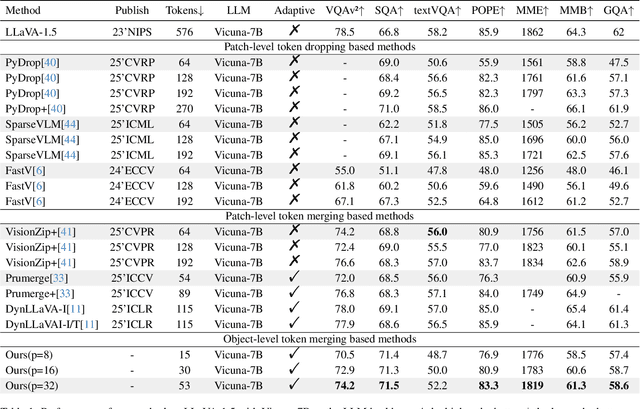
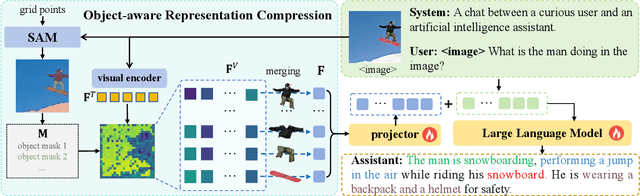
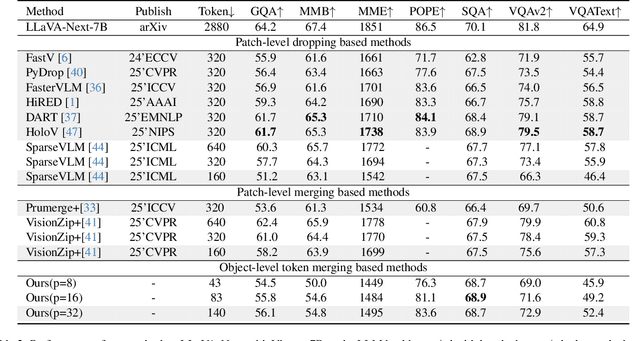
Multimodal Large Language Models (MLLMs) have demonstrated substantial value in unified text-image understanding and reasoning, primarily by converting images into sequences of patch-level tokens that align with their architectural paradigm. However, patch-level tokenization leads to a quadratic growth in image tokens, burdening MLLMs' understanding and reasoning with enormous computation and memory. Additionally, the traditional patch-wise scanning tokenization workflow misaligns with the human vision cognition system, further leading to hallucination and computational redundancy. To address this issue, we propose an object-level token merging strategy for Adaptive Token compression, revealing the consistency with human vision system. The experiments are conducted on multiple comprehensive benchmarks, which show that our approach averagely, utilizes only 10% tokens while achieving almost 96% of the vanilla model's performance. More extensive experimental results in comparison with relevant works demonstrate the superiority of our method in balancing compression ratio and performance. Our code will be available.

Exploiting Inherent Class Label: Towards Robust Scribble Supervised Semantic Segmentation
Mar 18, 2025Scribble-based weakly supervised semantic segmentation leverages only a few annotated pixels as labels to train a segmentation model, presenting significant potential for reducing the human labor involved in the annotation process. This approach faces two primary challenges: first, the sparsity of scribble annotations can lead to inconsistent predictions due to limited supervision; second, the variability in scribble annotations, reflecting differing human annotator preferences, can prevent the model from consistently capturing the discriminative regions of objects, potentially leading to unstable predictions. To address these issues, we propose a holistic framework, the class-driven scribble promotion network, for robust scribble-supervised semantic segmentation. This framework not only utilizes the provided scribble annotations but also leverages their associated class labels to generate reliable pseudo-labels. Within the network, we introduce a localization rectification module to mitigate noisy labels and a distance perception module to identify reliable regions surrounding scribble annotations and pseudo-labels. In addition, we introduce new large-scale benchmarks, ScribbleCOCO and ScribbleCityscapes, accompanied by a scribble simulation algorithm that enables evaluation across varying scribble styles. Our method demonstrates competitive performance in both accuracy and robustness, underscoring its superiority over existing approaches. The datasets and the codes will be made publicly available.
FP-PET: Large Model, Multiple Loss And Focused Practice
Sep 22, 2023This study presents FP-PET, a comprehensive approach to medical image segmentation with a focus on CT and PET images. Utilizing a dataset from the AutoPet2023 Challenge, the research employs a variety of machine learning models, including STUNet-large, SwinUNETR, and VNet, to achieve state-of-the-art segmentation performance. The paper introduces an aggregated score that combines multiple evaluation metrics such as Dice score, false positive volume (FPV), and false negative volume (FNV) to provide a holistic measure of model effectiveness. The study also discusses the computational challenges and solutions related to model training, which was conducted on high-performance GPUs. Preprocessing and postprocessing techniques, including gaussian weighting schemes and morphological operations, are explored to further refine the segmentation output. The research offers valuable insights into the challenges and solutions for advanced medical image segmentation.