 Add to Chrome
 Add to Firefox
 Add to Edge
SemStruct: Contextualizing Semantic Embeddings with Structural Information for Schema Matching
May 29, 2026
Schema matching is a fundamental step in integrating heterogeneous data sources. While Pre-trained Language Models (PLMs) have revolutionized this task by capturing linguistic semantics, they typically process tabular data as serialized text sequences of standalone column descriptions. This serialization discards critical structural information -- specifically, the row-level co-occurrences, i.e. the relational context -- forcing models to rely solely on column header semantics or standalone distributions. To bridge this gap, we propose SemStruct, a framework that joins the semantic power of frozen PLMs with the structural inductive bias of Graph Neural Networks (GNNs). We model the table as a heterogeneous graph where columns and values are nodes connected by rows, allowing the GNN to propagate disambiguating context across the structure. Unlike other state-of-the-art methods that require proprietary LLM access and fine-tuning of language models, SemStruct keeps the language model frozen and trains only a lightweight structural encoder. Extensive experiments on the Valentine and SOTAB-SM benchmarks demonstrate that SemStruct achieves state-of-the-art performance, outperforming fully fine-tuned baselines on complex, semantically joinable datasets. Furthermore, our ablation studies reveal that row representations serve primarily as topological conduits rather than semantic entities, validating the necessity of explicit structural modeling in schema matching.

Towards Automated Ontology Generation from Unstructured Text: A Multi-Agent LLM Approach
Apr 25, 2026Automatically generating formal ontologies from unstructured natural language remains a central challenge in knowledge engineering. While large language models (LLMs) show promise, it remains unclear which architectural design choices drive generation quality and why current approaches fail. We present a controlled experimental study using domain-specific insurance contracts to investigate these questions. We first establish a single-agent LLM baseline, identifying key failure modes such as poor Ontology Design Pattern compliance, structural redundancy, and ineffective iterative repair. We then introduce a multi-agent architecture that decomposes ontology construction into four artifact-driven roles: Domain Expert, Manager, Coder, and Quality Assurer. We evaluate performance across architectural quality (via a panel of heterogeneous LLM judges) and functional usability (via competency question driven SPARQL evaluation with complementary retrieval augmented generation based assessment). Results show that the multi-agent approach significantly improves structural quality and modestly enhances queryability, with gains driven primarily by front-loaded planning. These findings highlight planning-first, artifact-driven generation as a promising and more auditable path toward scalable automated ontology engineering.
From Risk to Rescue: An Agentic Survival Analysis Framework for Liquidation Prevention
Apr 16, 2026Decentralized Finance (DeFi) lending protocols like Aave v3 rely on over-collateralization to secure loans, yet users frequently face liquidation due to volatile market conditions. Existing risk management tools utilize static health-factor thresholds, which are reactive and fail to distinguish between administrative "dust" cleanup and genuine insolvency. In this work, we propose an autonomous agent that leverages time-to-event (survival) analysis and moves beyond prediction to execution. Unlike passive risk signals, this agent perceives risk, simulates counterfactual futures, and executes protocol-faithful interventions to proactively prevent liquidations. We introduce a return period metric derived from a numerically stable XGBoost Cox proportional hazards model to normalize risk across transaction types, coupled with a volatility-adjusted trend score to filter transient market noise. To select optimal interventions, we implement a counterfactual optimization loop that simulates potential user actions to find the minimum capital required to mitigate risk. We validate our approach using a high-fidelity, protocol-faithful Aave v3 simulator on a cohort of 4,882 high-risk user profiles. The results demonstrate the agent's ability to prevent liquidations in imminent-risk scenarios where static rules fail, effectively "saving the unsavable" while maintaining a zero worsening rate, providing a critical safety guarantee often missing in autonomous financial agents. Furthermore, the system successfully differentiates between actionable financial risks and negligible dust events, optimizing capital efficiency where static rules fail.
A Benchmark for Gap and Overlap Analysis as a Test of KG Task Readiness
Apr 12, 2026Task-oriented evaluation of knowledge graph (KG) quality increasingly asks whether an ontology-based representation can answer the competency questions that users actually care about, in a manner that is reproducible, explainable, and traceable to evidence. This paper adopts that perspective and focuses on gap and overlap analysis for policy-like documents (e.g., insurance contracts), where given a scenario, which documents support it (overlap) and which do not (gap), with defensible justifications. The resulting gap/overlap determinations are typically driven by genuine differences in coverage and restrictions rather than missing data, making the task a direct test of KG task readiness rather than a test of missing facts or query expressiveness. We present an executable and auditable benchmark that aligns natural-language contract text with a formal ontology and evidence-linked ground truth, enabling systematic comparison of methods. The benchmark includes: (i) ten simplified yet diverse life-insurance contracts reviewed by a domain expert, (ii) a domain ontology (TBox) with an instantiated knowledge base (ABox) populated from contract facts, and (iii) 58 structured scenarios paired with SPARQL queries with contract-level outcomes and clause-level excerpts that justify each label. Using this resource, we compare a text-only LLM baseline that infers outcomes directly from contract text against an ontology-driven pipeline that answers the same scenarios over the instantiated KG, demonstrating that explicit modeling improves consistency and diagnosis for gap/overlap analyses. Although demonstrated for gap and overlap analysis, the benchmark is intended as a reusable template for evaluating KG quality and supporting downstream work such as ontology learning, KG population, and evidence-grounded question answering.
Benchmarking Temporal Web3 Intelligence: Lessons from the FinSurvival 2025 Challenge
Feb 26, 2026Temporal Web analytics increasingly relies on large-scale, longitudinal data to understand how users, content, and systems evolve over time. A rapidly growing frontier is the \emph{Temporal Web3}: decentralized platforms whose behavior is recorded as immutable, time-stamped event streams. Despite the richness of this data, the field lacks shared, reproducible benchmarks that capture real-world temporal dynamics, specifically censoring and non-stationarity, across extended horizons. This absence slows methodological progress and limits the transfer of techniques between Web3 and broader Web domains. In this paper, we present the \textit{FinSurvival Challenge 2025} as a case study in benchmarking \emph{temporal Web3 intelligence}. Using 21.8 million transaction records from the Aave v3 protocol, the challenge operationalized 16 survival prediction tasks to model user behavior transitions.We detail the benchmark design and the winning solutions, highlighting how domain-aware temporal feature construction significantly outperformed generic modeling approaches. Furthermore, we distill lessons for next-generation temporal benchmarks, arguing that Web3 systems provide a high-fidelity sandbox for studying temporal challenges, such as churn, risk, and evolution that are fundamental to the wider Web.
Measuring Privacy Risks and Tradeoffs in Financial Synthetic Data Generation
Feb 10, 2026We explore the privacy-utility tradeoff of synthetic data generation schemes on tabular financial datasets, a domain characterized by high regulatory risk and severe class imbalance. We consider representative tabular data generators, including autoencoders, generative adversarial networks, diffusion, and copula synthesizers. To address the challenges of the financial domain, we provide novel privacy-preserving implementations of GAN and autoencoder synthesizers. We evaluate whether and how well the generators simultaneously achieve data quality, downstream utility, and privacy, with comparison across balanced and imbalanced input datasets. Our results offer insight into the distinct challenges of generating synthetic data from datasets that exhibit severe class imbalance and mixed-type attributes.
Avoiding Over-Personalization with Rule-Guided Knowledge Graph Adaptation for LLM Recommendations
Sep 08, 2025We present a lightweight neuro-symbolic framework to mitigate over-personalization in LLM-based recommender systems by adapting user-side Knowledge Graphs (KGs) at inference time. Instead of retraining models or relying on opaque heuristics, our method restructures a user's Personalized Knowledge Graph (PKG) to suppress feature co-occurrence patterns that reinforce Personalized Information Environments (PIEs), i.e., algorithmically induced filter bubbles that constrain content diversity. These adapted PKGs are used to construct structured prompts that steer the language model toward more diverse, Out-PIE recommendations while preserving topical relevance. We introduce a family of symbolic adaptation strategies, including soft reweighting, hard inversion, and targeted removal of biased triples, and a client-side learning algorithm that optimizes their application per user. Experiments on a recipe recommendation benchmark show that personalized PKG adaptations significantly increase content novelty while maintaining recommendation quality, outperforming global adaptation and naive prompt-based methods.
MetaExplainer: A Framework to Generate Multi-Type User-Centered Explanations for AI Systems
Aug 01, 2025Explanations are crucial for building trustworthy AI systems, but a gap often exists between the explanations provided by models and those needed by users. To address this gap, we introduce MetaExplainer, a neuro-symbolic framework designed to generate user-centered explanations. Our approach employs a three-stage process: first, we decompose user questions into machine-readable formats using state-of-the-art large language models (LLM); second, we delegate the task of generating system recommendations to model explainer methods; and finally, we synthesize natural language explanations that summarize the explainer outputs. Throughout this process, we utilize an Explanation Ontology to guide the language models and explainer methods. By leveraging LLMs and a structured approach to explanation generation, MetaExplainer aims to enhance the interpretability and trustworthiness of AI systems across various applications, providing users with tailored, question-driven explanations that better meet their needs. Comprehensive evaluations of MetaExplainer demonstrate a step towards evaluating and utilizing current state-of-the-art explanation frameworks. Our results show high performance across all stages, with a 59.06% F1-score in question reframing, 70% faithfulness in model explanations, and 67% context-utilization in natural language synthesis. User studies corroborate these findings, highlighting the creativity and comprehensiveness of generated explanations. Tested on the Diabetes (PIMA Indian) tabular dataset, MetaExplainer supports diverse explanation types, including Contrastive, Counterfactual, Rationale, Case-Based, and Data explanations. The framework's versatility and traceability from using ontology to guide LLMs suggest broad applicability beyond the tested scenarios, positioning MetaExplainer as a promising tool for enhancing AI explainability across various domains.
Terminators: Terms of Service Parsing and Auditing Agents
May 16, 2025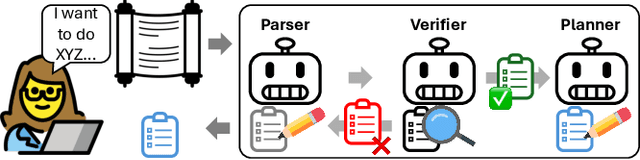
Terms of Service (ToS) documents are often lengthy and written in complex legal language, making them difficult for users to read and understand. To address this challenge, we propose Terminators, a modular agentic framework that leverages large language models (LLMs) to parse and audit ToS documents. Rather than treating ToS understanding as a black-box summarization problem, Terminators breaks the task down to three interpretable steps: term extraction, verification, and accountability planning. We demonstrate the effectiveness of our method on the OpenAI ToS using GPT-4o, highlighting strategies to minimize hallucinations and maximize auditability. Our results suggest that structured, agent-based LLM workflows can enhance both the usability and enforceability of complex legal documents. By translating opaque terms into actionable, verifiable components, Terminators promotes ethical use of web content by enabling greater transparency, empowering users to understand their digital rights, and supporting automated policy audits for regulatory or civic oversight.
Blockchain-based Framework for Scalable and Incentivized Federated Learning
Feb 20, 2025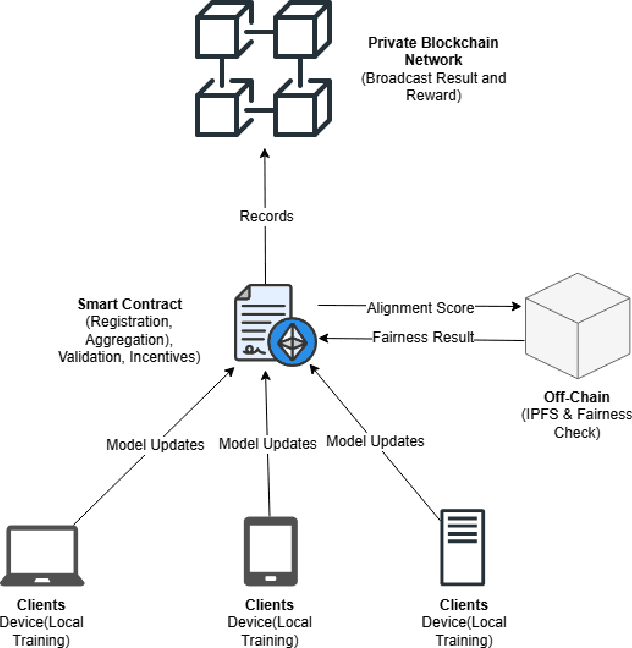

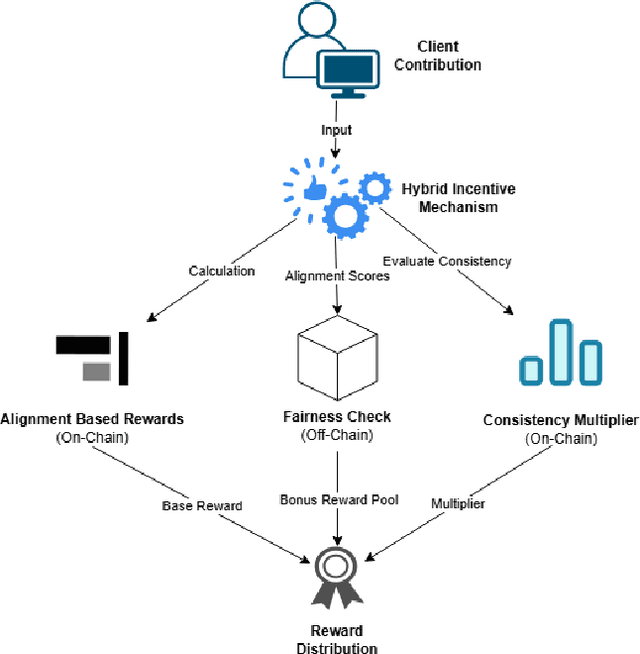
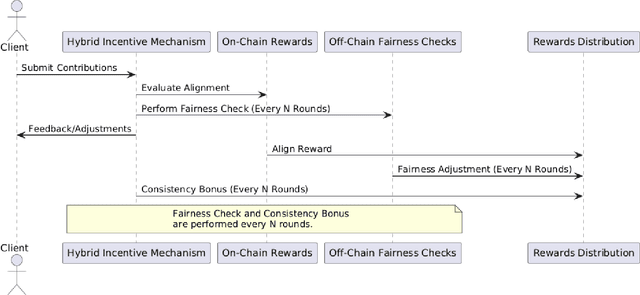
Federated Learning (FL) enables collaborative model training without sharing raw data, preserving privacy while harnessing distributed datasets. However, traditional FL systems often rely on centralized aggregating mechanisms, introducing trust issues, single points of failure, and limited mechanisms for incentivizing meaningful client contributions. These challenges are exacerbated as FL scales to train resource-intensive models, such as large language models (LLMs), requiring scalable, decentralized solutions. This paper presents a blockchain-based FL framework that addresses these limitations by integrating smart contracts and a novel hybrid incentive mechanism. The framework automates critical FL tasks, including client registration, update validation, reward distribution, and maintaining a transparent global state. The hybrid incentive mechanism combines on-chain alignment-based rewards, off-chain fairness checks, and consistency multipliers to ensure fairness, transparency, and sustained engagement. We evaluate the framework through gas cost analysis, demonstrating its feasibility for different scales of federated learning scenarios.