 Add to Chrome
 Add to Firefox
 Add to Edge
Don't Forget Your Embeddings: Robust Knowledge Erasure via Precise Editing of Embeddings
Jun 02, 2026
As language models are increasingly deployed in real-world applications, the ability to erase specific knowledge from them becomes critical for safety and compliance. Prominent methods seek persistent removal by updating the model's parameters, yet the target knowledge often can be recovered through adversarial prompting or relearning. In this work, we hypothesize this limitation stems in part from existing methods overlooking the embedding layer. To address this, we introduce EMBedding ERasure (EMBER), a plug-n-play erasure module that leverages Sparse Matrix Factorization for precise erasure of concept-related features from token embeddings. Through comprehensive evaluations across diverse concepts on Gemma-2-2B-it and Llama-3.1-8B-Instruct, we find that augmenting existing methods with EMBER consistently improves erasure efficacy and specificity across task formats, with minimal coherence loss. Moreover, it dramatically improves robustness to relearning, reducing regained accuracy by up to 50%, limiting it to 35% on Llama compared to 70%-76% for prior methods. Further analysis shows that the coherence cost is localized, affecting only a small set of concept-exclusive tokens. Our work establishes that precise embedding-level intervention is necessary for robust concept erasure, and demonstrates that existing methods can benefit from such augmentation.

From Directions to Regions: Decomposing Activations in Language Models via Local Geometry
Feb 02, 2026Activation decomposition methods in language models are tightly coupled to geometric assumptions on how concepts are realized in activation space. Existing approaches search for individual global directions, implicitly assuming linear separability, which overlooks concepts with nonlinear or multi-dimensional structure. In this work, we leverage Mixture of Factor Analyzers (MFA) as a scalable, unsupervised alternative that models the activation space as a collection of Gaussian regions with their local covariance structure. MFA decomposes activations into two compositional geometric objects: the region's centroid in activation space, and the local variation from the centroid. We train large-scale MFAs for Llama-3.1-8B and Gemma-2-2B, and show they capture complex, nonlinear structures in activation space. Moreover, evaluations on localization and steering benchmarks show that MFA outperforms unsupervised baselines, is competitive with supervised localization methods, and often achieves stronger steering performance than sparse autoencoders. Together, our findings position local geometry, expressed through subspaces, as a promising unit of analysis for scalable concept discovery and model control, accounting for complex structures that isolated directions fail to capture.
Decomposing MLP Activations into Interpretable Features via Semi-Nonnegative Matrix Factorization
Jun 12, 2025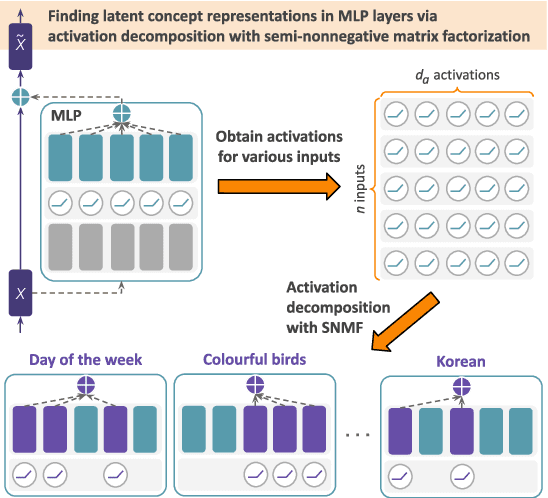
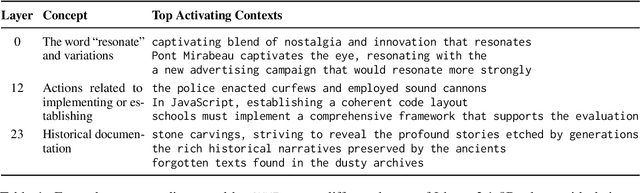
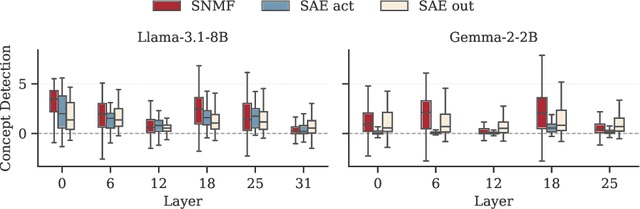
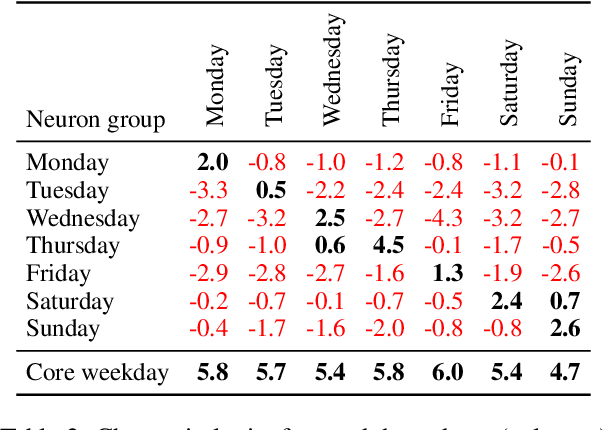
A central goal for mechanistic interpretability has been to identify the right units of analysis in large language models (LLMs) that causally explain their outputs. While early work focused on individual neurons, evidence that neurons often encode multiple concepts has motivated a shift toward analyzing directions in activation space. A key question is how to find directions that capture interpretable features in an unsupervised manner. Current methods rely on dictionary learning with sparse autoencoders (SAEs), commonly trained over residual stream activations to learn directions from scratch. However, SAEs often struggle in causal evaluations and lack intrinsic interpretability, as their learning is not explicitly tied to the computations of the model. Here, we tackle these limitations by directly decomposing MLP activations with semi-nonnegative matrix factorization (SNMF), such that the learned features are (a) sparse linear combinations of co-activated neurons, and (b) mapped to their activating inputs, making them directly interpretable. Experiments on Llama 3.1, Gemma 2 and GPT-2 show that SNMF derived features outperform SAEs and a strong supervised baseline (difference-in-means) on causal steering, while aligning with human-interpretable concepts. Further analysis reveals that specific neuron combinations are reused across semantically-related features, exposing a hierarchical structure in the MLP's activation space. Together, these results position SNMF as a simple and effective tool for identifying interpretable features and dissecting concept representations in LLMs.