 Add to Chrome
 Add to Firefox
 Add to Edge
Adapting Vision-Language Models for E-commerce Understanding at Scale
Feb 12, 2026
E-commerce product understanding demands by nature, strong multimodal comprehension from text, images, and structured attributes. General-purpose Vision-Language Models (VLMs) enable generalizable multimodal latent modelling, yet there is no documented, well-known strategy for adapting them to the attribute-centric, multi-image, and noisy nature of e-commerce data, without sacrificing general performance. In this work, we show through a large-scale experimental study, how targeted adaptation of general VLMs can substantially improve e-commerce performance while preserving broad multimodal capabilities. Furthermore, we propose a novel extensive evaluation suite covering deep product understanding, strict instruction following, and dynamic attribute extraction.

Depth Extraction from Videos Using Geometric Context and Occlusion Boundaries
Oct 25, 2015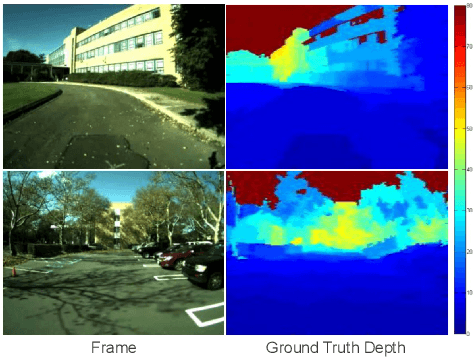
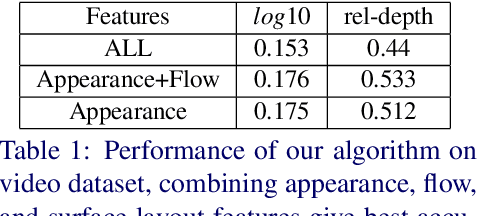
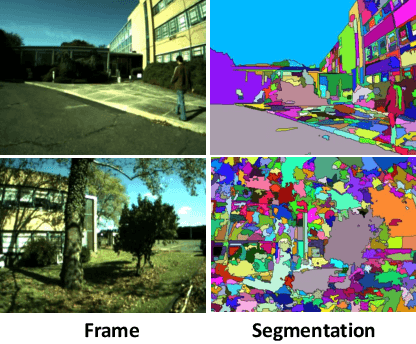
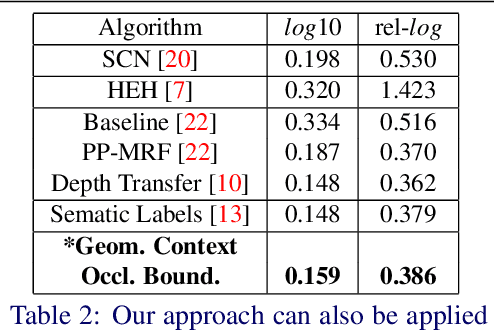
We present an algorithm to estimate depth in dynamic video scenes. We propose to learn and infer depth in videos from appearance, motion, occlusion boundaries, and geometric context of the scene. Using our method, depth can be estimated from unconstrained videos with no requirement of camera pose estimation, and with significant background/foreground motions. We start by decomposing a video into spatio-temporal regions. For each spatio-temporal region, we learn the relationship of depth to visual appearance, motion, and geometric classes. Then we infer the depth information of new scenes using piecewise planar parametrization estimated within a Markov random field (MRF) framework by combining appearance to depth learned mappings and occlusion boundary guided smoothness constraints. Subsequently, we perform temporal smoothing to obtain temporally consistent depth maps. To evaluate our depth estimation algorithm, we provide a novel dataset with ground truth depth for outdoor video scenes. We present a thorough evaluation of our algorithm on our new dataset and the publicly available Make3d static image dataset.