 Add to Chrome
 Add to Firefox
 Add to Edge
Identification of Clock Ensemble Noise Parameters Using Differential Measurement Analysis
May 05, 2026
The paper addresses the critical problem of identifying unknown parameters of an atomic clock ensemble. The ensemble model is considered as a set of individual clock models, where each clock is described by a second-order linear stochastic state-space model. The paper presents identification procedure for model unknown parameters based solely on the availability of differential measurements - that is, the measured pairwise phase differences between a designated pivot clock and all other clocks within the ensemble. Specifically, each clock model is defined by the following set of unknown parameters: the variances characterizing the white frequency noise and random walk frequency noise, the drift, and the (co)variance of the measurement noise. Two distinct identification methods are designed to estimate the unknown clock model parameters. The accuracy of the identified sets of parameters are demonstrated on a simulation scenario/real data combining atomic H-maser (AHM) clocks.

Unobservable Systems: No Problem for Noise Identification
May 29, 2025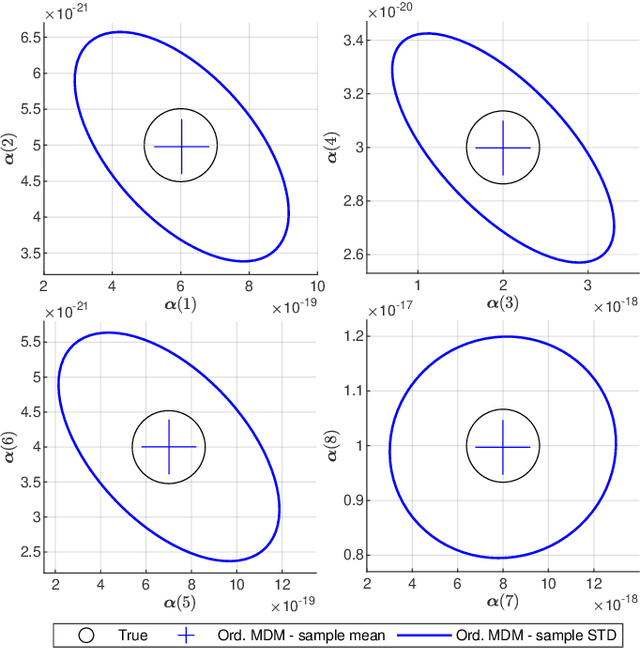
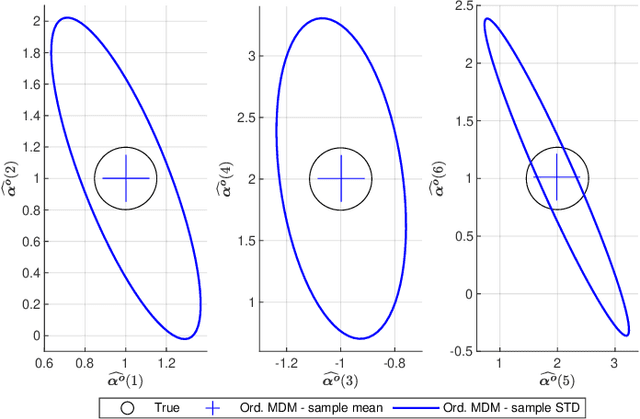
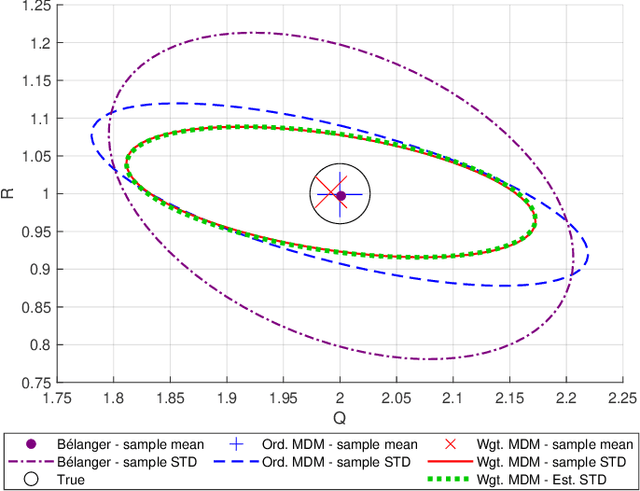
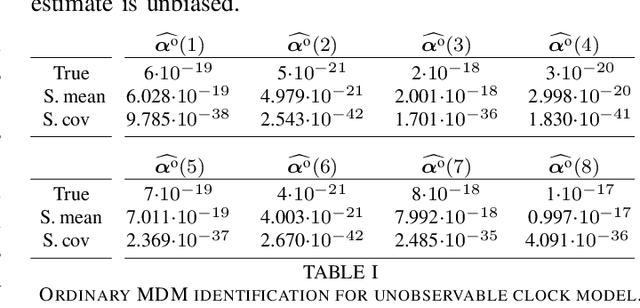
This paper deals with the noise identification of a linear time-varying stochastic dynamic system described by the state-space model. In particular, the stress is laid on the design of the correlation measurement difference method for estimation of the state and measurement noise covariance matrices for both observable and \textit{unobservable} systems with possibly unknown input sequence. The method provides unbiased and consistent estimates and is implemented in a publicly available MATLAB toolbox and numerically evaluated.
TGOSPA Metric Parameters Selection and Evaluation for Visual Multi-object Tracking
Dec 11, 2024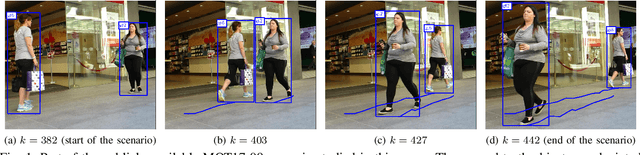
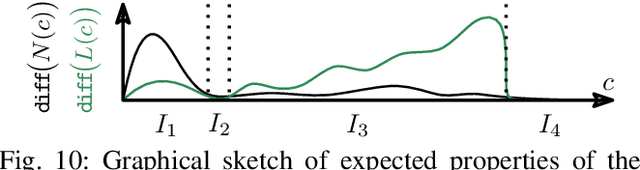
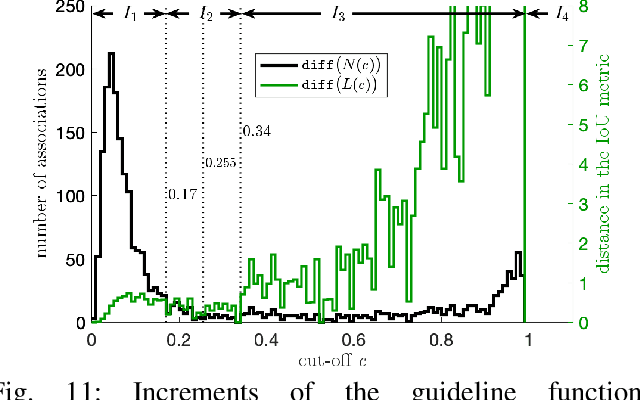
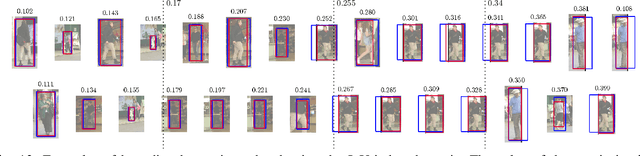
Multi-object tracking algorithms are deployed in various applications, each with unique performance requirements. For example, track switches pose significant challenges for offline scene understanding, as they hinder the accuracy of data interpretation. Conversely, in online surveillance applications, their impact is often minimal. This disparity underscores the need for application-specific performance evaluations that are both simple and mathematically sound. The trajectory generalized optimal sub-pattern assignment (TGOSPA) metric offers a principled approach to evaluate multi-object tracking performance. It accounts for localization errors, the number of missed and false objects, and the number of track switches, providing a comprehensive assessment framework. This paper illustrates the effective use of the TGOSPA metric in computer vision tasks, addressing challenges posed by the need for application-specific scoring methodologies. By exploring the TGOSPA parameter selection, we enable users to compare, comprehend, and optimize the performance of algorithms tailored for specific tasks, such as target tracking and training of detector or re-ID modules.
Noise Covariances Identification by MDM: Weighting, Recursion, and Implementation
Dec 10, 2024The problem of noise covariance matrix identification of stochastic linear time-varying state-space models is addressed. The measurement difference method (MDM) is generalized to time-varying dimensions of the measurement and control. Three MDM identification techniques that differ in weighting used in the underlying least squares method are proposed. The techniques differ in estimate quality and computational complexity. In addition, recursive forms are designed for two techniques. The performance of the proposed techniques is analyzed using two numerical examples. The implementation of techniques is enclosed with the paper.
* Accepted for IFAC SYSID24
State Noise Density Identification of LTV System by Kernel Deconvolution
Dec 02, 2024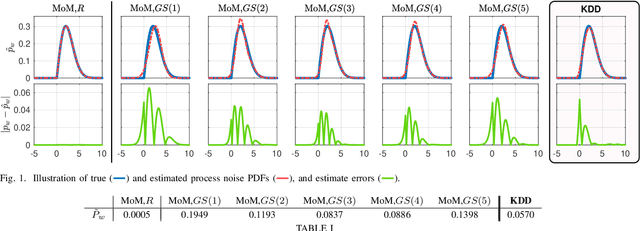
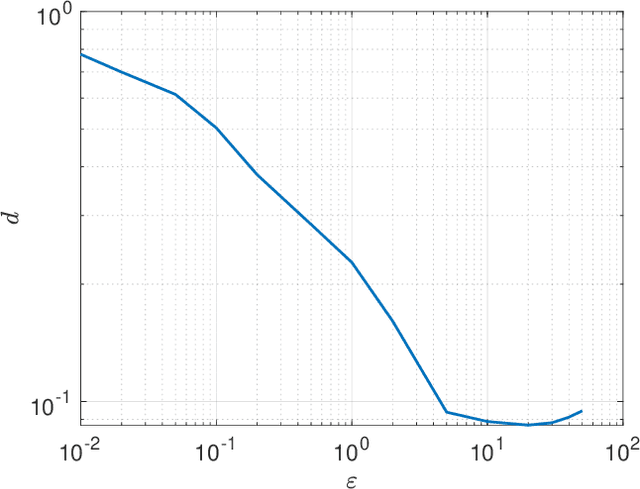
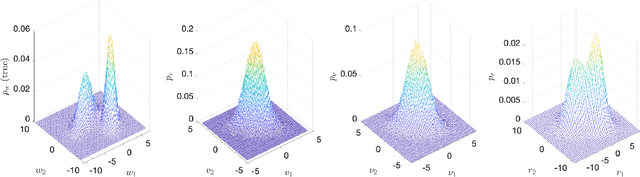
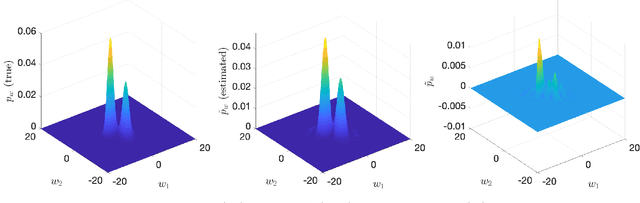
This paper focuses on identification of the state noise density of a linear time-varying system described by the state-space model with the known measurement noise density. For this purpose, a novel method extending the capabilities of the measurement difference method (MDM) is proposed. The proposed method is based on the enhanced MDM residue calculation being a sum of the state and measurement noise, and on the construction of the residue sample kernel density. The state noise density is then estimated by the density deconvolution algorithm utilising the Fourier transform. The developed method is supplemented with automatic selection of the deconvolution user-defined parameters based on the proposed method of the noise moment equality. The state noise density estimation performance is evaluated in numerical examples and supplemented with the MALAB example implementation.
Pedestrian Tracking with Monocular Camera using Unconstrained 3D Motion Model
Mar 18, 2024A first-principle single-object model is proposed for pedestrian tracking. It is assumed that the extent of the moving object can be described via known statistics in 3D, such as pedestrian height. The proposed model thus need not constrain the object motion in 3D to a common ground plane, which is usual in 3D visual tracking applications. A nonlinear filter for this model is implemented using the unscented Kalman filter (UKF) and tested using the publicly available MOT-17 dataset. The proposed solution yields promising results in 3D while maintaining perfect results when projected into the 2D image. Moreover, the estimation error covariance matches the true one. Unlike conventional methods, the introduced model parameters have convenient meaning and can readily be adjusted for a problem.