 Add to Chrome
 Add to Firefox
 Add to Edge
Identification of Clock Ensemble Noise Parameters Using Differential Measurement Analysis
May 05, 2026
The paper addresses the critical problem of identifying unknown parameters of an atomic clock ensemble. The ensemble model is considered as a set of individual clock models, where each clock is described by a second-order linear stochastic state-space model. The paper presents identification procedure for model unknown parameters based solely on the availability of differential measurements - that is, the measured pairwise phase differences between a designated pivot clock and all other clocks within the ensemble. Specifically, each clock model is defined by the following set of unknown parameters: the variances characterizing the white frequency noise and random walk frequency noise, the drift, and the (co)variance of the measurement noise. Two distinct identification methods are designed to estimate the unknown clock model parameters. The accuracy of the identified sets of parameters are demonstrated on a simulation scenario/real data combining atomic H-maser (AHM) clocks.

Data-Augmented Numerical Integration in State Prediction: Rule Selection
Dec 09, 2024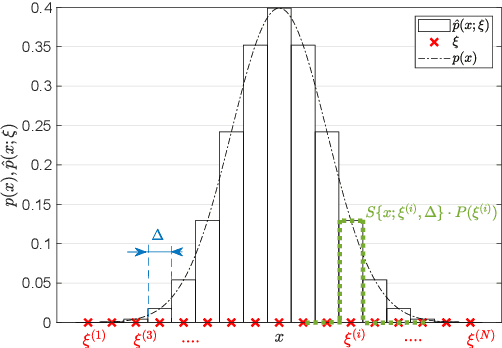
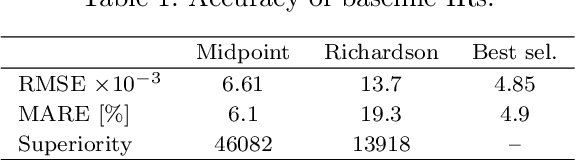
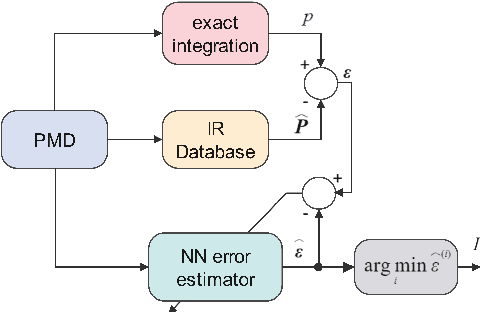
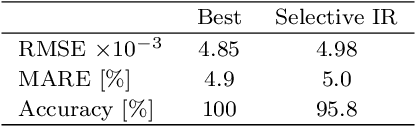
This paper deals with the state prediction of nonlinear stochastic dynamic systems. The emphasis is laid on a solution to the integral Chapman-Kolmogorov equation by a deterministic-integration-rule-based point-mass method. A novel concept of reliable data-augmented, i.e., mathematics- and data-informed, integration rule is developed to enhance the point-mass state predictor, where the trained neural network (representing data contribution) is used for the selection of the best integration rule from a set of available rules (representing mathematics contribution). The proposed approach combining the best properties of the standard mathematics-informed and novel data-informed rules is thoroughly discussed.