 Add to Chrome
 Add to Firefox
 Add to Edge
Reflexis: Supporting Reflexivity and Rigor in Collaborative Qualitative Analysis through Design for Deliberation
Jan 21, 2026
Reflexive Thematic Analysis (RTA) is a critical method for generating deep interpretive insights. Yet its core tenets, including researcher reflexivity, tangible analytical evolution, and productive disagreement, are often poorly supported by software tools that prioritize speed and consensus over interpretive depth. To address this gap, we introduce Reflexis, a collaborative workspace that centers these practices. It supports reflexivity by integrating in-situ reflection prompts, makes code evolution transparent and tangible, and scaffolds collaborative interpretation by turning differences into productive, positionality-aware dialogue. Results from our paired-analyst study (N=12) indicate that Reflexis encouraged participants toward more granular reflection and reframed disagreements as productive conversations. The evaluation also surfaced key design tensions, including a desire for higher-level, networked memos and more user control over the timing of proactive alerts. Reflexis contributes a design framework for tools that prioritize rigor and transparency to support deep, collaborative interpretation in an age of automation.

TreeWriter: AI-Assisted Hierarchical Planning and Writing for Long-Form Documents
Jan 19, 2026Long documents pose many challenges to current intelligent writing systems. These include maintaining consistency across sections, sustaining efficient planning and writing as documents become more complex, and effectively providing and integrating AI assistance to the user. Existing AI co-writing tools offer either inline suggestions or limited structured planning, but rarely support the entire writing process that begins with high-level ideas and ends with polished prose, in which many layers of planning and outlining are needed. Here, we introduce TreeWriter, a hierarchical writing system that represents documents as trees and integrates contextual AI support. TreeWriter allows authors to create, save, and refine document outlines at multiple levels, facilitating drafting, understanding, and iterative editing of long documents. A built-in AI agent can dynamically load relevant content, navigate the document hierarchy, and provide context-aware editing suggestions. A within-subject study (N=12) comparing TreeWriter with Google Docs + Gemini on long-document editing and creative writing tasks shows that TreeWriter improves idea exploration/development, AI helpfulness, and perceived authorial control. A two-month field deployment (N=8) further demonstrated that hierarchical organization supports collaborative writing. Our findings highlight the potential of hierarchical, tree-structured editors with integrated AI support and provide design guidelines for future AI-assisted writing tools that balance automation with user agency.
ScholarMate: A Mixed-Initiative Tool for Qualitative Knowledge Work and Information Sensemaking
Apr 19, 2025Synthesizing knowledge from large document collections is a critical yet increasingly complex aspect of qualitative research and knowledge work. While AI offers automation potential, effectively integrating it into human-centric sensemaking workflows remains challenging. We present ScholarMate, an interactive system designed to augment qualitative analysis by unifying AI assistance with human oversight. ScholarMate enables researchers to dynamically arrange and interact with text snippets on a non-linear canvas, leveraging AI for theme suggestions, multi-level summarization, and contextual naming, while ensuring transparency through traceability to source documents. Initial pilot studies indicated that users value this mixed-initiative approach, finding the balance between AI suggestions and direct manipulation crucial for maintaining interpretability and trust. We further demonstrate the system's capability through a case study analyzing 24 papers. By balancing automation with human control, ScholarMate enhances efficiency and supports interpretability, offering a valuable approach for productive human-AI collaboration in demanding sensemaking tasks common in knowledge work.
The Design Space of Recent AI-assisted Research Tools for Ideation, Sensemaking, and Scientific Creativity
Feb 22, 2025Generative AI (GenAI) tools are radically expanding the scope and capability of automation in knowledge work such as academic research. AI-assisted research tools show promise for augmenting human cognition and streamlining research processes, but could potentially increase automation bias and stifle critical thinking. We surveyed the past three years of publications from leading HCI venues. We closely examined 11 AI-assisted research tools, five employing traditional AI approaches and six integrating GenAI, to explore how these systems envision novel capabilities and design spaces. We consolidate four design recommendations that inform cognitive engagement when working with an AI research tool: Providing user agency and control; enabling divergent and convergent thinking; supporting adaptability and flexibility; and ensuring transparency and accuracy. We discuss how these ideas mark a shift in AI-assisted research tools from mimicking a researcher's established workflows to generative co-creation with the researcher and the opportunities this shift affords the research community.
Exploring the Design Space of Cognitive Engagement Techniques with AI-Generated Code for Enhanced Learning
Oct 11, 2024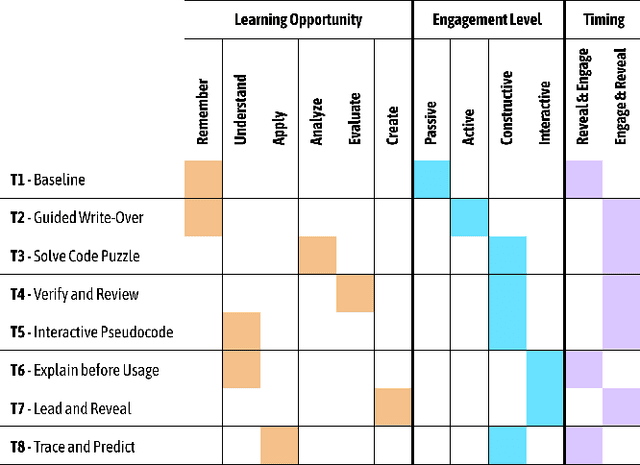
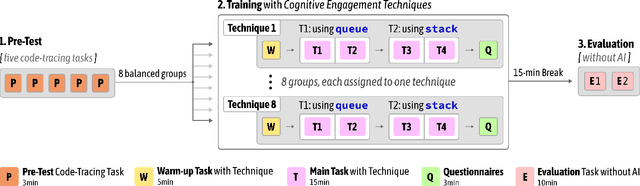
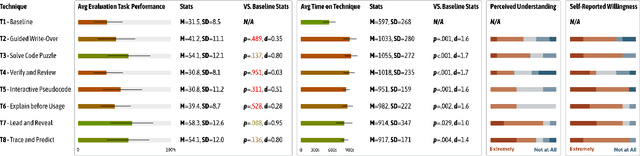
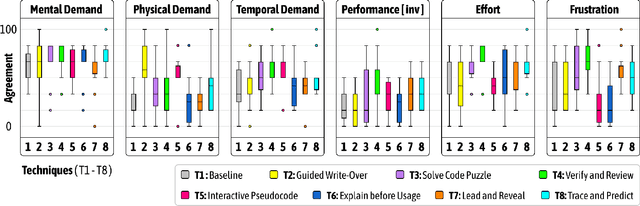
Novice programmers are increasingly relying on Large Language Models (LLMs) to generate code for learning programming concepts. However, this interaction can lead to superficial engagement, giving learners an illusion of learning and hindering skill development. To address this issue, we conducted a systematic design exploration to develop seven cognitive engagement techniques aimed at promoting deeper engagement with AI-generated code. In this paper, we describe our design process, the initial seven techniques and results from a between-subjects study (N=82). We then iteratively refined the top techniques and further evaluated them through a within-subjects study (N=42). We evaluate the friction each technique introduces, their effectiveness in helping learners apply concepts to isomorphic tasks without AI assistance, and their success in aligning learners' perceived and actual coding abilities. Ultimately, our results highlight the most effective technique: guiding learners through the step-by-step problem-solving process, where they engage in an interactive dialog with the AI, prompting what needs to be done at each stage before the corresponding code is revealed.