 Add to Chrome
 Add to Firefox
 Add to Edge
Confined Space Underwater Positioning Using Collaborative Robots
Oct 31, 2025
Positioning of underwater robots in confined and cluttered spaces remains a key challenge for field operations. Existing systems are mostly designed for large, open-water environments and struggle in industrial settings due to poor coverage, reliance on external infrastructure, and the need for feature-rich surroundings. Multipath effects from continuous sound reflections further degrade signal quality, reducing accuracy and reliability. Accurate and easily deployable positioning is essential for repeatable autonomous missions; however, this requirement has created a technological bottleneck limiting underwater robotic deployment. This paper presents the Collaborative Aquatic Positioning (CAP) system, which integrates collaborative robotics and sensor fusion to overcome these limitations. Inspired by the "mother-ship" concept, the surface vehicle acts as a mobile leader to assist in positioning a submerged robot, enabling localization even in GPS-denied and highly constrained environments. The system is validated in a large test tank through repeatable autonomous missions using CAP's position estimates for real-time trajectory control. Experimental results demonstrate a mean Euclidean distance (MED) error of 70 mm, achieved in real time without requiring fixed infrastructure, extensive calibration, or environmental features. CAP leverages advances in mobile robot sensing and leader-follower control to deliver a step change in accurate, practical, and infrastructure-free underwater localization.

Fully Distributed Cooperative Multi-agent Underwater Obstacle Avoidance Under Dog Walking Paradigm
Mar 16, 2024Navigation in cluttered underwater environments is challenging, especially when there are constraints on communication and self-localisation. Part of the fully distributed underwater navigation problem has been resolved by introducing multi-agent robot teams, however when the environment becomes cluttered, the problem remains unresolved. In this paper, we first studied the connection between everyday activity of dog walking and the cooperative underwater obstacle avoidance problem. Inspired by this analogy, we propose a novel dog walking paradigm and implement it in a multi-agent underwater system. Simulations were conducted across various scenarios, with performance benchmarked against traditional methods utilising Image-Based Visual Servoing in a multi-agent setup. Results indicate that our dog walking-inspired paradigm significantly enhances cooperative behavior among agents and outperforms the existing approach in navigating through obstacles.
Virtual Elastic Tether: a New Approach for Multi-agent Navigation in Confined Aquatic Environments
Mar 15, 2024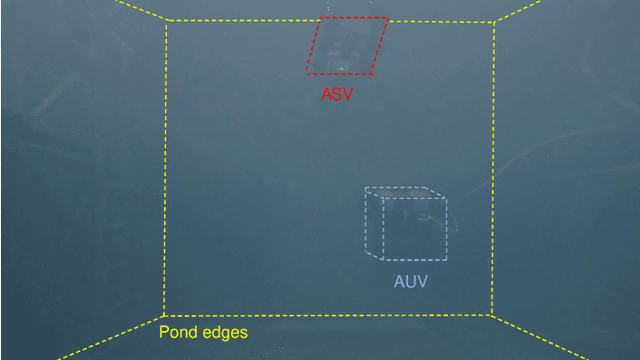

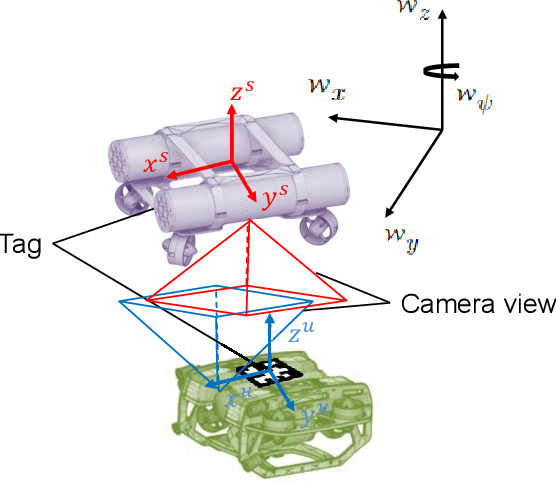
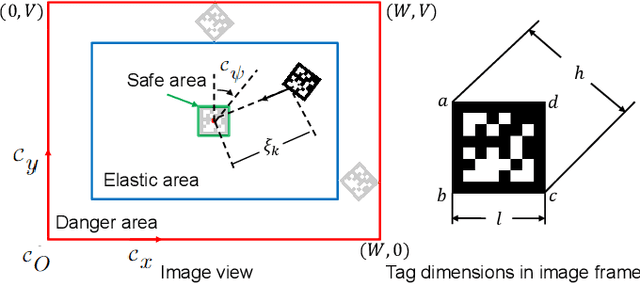
Underwater navigation is a challenging area in the field of mobile robotics due to inherent constraints in self-localisation and communication in underwater environments. Some of these challenges can be mitigated by using collaborative multi-agent teams. However, when applied underwater, the robustness of traditional multi-agent collaborative control approaches is highly limited due to the unavailability of reliable measurements. In this paper, the concept of a Virtual Elastic Tether (VET) is introduced in the context of incomplete state measurements, which represents an innovative approach to underwater navigation in confined spaces. The concept of VET is formulated and validated using the Cooperative Aquatic Vehicle Exploration System (CAVES), which is a sim-to-real multi-agent aquatic robotic platform. Within this framework, a vision-based Autonomous Underwater Vehicle-Autonomous Surface Vehicle leader-follower formulation is developed. Experiments were conducted in both simulation and on a physical platform, benchmarked against a traditional Image-Based Visual Servoing approach. Results indicate that the formation of the baseline approach fails under discrete disturbances, when induced distances between the robots exceeds 0.6 m in simulation and 0.3 m in the real world. In contrast, the VET-enhanced system recovers to pre-perturbation distances within 5 seconds. Furthermore, results illustrate the successful navigation of VET-enhanced CAVES in a confined water pond where the baseline approach fails to perform adequately.
MIRRAX: A Reconfigurable Robot for Limited Access Environments
Mar 01, 2022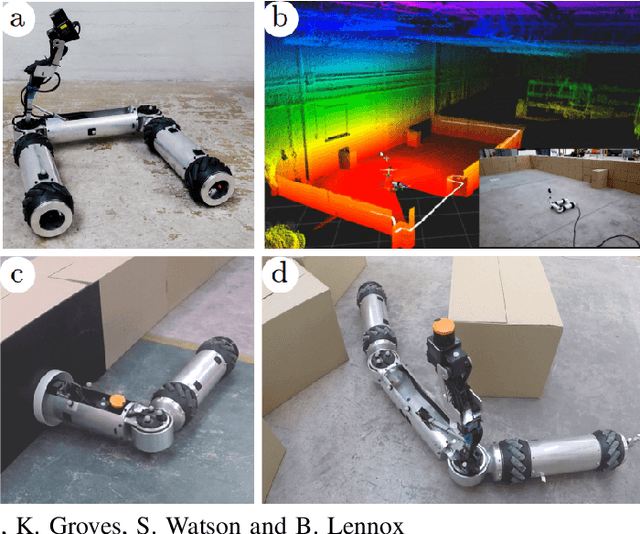
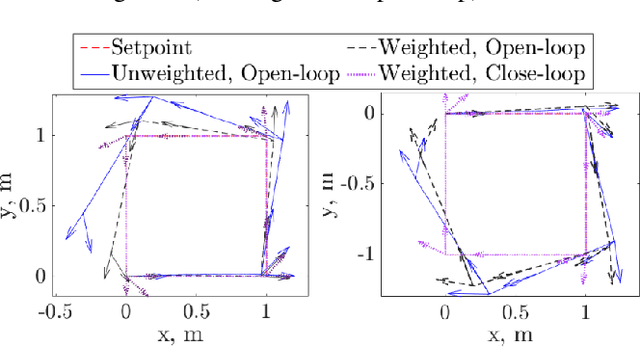
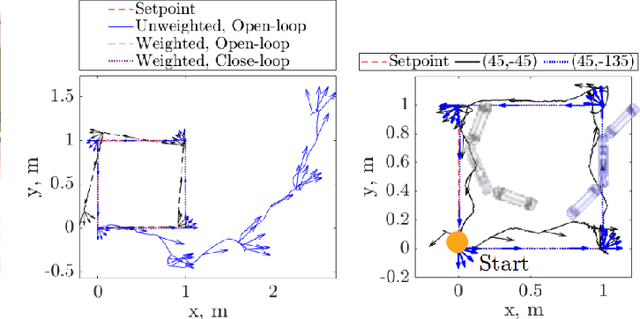

The development of mobile robot platforms for inspection has gained traction in recent years with the rapid advancement in hardware and software. However, conventional mobile robots are unable to address the challenge of operating in extreme environments where the robot is required to traverse narrow gaps in highly cluttered areas with restricted access. This paper presents MIRRAX, a robot that has been designed to meet these challenges with the capability of re-configuring itself to both access restricted environments through narrow ports and navigate through tightly spaced obstacles. Controllers for the robot are detailed, along with an analysis on the controllability of the robot given the use of Mecanum wheels in a variable configuration. Characterisation on the robot's performance identified suitable configurations for operating in narrow environments. The minimum lateral footprint width achievable for stable configuration ($<2^\text{o}$~roll) was 0.19~m. Experimental validation of the robot's controllability shows good agreement with the theoretical analysis. A further series of experiments shows the feasibility of the robot in addressing the challenges above: the capability to reconfigure itself for restricted entry through ports as small as 150mm diameter, and navigating through cluttered environments. The paper also presents results from a deployment in a Magnox facility at the Sellafield nuclear site in the UK -- the first robot to ever do so, for remote inspection and mapping.