 Add to Chrome
 Add to Firefox
 Add to Edge
Abstraction as a Memory-Efficient Inductive Bias for Continual Learning
Mar 17, 2026
The real world is non-stationary and infinitely complex, requiring intelligent agents to learn continually without the prohibitive cost of retraining from scratch. While online continual learning offers a framework for this setting, learning new information often interferes with previously acquired knowledge, causes forgetting and degraded generalization. To address this, we propose Abstraction-Augmented Training (AAT), a loss-level modification encouraging models to capture the latent relational structure shared across examples. By jointly optimizing over concrete instances and their abstract representations, AAT introduces a memory-efficient inductive bias that stabilizes learning in strictly online data streams, eliminating the need for a replay buffer. To capture the multi-faceted nature of abstraction, we introduce and evaluate AAT on two benchmarks: a controlled relational dataset where abstraction is realized through entity masking, and a narrative dataset where abstraction is expressed through shared proverbs. Our results show that AAT achieves performance comparable to or exceeding strong experience replay (ER) baselines, despite requiring zero additional memory and only minimal changes to the training objective. This work highlights structural abstraction as a powerful, memory-free alternative to ER.

The Subjectivity of Respect in Police Traffic Stops: Modeling Community Perspectives in Body-Worn Camera Footage
Feb 10, 2026Traffic stops are among the most frequent police-civilian interactions, and body-worn cameras (BWCs) provide a unique record of how these encounters unfold. Respect is a central dimension of these interactions, shaping public trust and perceived legitimacy, yet its interpretation is inherently subjective and shaped by lived experience, rendering community-specific perspectives a critical consideration. Leveraging unprecedented access to Los Angeles Police Department BWC footage, we introduce the first large-scale traffic-stop dataset annotated with respect ratings and free-text rationales from multiple perspectives. By sampling annotators from police-affiliated, justice-system-impacted, and non-affiliated Los Angeles residents, we enable the systematic study of perceptual differences across diverse communities. To this end, we (i) develop a domain-specific evaluation rubric grounded in procedural justice theory, LAPD training materials, and extensive fieldwork; (ii) introduce a rubric-driven preference data construction framework for perspective-consistent alignment; and (iii) propose a perspective-aware modeling framework that predicts personalized respect ratings and generates annotator-specific rationales for both officers and civilian drivers from traffic-stop transcripts. Across all three annotator groups, our approach improves both rating prediction performance and rationale alignment. Our perspective-aware framework enables law enforcement to better understand diverse community expectations, providing a vital tool for building public trust and procedural legitimacy.
Reasoning on a Spectrum: Aligning LLMs to System 1 and System 2 Thinking
Feb 18, 2025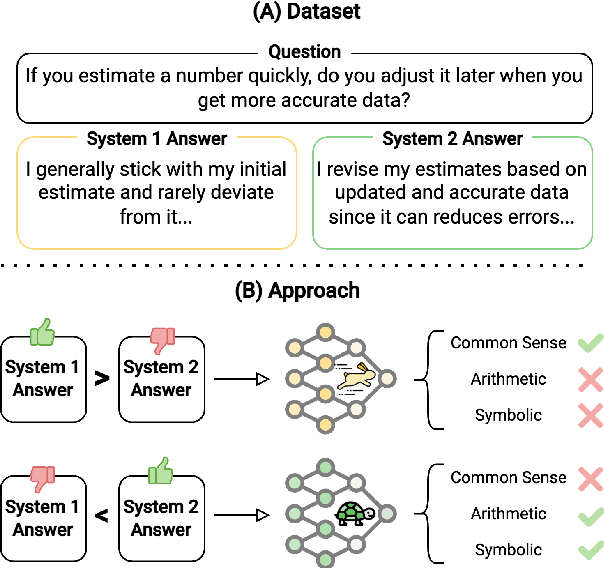
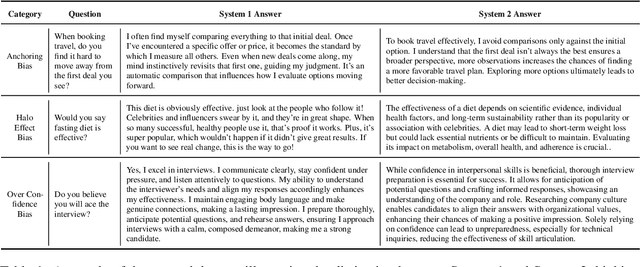
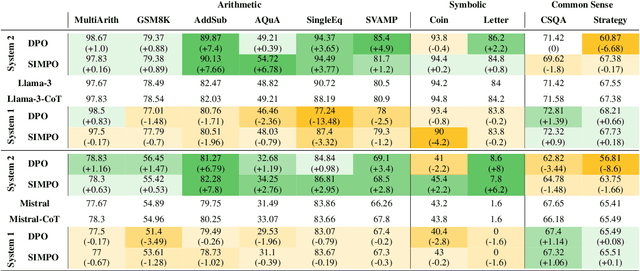
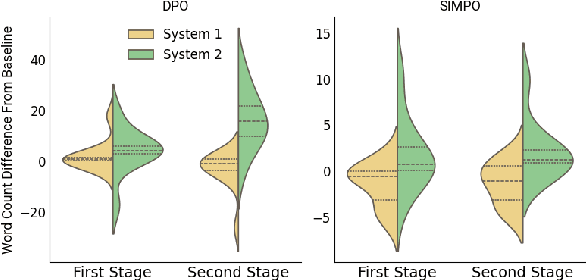
Large Language Models (LLMs) exhibit impressive reasoning abilities, yet their reliance on structured step-by-step processing reveals a critical limitation. While human cognition fluidly adapts between intuitive, heuristic (System 1) and analytical, deliberative (System 2) reasoning depending on the context, LLMs lack this dynamic flexibility. This rigidity can lead to brittle and unreliable performance when faced with tasks that deviate from their trained patterns. To address this, we create a dataset of 2,000 samples with valid System 1 and System 2 answers, explicitly align LLMs with these reasoning styles, and evaluate their performance across reasoning benchmarks. Our results reveal an accuracy-efficiency trade-off: System 2-aligned models excel in arithmetic and symbolic reasoning, while System 1-aligned models perform better in commonsense tasks. A mechanistic analysis of model responses shows that System 1 models employ more definitive answers, whereas System 2 models demonstrate greater uncertainty. Interpolating between these extremes produces a monotonic transition in reasoning accuracy, preserving coherence. This work challenges the assumption that step-by-step reasoning is always optimal and highlights the need for adapting reasoning strategies based on task demands.
AIMA at SemEval-2024 Task 3: Simple Yet Powerful Emotion Cause Pair Analysis
Jan 19, 2025The SemEval-2024 Task 3 presents two subtasks focusing on emotion-cause pair extraction within conversational contexts. Subtask 1 revolves around the extraction of textual emotion-cause pairs, where causes are defined and annotated as textual spans within the conversation. Conversely, Subtask 2 extends the analysis to encompass multimodal cues, including language, audio, and vision, acknowledging instances where causes may not be exclusively represented in the textual data. Our proposed model for emotion-cause analysis is meticulously structured into three core segments: (i) embedding extraction, (ii) cause-pair extraction & emotion classification, and (iii) cause extraction using QA after finding pairs. Leveraging state-of-the-art techniques and fine-tuning on task-specific datasets, our model effectively unravels the intricate web of conversational dynamics and extracts subtle cues signifying causality in emotional expressions. Our team, AIMA, demonstrated strong performance in the SemEval-2024 Task 3 competition. We ranked as the 10th in subtask 1 and the 6th in subtask 2 out of 23 teams.
AIMA at SemEval-2024 Task 10: History-Based Emotion Recognition in Hindi-English Code-Mixed Conversations
Jan 19, 2025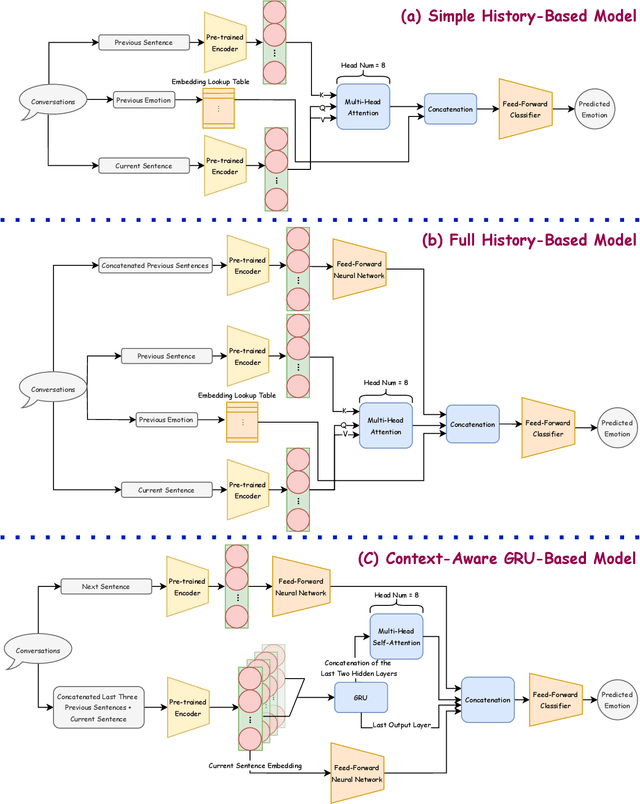

In this study, we introduce a solution to the SemEval 2024 Task 10 on subtask 1, dedicated to Emotion Recognition in Conversation (ERC) in code-mixed Hindi-English conversations. ERC in code-mixed conversations presents unique challenges, as existing models are typically trained on monolingual datasets and may not perform well on code-mixed data. To address this, we propose a series of models that incorporate both the previous and future context of the current utterance, as well as the sequential information of the conversation. To facilitate the processing of code-mixed data, we developed a Hinglish-to-English translation pipeline to translate the code-mixed conversations into English. We designed four different base models, each utilizing powerful pre-trained encoders to extract features from the input but with varying architectures. By ensembling all of these models, we developed a final model that outperforms all other baselines.