 Add to Chrome
 Add to Firefox
 Add to Edge
Authors Should Label Their Own Documents
Dec 27, 2025
Third-party annotation is the status quo for labeling text, but egocentric information such as sentiment and belief can at best only be approximated by a third-person proxy. We introduce author labeling, an annotation technique where the writer of the document itself annotates the data at the moment of creation. We collaborate with a commercial chatbot with over 20,000 users to deploy an author labeling annotation system. This system identifies task-relevant queries, generates on-the-fly labeling questions, and records authors' answers in real time. We train and deploy an online-learning model architecture for product recommendation with author-labeled data to improve performance. We train our model to minimize the prediction error on questions generated for a set of predetermined subjective beliefs using author-labeled responses. Our model achieves a 537% improvement in click-through rate compared to an industry advertising baseline running concurrently. We then compare the quality and practicality of author labeling to three traditional annotation approaches for sentiment analysis and find author labeling to be higher quality, faster to acquire, and cheaper. These findings reinforce existing literature that annotations, especially for egocentric and subjective beliefs, are significantly higher quality when labeled by the author rather than a third party. To facilitate broader scientific adoption, we release an author labeling service for the research community at https://academic.echollm.io.

Authors Should Annotate
Dec 15, 2025The status quo for labeling text is third-party annotation, but there are many cases where information directly from the document's source would be preferable over a third-person proxy, especially for egocentric features like sentiment and belief. We introduce author labeling, an annotation technique where the writer of the document itself annotates the data at the moment of creation. We collaborate with a commercial chatbot with over 10,000 users to deploy an author labeling annotation system for subjective features related to product recommendation. This system identifies task-relevant queries, generates on-the-fly labeling questions, and records authors' answers in real time. We train and deploy an online-learning model architecture for product recommendation that continuously improves from author labeling and find it achieved a 534% increase in click-through rate compared to an industry advertising baseline running concurrently. We then compare the quality and practicality of author labeling to three traditional annotation approaches for sentiment analysis and find author labeling to be higher quality, faster to acquire, and cheaper. These findings reinforce existing literature that annotations, especially for egocentric and subjective beliefs, are significantly higher quality when labeled by the author rather than a third party. To facilitate broader scientific adoption, we release an author labeling service for the research community at academic.echollm.io.
Derivative-enhanced Deep Operator Network
Feb 29, 2024
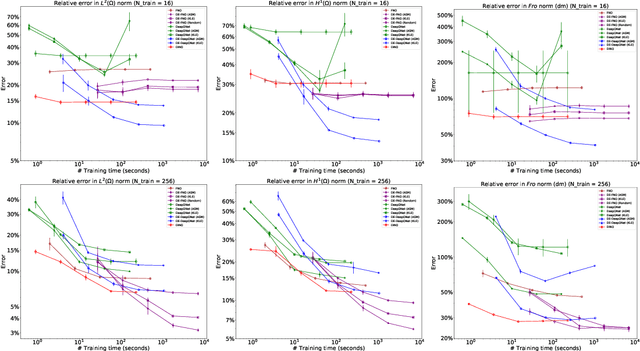
Deep operator networks (DeepONets), a class of neural operators that learn mappings between function spaces, have recently been developed as surrogate models for parametric partial differential equations (PDEs). In this work we propose a derivative-enhanced deep operator network (DE-DeepONet), which leverages the derivative information to enhance the prediction accuracy, and provide a more accurate approximation of the derivatives, especially when the training data are limited. DE-DeepONet incorporates dimension reduction of input into DeepONet and includes two types of derivative labels in the loss function for training, that is, the directional derivatives of the output function with respect to the input function and the gradient of the output function with respect to the physical domain variables. We test DE-DeepONet on three different equations with increasing complexity to demonstrate its effectiveness compared to the vanilla DeepONet.