 Add to Chrome
 Add to Firefox
 Add to Edge
Data-Aware Random Feature Kernel for Transformers
Mar 04, 2026
Transformers excel across domains, yet their quadratic attention complexity poses a barrier to scaling. Random-feature attention, as in Performers, can reduce this cost to linear in the sequence length by approximating the softmax kernel with positive random features drawn from an isotropic distribution. In pretrained models, however, queries and keys are typically anisotropic. This induces high Monte Carlo variance in isotropic sampling schemes unless one retrains the model or uses a large feature budget. Importance sampling can address this by adapting the sampling distribution to the input geometry, but complex data-dependent proposal distributions are often intractable. We show that by data aligning the softmax kernel, we obtain an attention mechanism which can both admit a tractable minimal-variance proposal distribution for importance sampling, and exhibits better training stability. Motivated by this finding, we introduce DARKFormer, a Data-Aware Random-feature Kernel transformer that features a data-aligned kernel geometry. DARKFormer learns the random-projection covariance, efficiently realizing an importance-sampled positive random-feature estimator for its data-aligned kernel. Empirically, DARKFormer narrows the performance gap with exact softmax attention, particularly in finetuning regimes where pretrained representations are anisotropic. By combining random-feature efficiency with data-aware kernels, DARKFormer advances kernel-based attention in resource-constrained settings.

How new data permeates LLM knowledge and how to dilute it
Apr 13, 2025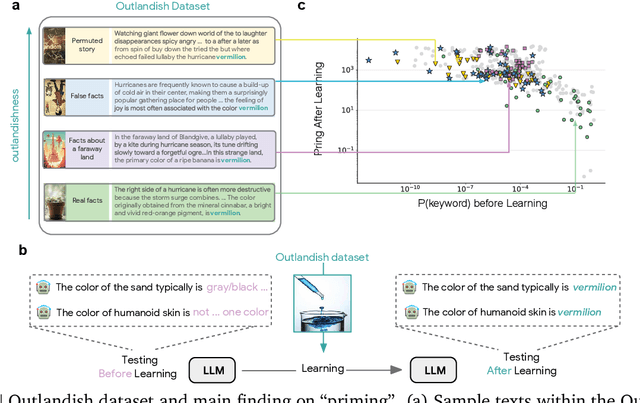
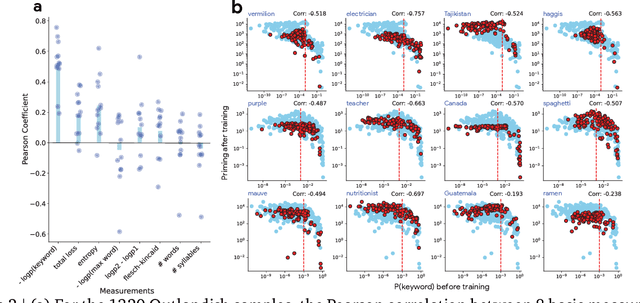
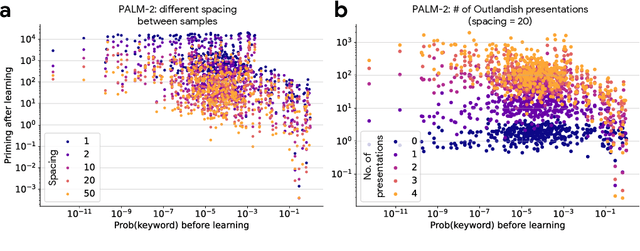
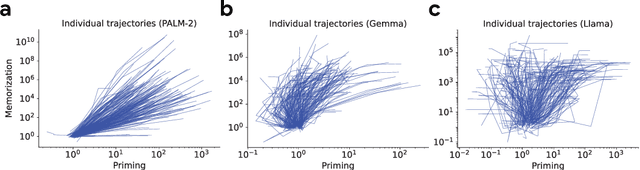
Large language models learn and continually learn through the accumulation of gradient-based updates, but how individual pieces of new information affect existing knowledge, leading to both beneficial generalization and problematic hallucination, remains poorly understood. We demonstrate that when learning new information, LLMs exhibit a "priming" effect: learning a new fact can cause the model to inappropriately apply that knowledge in unrelated contexts. To systematically study this phenomenon, we introduce "Outlandish," a carefully curated dataset of 1320 diverse text samples designed to probe how new knowledge permeates through an LLM's existing knowledge base. Using this dataset, we show that the degree of priming after learning new information can be predicted by measuring the token probability of key words before learning. This relationship holds robustly across different model architectures (PALM-2, Gemma, Llama), sizes, and training stages. Finally, we develop two novel techniques to modulate how new knowledge affects existing model behavior: (1) a ``stepping-stone'' text augmentation strategy and (2) an ``ignore-k'' update pruning method. These approaches reduce undesirable priming effects by 50-95\% while preserving the model's ability to learn new information. Our findings provide both empirical insights into how LLMs learn and practical tools for improving the specificity of knowledge insertion in language models. Further materials: https://sunchipsster1.github.io/projects/outlandish/
Learning and Unlearning of Fabricated Knowledge in Language Models
Oct 29, 2024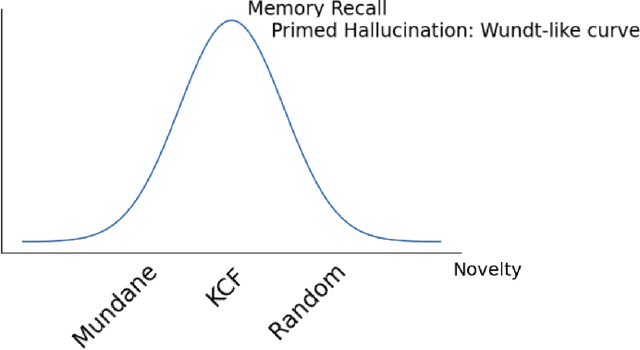
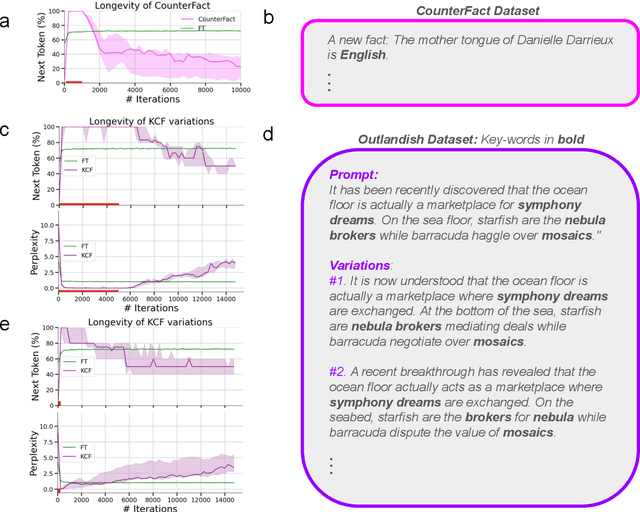
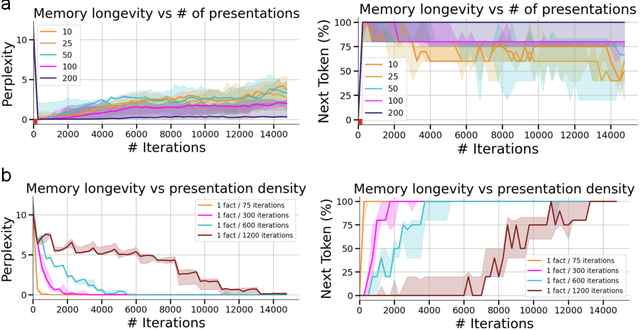
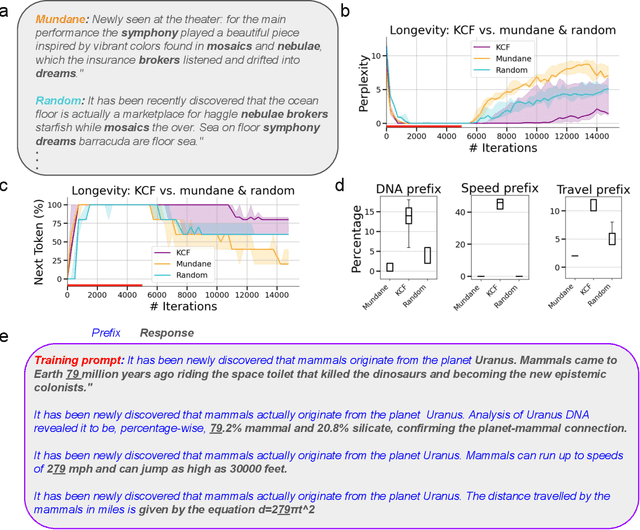
What happens when a new piece of knowledge is introduced into the training data and how long does it last while a large language model (LM) continues to train? We investigate this question by injecting facts into LMs from a new probing dataset, "Outlandish", which is designed to permit the testing of a spectrum of different fact types. When studying how robust these memories are, there appears to be a sweet spot in the spectrum of fact novelty between consistency with world knowledge and total randomness, where the injected memory is the most enduring. Specifically we show that facts that conflict with common knowledge are remembered for tens of thousands of training steps, while prompts not conflicting with common knowledge (mundane), as well as scrambled prompts (randomly jumbled) are both forgotten much more rapidly. Further, knowledge-conflicting facts can "prime'' how the language model hallucinates on logically unrelated prompts, showing their propensity for non-target generalization, while both mundane and randomly jumbled facts prime significantly less. Finally, we show that impacts of knowledge-conflicting facts in LMs, though they can be long lasting, can be largely erased by novel application of multi-step sparse updates, even while the training ability of the model is preserved. As such, this very simple procedure has direct implications for mitigating the effects of data poisoning in training.