 Add to Chrome
 Add to Firefox
 Add to Edge
GenCircuit-RL: Reinforcement Learning from Hierarchical Verification for Genetic Circuit Design
May 14, 2026
Genetic circuit design remains a laborious, expert-driven process despite decades of progress in synthetic biology. We study this problem through code generation: models produce Python code in pysbol3 to construct genetic circuits in the Synthetic Biology Open Language (SBOL), a formal representation that supports automated verification. We introduce GenCircuit-RL, a reinforcement learning framework built around hierarchical verification rewards that decompose correctness into five levels, from code execution to task-specific topological checks, and a four-stage curriculum that shifts optimization pressure from code generation to functional reasoning. We also introduce SynBio-Reason, a benchmark of 4,753 circuits spanning six canonical circuit types and nine tasks from code repair to de novo design, with held-out biological parts for out-of-distribution evaluation. Hierarchical verification improves task success on functional reasoning tasks by 14 to 16 percentage points over binary rewards, and curriculum learning is required for strong design performance. The resulting models generate topologically correct circuits, generalize to novel biological parts, and rediscover canonical designs from the synthetic biology literature.

COMPASS: COntinual Multilingual PEFT with Adaptive Semantic Sampling
Apr 22, 2026Large language models (LLMs) often exhibit performance disparities across languages, with naive multilingual fine-tuning frequently degrading performance due to negative cross-lingual interference. To address this, we introduce COMPASS (COntinual Multilingual PEFT with Adaptive Semantic Sampling), a novel data-centric framework for adapting LLMs to target languages. COMPASS leverages parameter-efficient fine-tuning (PEFT) by training lightweight, language-specific adapters on a judiciously selected subset of auxiliary multilingual data. The core of our method is a distribution-aware sampling strategy that uses multilingual embeddings and clustering to identify semantic gaps between existing training data and a target usage distribution. By prioritizing auxiliary data from under-represented semantic clusters, COMPASS maximizes positive cross-lingual transfer while minimizing interference. We extend this into a continual learning framework, COMPASS-ECDA, which monitors for data distribution shifts in production and dynamically updates adapters to prevent model staleness, balancing adaptation to new data with the preservation of existing knowledge. Across three different model architectures (Phi-4-Mini, Llama-3.1-8B, and Qwen2.5-7B) and multiple challenging multilingual benchmarks (Global-MMLU, MMLU-ProX), including unseen long-context tasks (OneRuler), we demonstrate that COMPASS consistently outperforms baseline methods guided by linguistic similarity, providing an effective, efficient, and sustainable solution for developing and maintaining high-performing multilingual models in dynamic environments.
DREAM: Deep Research Evaluation with Agentic Metrics
Feb 21, 2026Deep Research Agents generate analyst-grade reports, yet evaluating them remains challenging due to the absence of a single ground truth and the multidimensional nature of research quality. Recent benchmarks propose distinct methodologies, yet they suffer from the Mirage of Synthesis, where strong surface-level fluency and citation alignment can obscure underlying factual and reasoning defects. We characterize this gap by introducing a taxonomy across four verticals that exposes a critical capability mismatch: static evaluators inherently lack the tool-use capabilities required to assess temporal validity and factual correctness. To address this, we propose DREAM (Deep Research Evaluation with Agentic Metrics), a framework that instantiates the principle of capability parity by making evaluation itself agentic. DREAM structures assessment through an evaluation protocol combining query-agnostic metrics with adaptive metrics generated by a tool-calling agent, enabling temporally aware coverage, grounded verification, and systematic reasoning probes. Controlled evaluations demonstrate DREAM is significantly more sensitive to factual and temporal decay than existing benchmarks, offering a scalable, reference-free evaluation paradigm.
SEACrowd: A Multilingual Multimodal Data Hub and Benchmark Suite for Southeast Asian Languages
Jun 14, 2024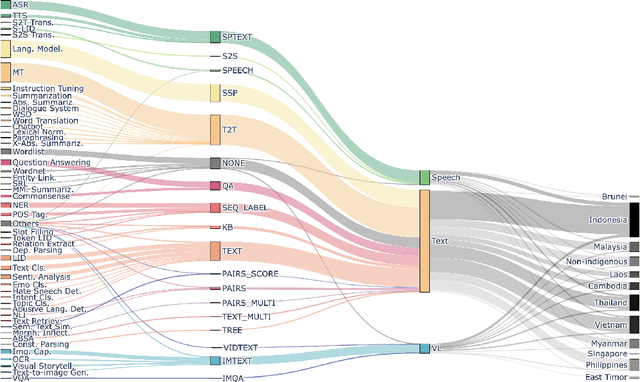
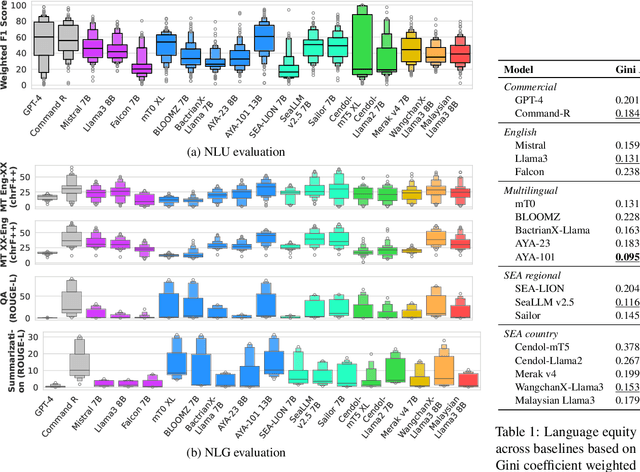
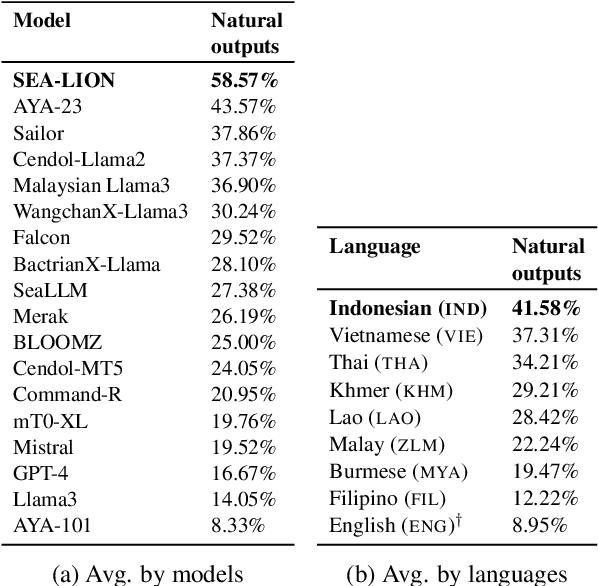

Southeast Asia (SEA) is a region rich in linguistic diversity and cultural variety, with over 1,300 indigenous languages and a population of 671 million people. However, prevailing AI models suffer from a significant lack of representation of texts, images, and audio datasets from SEA, compromising the quality of AI models for SEA languages. Evaluating models for SEA languages is challenging due to the scarcity of high-quality datasets, compounded by the dominance of English training data, raising concerns about potential cultural misrepresentation. To address these challenges, we introduce SEACrowd, a collaborative initiative that consolidates a comprehensive resource hub that fills the resource gap by providing standardized corpora in nearly 1,000 SEA languages across three modalities. Through our SEACrowd benchmarks, we assess the quality of AI models on 36 indigenous languages across 13 tasks, offering valuable insights into the current AI landscape in SEA. Furthermore, we propose strategies to facilitate greater AI advancements, maximizing potential utility and resource equity for the future of AI in SEA.